150x150.png)
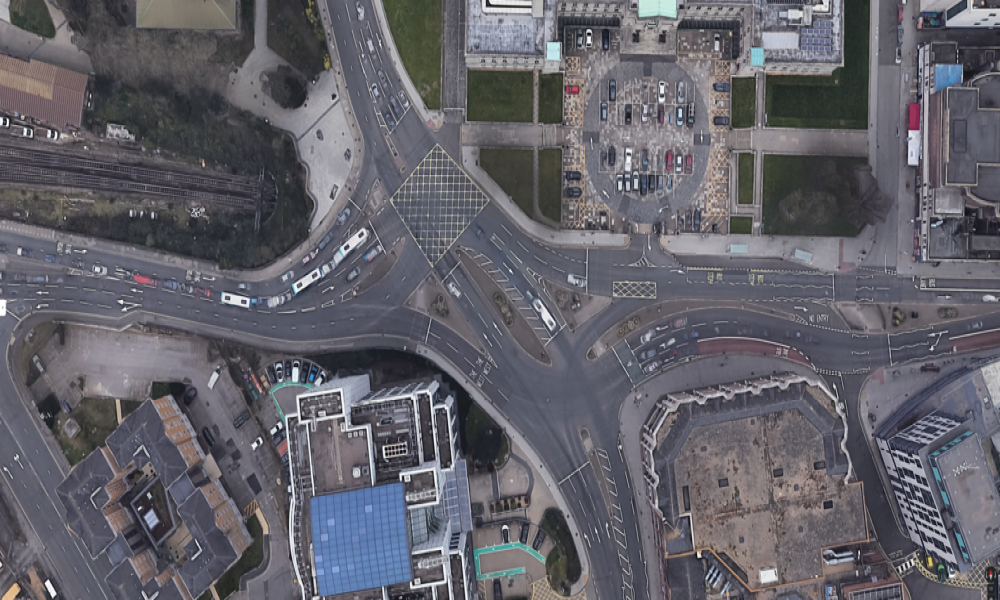
When designing and operating traffic signal installations in the UK, safety is the overriding priority. Among the most critical safety mechanisms within a Traffic Signal Controller (TSC) are the definitions of conflicts between traffic movements and the inter-green timings that separate them. These elements ensure that incompatible movements are never permitted to operate simultaneously and that sufficient clearance time is provided between successive movements.
This article explores the principles behind conflicts, inter-greens, and inter-stage periods, explaining how they are defined, calculated, and applied in practice. A clear understanding of these concepts is essential for anyone involved in traffic signal design, specification, or operation.
At the heart of traffic signal safety is the concept of conflicting movements. When a signalised junction is designed, every phase is assessed against every other phase to determine whether their traffic movements would physically conflict if they were to run at the same time. Importantly, this assessment is carried out even if the designer never intends those phases to operate concurrently.
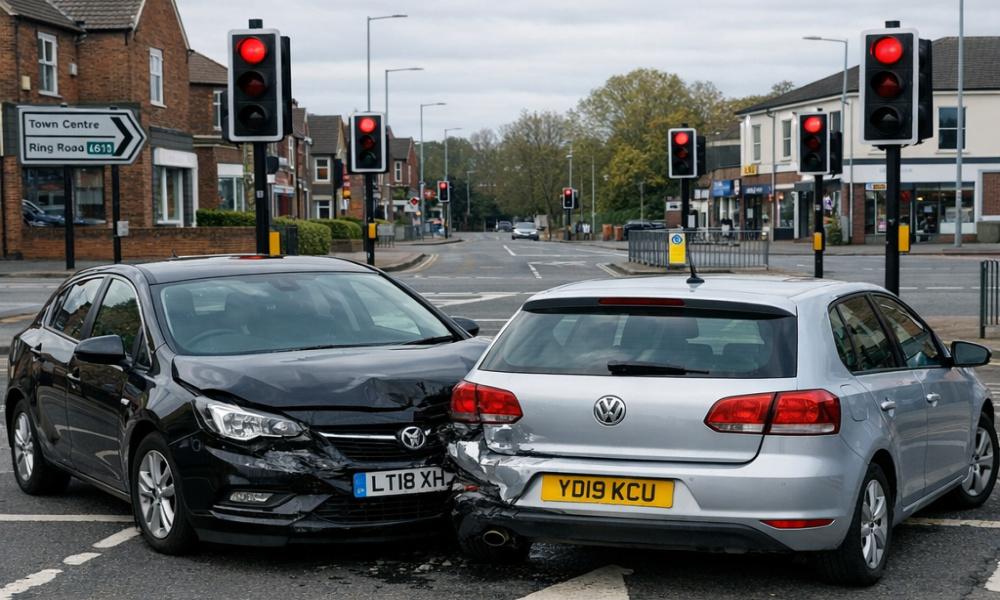
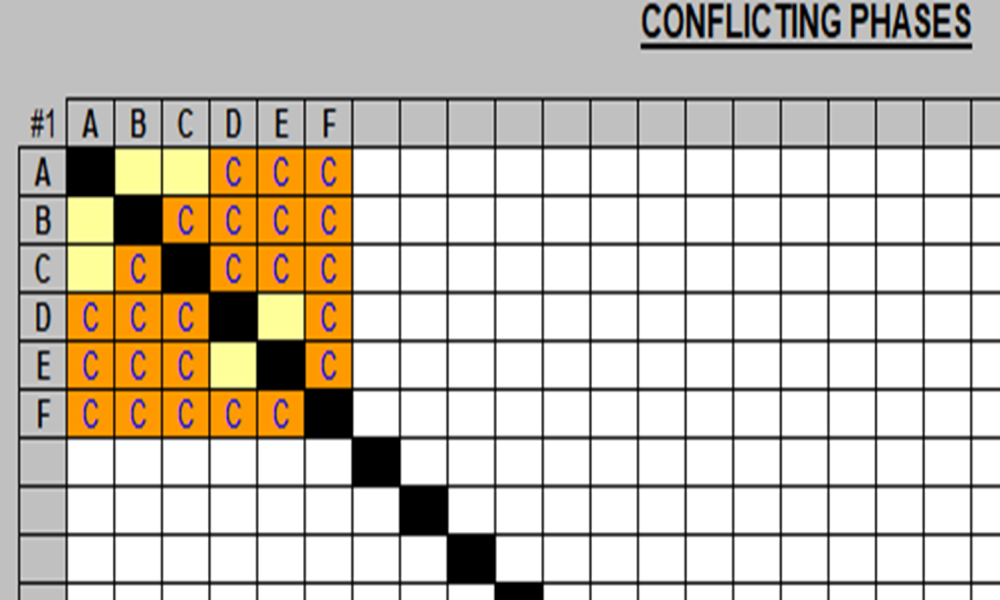
If two phases are found to be conflicting, that conflict is mutual. For example, if phase A conflicts with phase E, then phase E must also conflict with phase A. These relationships are fundamental and form the basis of all subsequent safety logic within the controller.
All identified conflicts are programmed into the TSC in the form of a conflict matrix. This matrix defines every prohibited phase combination and is symmetrical in nature, meaning conflicts are mirrored across the matrix diagonal.
The conflict matrix underpins the controller’s most critical safety monitoring function. If, due to a fault or error, two conflicting phases were ever detected as running at the same time, the controller would automatically shut down. Once configured, this safety feature cannot be overridden locally or via Urban Traffic Control (UTC), ensuring that unsafe phase combinations cannot be forced into operation.
While conflicts prevent simultaneous operation of incompatible phases, inter-greens manage the transition between them. The inter-green is the period between one phase losing right of way and a conflicting phase gaining it. Specifically, it runs from the moment the green aspect extinguishes on the terminating phase to the moment the green aspect illuminates on the succeeding phase.
Each conflicting phase pair is assigned its own inter-green timing. These timings define the minimum separation required to ensure that vehicles from the first movement have time to clear the conflict area before vehicles from the next movement begin to move.
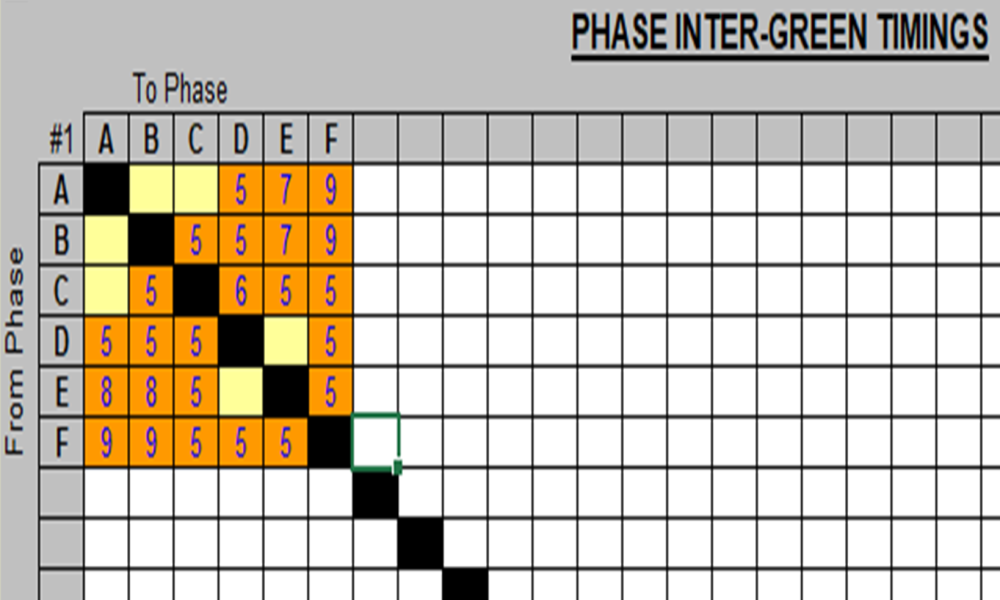
By default, a basic inter-green of five seconds is achieved through the use of sequent ambers: a three-second leaving amber on the terminating phase and a two-second starting amber on the gaining phase. This provides a standard clearance interval between most conflicting vehicular movements.
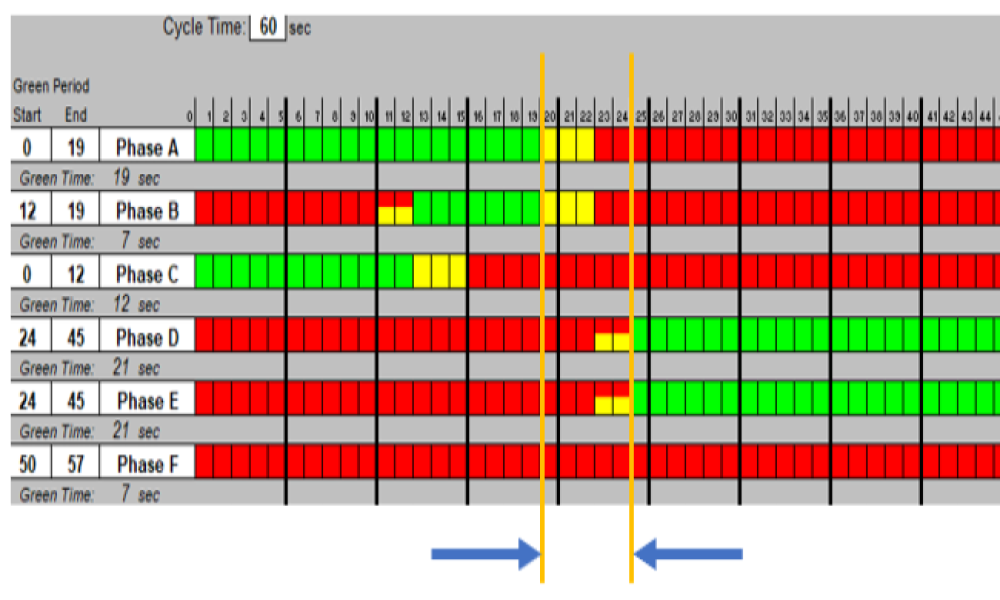
Although inter-green values can be adjusted within the TSC, minimum limits are enforced to prevent accidental or malicious reductions. As with the conflict matrix, these safeguards mean inter-green timings cannot be circumvented during operation.
In many situations, the default five-second inter-green is insufficient. Junction geometry, the distance between stop lines, visibility, gradients, and approach speeds all influence how long vehicles take to clear the conflict zone. Longer inter-greens may therefore be required to maintain safety.
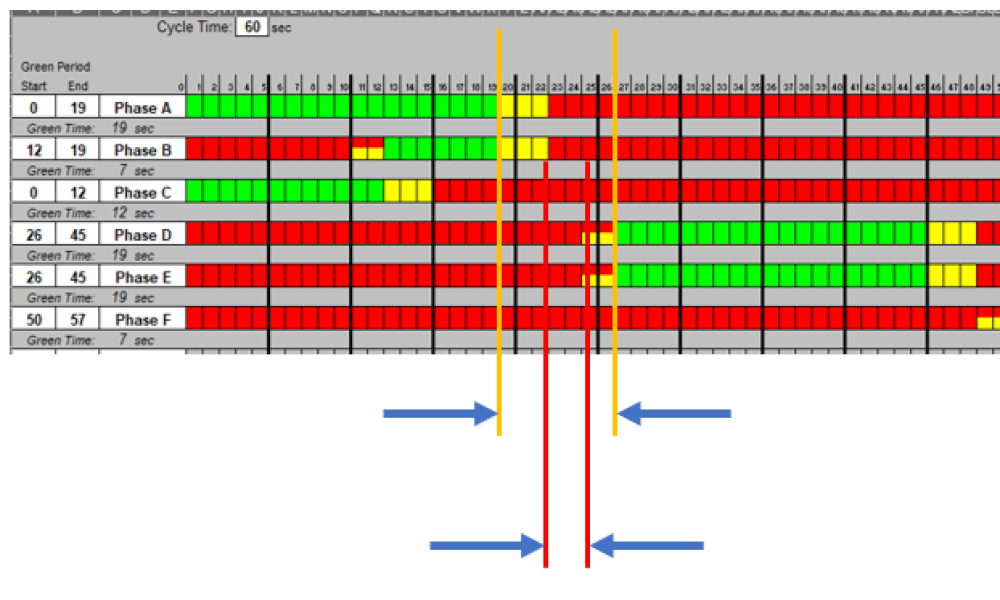
Extended inter-greens are achieved not by lengthening amber periods, but by displaying red aspects between the leaving and starting ambers of the relevant phases. If an inter-green is set too low, there is a risk of vehicle collisions. If it is set too high, junction capacity is reduced and congestion may increase.
Inter-green timings for all conflicting phase pairs are calculated using transit times to the probable collision points within the junction. Although modelling software can assist, it is recommended that these calculations are undertaken manually due to their safety-critical nature.
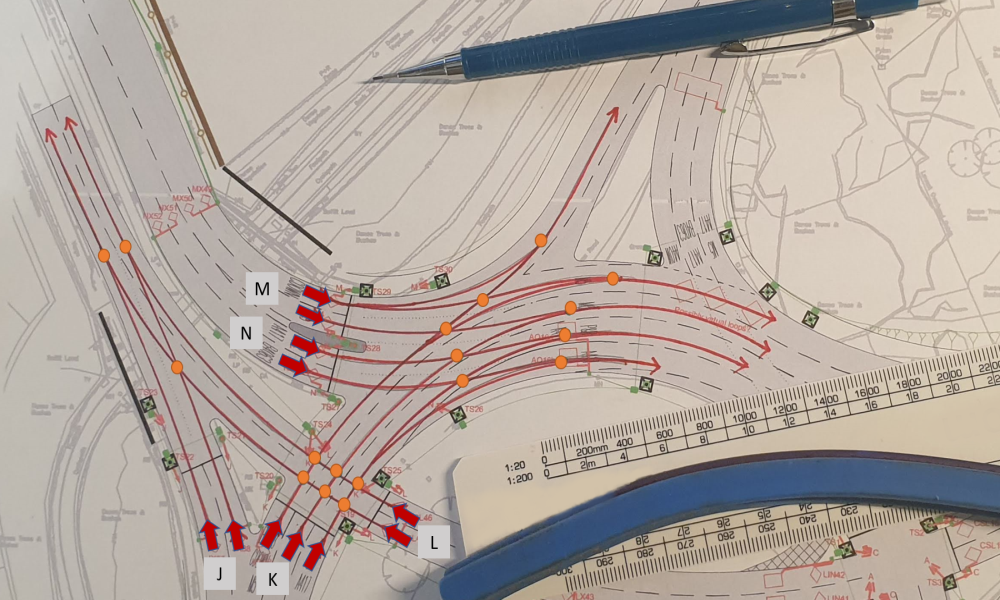
Using a scale drawing of the junction, swept paths are plotted for each movement to identify collision points. The distance from the stop line of the phase losing right of way to the collision point is measured, as is the distance from the stop line of the phase gaining right of way to the same point.
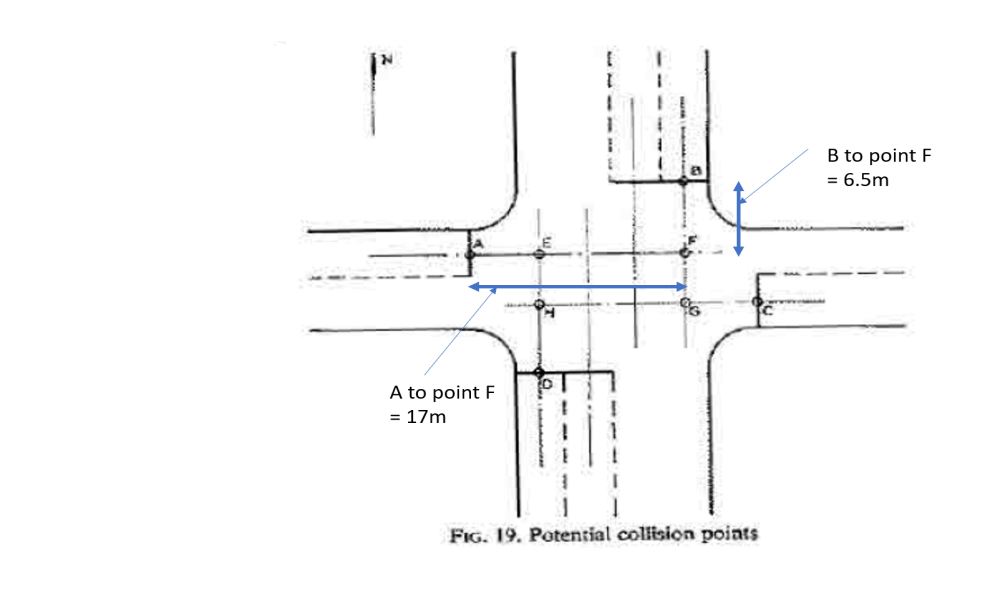
Subtracting the gaining distance from the losing distance produces the ‘X’ distance. On multi-lane approaches, all possible paths should be measured and the longest ‘X’ distance used. Inter-green tables are then referenced to determine the required timing, and calculations must be carried out in both directions, as the values are often different.
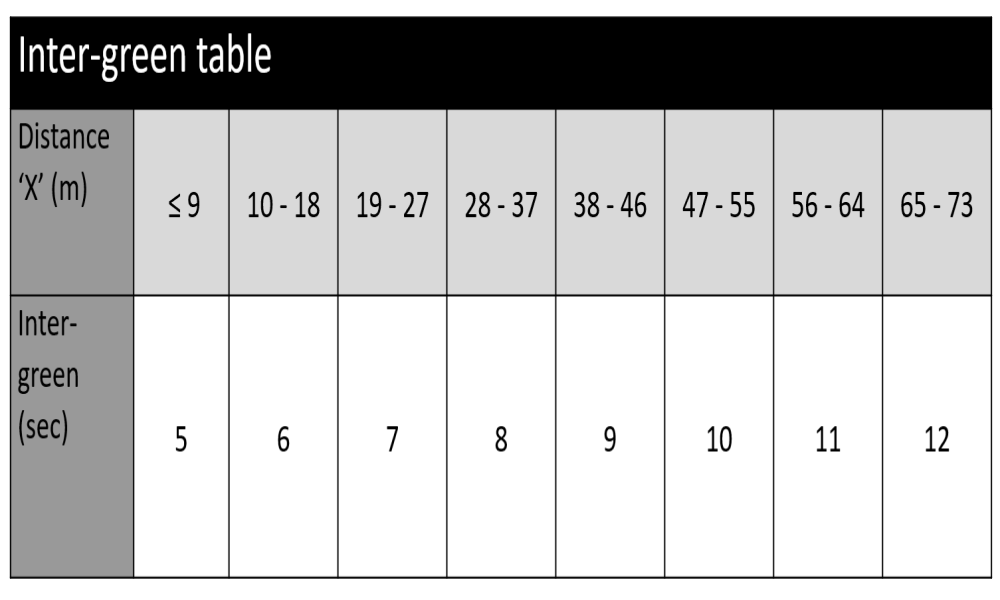
Although the absolute minimum permissible inter-green in the UK can be as low as four seconds in specific circumstances, the standard minimum used in inter-green tables is five seconds. In cases where the calculated ‘X’ distance is negative or less than ten metres, a five-second inter-green is normally applied.
Additional time may need to be added to account for site-specific conditions such as slow-moving turning traffic, uphill approaches, awkward geometry, or a high proportion of heavy goods vehicles. These factors highlight the need for careful professional judgement when specifying inter-green values.
Inter-greens are not limited to vehicle-to-vehicle conflicts. Cyclists, who accelerate more slowly and travel at lower speeds, may require additional clearance time to safely clear conflict zones, particularly at large or uphill junctions.
For vehicle-to-pedestrian inter-greens, the distance from the vehicle stop line to the far-side pedestrian crossing stud line is used to ensure vehicles clear the crossing before pedestrians are released.
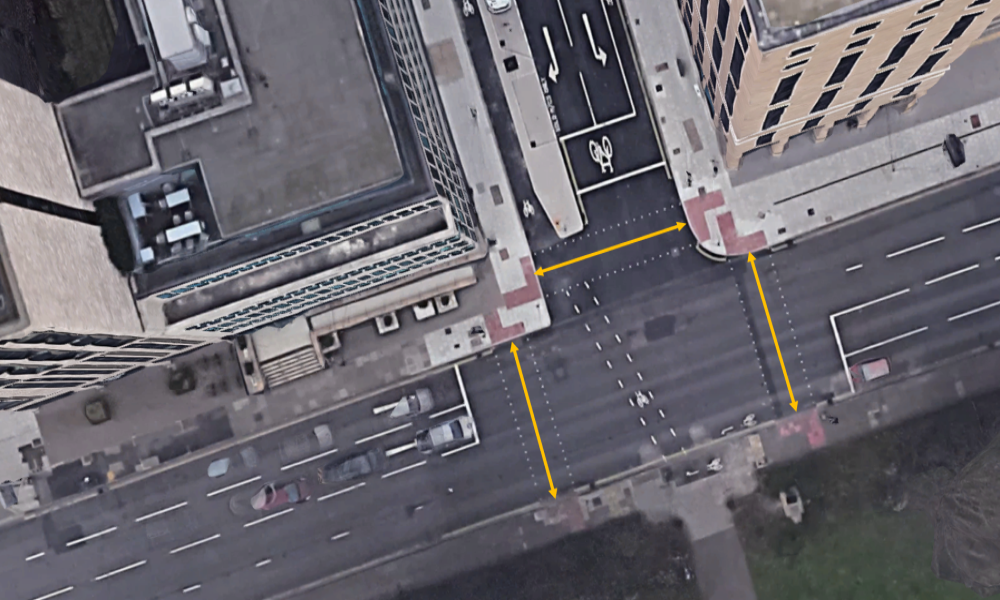
In the opposite direction, pedestrian-to-vehicle inter-greens are based on the crossing distance and assumed walking speeds, commonly between 1.0 and 1.2 metres per second, with additional allowance for less mobile users.
The inter-stage period describes the total time between one stage ending and the next stage beginning. It starts when the first green extinguishes in a stage and ends when all greens illuminate in the subsequent stage. This period is governed by the inter-greens between all constituent phases and may be extended by the use of phase delays.
Phase delays can be applied selectively to specific stage changes to improve safety or efficiency without unnecessarily increasing wasted time across the entire signal cycle. Considering inter-stage effects during the design process can help identify staging arrangements that minimise excessive clearance times.
Conflicts, inter-greens, and inter-stage periods form the backbone of traffic signal safety in the UK. Correctly defining conflicts and carefully calculating inter-green timings for each site are among the most important responsibilities of a signal designer.
A thorough understanding of these principles ensures that signal installations operate safely, efficiently, and reliably throughout their life, protecting all road users while making best use of available junction capacity.
To find out lots more about traffic signal principles, try watching our video about Conflicts and Inter-greens on the @ITSNow YouTube Channel -Click the buttons below to see more articles:
See all ArticlesIndustry InsightEventsITS Thought LeadershipITS Educational