Articles


Navigating the Future of Global Mobility

Welcome to the ITS Now hub, your central resource for expert analysis, technical insight, strategic thought leadership and educational content within the Intelligent Transport Systems (ITS) sector. As the transport landscape undergoes a radical transformation driven by digitisation, decarbonisation and automation, staying informed is no longer just an advantage, it is a necessity for industry professionals, policymakers and innovators alike.


Global Insight, Local Impact


While the challenges of congestion and safety are universal, the solutions are often local. ITS Now brings together perspectives from across the globe, highlighting international best practices while providing a dedicated lens on the UK’s evolving transport strategy. As the growing technological requirements of mobility evolve and mature, our content is designed to provide you with actionable intelligence.


We invite you to explore these insights, engage with the latest trends, and join the conversation as we work together to build a smarter, safer, and more efficient future for transport.


The articles are split into the following sections below: Industry Insight, ITS Thought Leadership and ITS Educational.


The collection will continue to grow, as we add new items on a regular basis, so make sure to check back to read the latest articles!


Industry Insight

We bring you a range of topics from across the ITS sector.

Image to illustrate the CVS Outreach article

CVS Supply Chain Outreach
Connected Vehicle Services

The CVS Supplier Engagement brought together representatives from central government, local authorities, industry suppliers and technology providers to discuss the development of the CVS Framework

Image of Paula Claytonsmith

The Trust Deficit
Why It Matters for Safety and Resilience

Paula Claytonsmith looks at a growing 'Trust Deficit' the public have of Intelligent Systems, and that gap matters more than we sometimes like to admit.

Image to illustrate the pay per mile article

The Pay per Mile Mandate
The Chancellor's Pay-Per-Mile Mandate and the Future of Motoring Taxation

The UK's transition to electric vehicles (EVs) has long been heralded as a cornerstone of the nation's net-zero ambitions, promising cleaner air and a greener future. Yet, this environmental imperative has collided with a fiscal reality.

Image of Rt Hon Rachael Reeves Budget Day

The Financial Burden
Local Highway Authorities - Making the most of their traffic infrastructure

The stark reality for many local highway authorities is that they don't have budgets to keep their existing equipment up-to-date, find out how to address skill shortages and strategic approaches to adopt for effective Intelligent Transport Systems.

Image to illustrate TTF Autumn Update - Connected Vehicle Services

Connected Vehicle Services
Connected Vehicle Services are set to shape the future of transport

At the recent TTF Autumn Update in Birmingham, Darren Capes and Jonathan Mann delivered a compelling presentation on the future of connected vehicle services in the UK.

Image to illustrate the article When Critical Controls Fail

Highways and AI
Separating Fact from Fiction

The highlights from a panel discussion at the 2025 Highways UK Conference, where Alistair spoke to leading figures in the industry to cut through the buzzwords and hype, and look at what the challenges are, and how AI could transform roads in the years ahead.

Image of Max Sugarman

Policy and Transport
Max Sugarman, Chief Executive, Intelligent Transport Systems UK, looks at how the policy landscape will transform the future of transport.

The Government has set out plans that will reshape how decisions are made and how new technologies are deployed. For the intelligent transport sector, the implications are far-reaching.

Illustration of how 6G and AI might transform freight and logistics

6G & AI - Next-Gen' Logistics
Dr Nikolaos Tsampieris and Dr Eusebiu Catana, Senior Managers at ERTICO explain how 6G and AI will revolutionise ITS and logistics in particular.

In the near future, the logistics industry will experience a dramatic shift in how it operates, driven by the convergence of Sixth Generation (6G) wireless networks and Artificial Intelligence (AI).

Image of Joost Vantomme

Achievements so far in 2025
Joost Vantomme, CEO of ERTICO – ITS Europe provides an update about achievements so far in 2025.

The first eight months of 2025 have been transformative for ERTICO – ITS Europe. As we reflect on this dynamic period, I am proud of the milestones achieved in close collaboration with our Partners, Supervisory Board, Strategy Committee and dedicated team.

Image to illustrate the UK ITS market

The UK's ITS Market
A Landscape of Opportunity and Complexity for Foreign Entrants

The United Kingdom's Intelligent Transport Systems (ITS) market is in a state of dynamic transformation, driven by ambitious government strategies, significant public and private investment, along with a pressing need to create a more efficient, sustainable and resilient transport network.

Image of Joost Vantomme

Seville Sets the Stage
Alistair Gollop sits down with Joost Vantomme

How will the Seville Congress translate 'Clean, Resilient and Connected Mobility' from buzzwords into tangible actions, leveraging AI, data and unprecedented collaboration?

Image of Coen Bresser

AI in the Driving Seat?
Alistair Gollop discusses AI with Coen Bresser

Artificial Intelligence (AI) is no longer a futuristic buzzword in transport; it's increasingly embedded in the systems managing our road networks. From optimizing signal timings to predicting congestion hotspots, its potential seems boundless.

Image of Dr Eusebiu Catana

Charting the Course
Dr Eusebiu Catana discusses innovations with Alistair Gollop

We look forward to the innovations and strategies which are likely to emerge from the Seville ITS Congress

Image of Dr Eusebiu Catana

Why Radar?
Euichul Kim describes the “visibility gap” to Alistair Gollop

South Korea experienced one of its most severe road traffic disasters when a 100-car pile-up occurred on the Incheon Yeongjong Bridge due to dense sea fog and icy road conditions.

image of the DfT report cover

AI at the wheel
Unpacking the UK's Blueprint for a Smarter Transport Future

The UK's Department for Transport has laid down the gauntlet with its new Transport AI Action Plan. This isn't just another policy paper; it's a comprehensive roadmap designed to embed Artificial Intelligence into the very fabric of the nation's transport system.


< Top


ITS Thought Leadership

The Thought Leadership series provides insight to a range of topic issues which surround the ITS sector.

Image to illustrate the safety and resilience article

Safety and Resilience
Building Trustworthy Mobility for a Complex Future

This article explores how intelligent systems can strengthen safety and resilience across increasingly complex transport networks

Image to illustrate the Multimodal Mobility article

Multimodal Mobility
Building Trustworthy Mobility for a Complex Future

As cities and regions evolve, mobility systems are being reshaped by rapid technological change, shifting user expectations and the urgent need for more sustainable, inclusive transport.

Image to illustrate the Smart Logistics article

Smart Logistics
Logistics in the Digital Era

Every product we consume, every component that fuels industry and every parcel that arrives at our door relies on a complex web of supply chains that span cities, regions and continents.

Image to illustrate the Beyond the Road article

Beyond the Road
Enhancing Transport and Mobility

The question is no longer whether non road modes should evolve, but how innovation can accelerate sustainable, connected mobility across rail, air and water.

Image to illustrate Bridging the Connectivity Gap

Bridging the Connectivity Gap
The compelling case for prioritising digital connectivity in the UK's transport strategy

As Connected and Automated Mobility technologies mature, the promise of safer, cleaner and more efficient mobility is fraught with technical, infrastructural and strategic challenges, chief among them, digital connectivity.

image to illustrate Paving The Way

Paving The Way
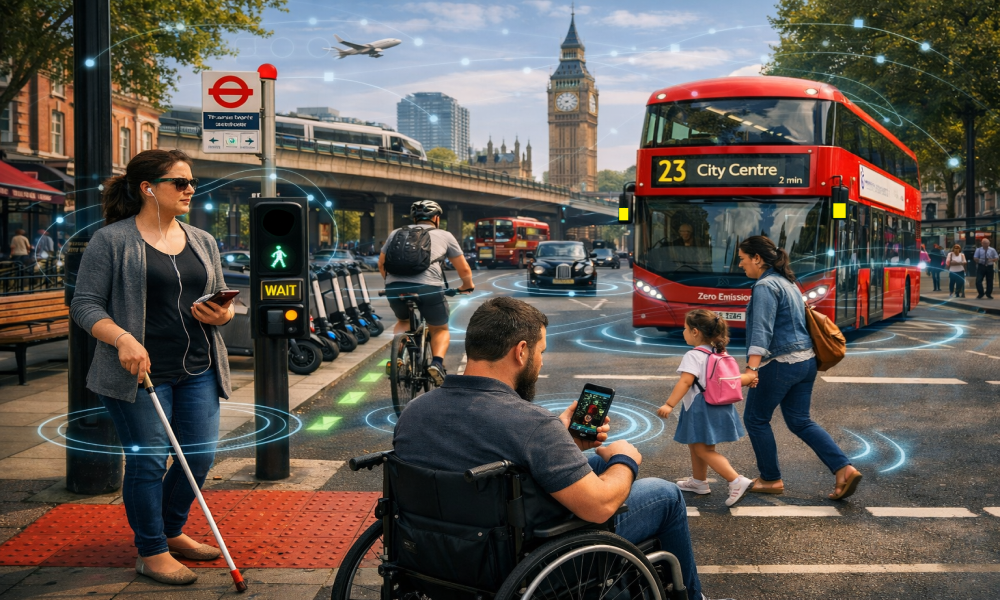
How ITS can help create truly inclusive urban mobility

For decades, urban streets and public transport have presented significant, often prohibitive, barriers for individuals with mobility and sensory impairments, but now Intelligent Transport Systems (ITS) are poised to deliver the next revolution in accessibility.

Image to illustrate the article When Critical Controls Fail

When Critical Controls Fail
Lessons for ITS from the Ahmedabad Air Crash

For the Intelligent Transport Systems (ITS) sector, which increasingly relies on interconnected, automated and safety critical technologies, the lessons from Ahmedabad are not just relevant they are imperative.

Image to illustrate the article a road to relevance

The Road to Relevance
A call to action for the ITS sector

The Intelligent Transport Systems (ITS) sector stands at a critical juncture. For decades, it has served as the silent architect of modern mobility.

image of vehicles at night on a wet street

From Pilots to Permanence
CCAM Deployment Takes Centre Stage in a New Era of Mobility

The conversation surrounding Connected, Cooperative and Automated Mobility (CCAM) has fundamentally shifted.

an illustration of vehicle to everything (V2X) communications operating in astreet scene

DSRC versus 5G
A Crossroads for CAV/CCAM in ITS and Mobility

The evolution of Intelligent Transport Systems (ITS) and Cooperative, Connected, and Automated Mobility (CCAM) hinges critically on robust and reliable communication technologies.

image of traffic systems equipment being vandalised

The Unseen Barriers
Why ITS Technologies Face Public Mistrust and Vandalism

Despite the clear public benefits of ITS, a significant minority of people view these systems with suspicion, hostility and in some cases, outright vandalism.

Placeholder Picture

Navigating the Issues
Addressing the Top 5 Global Challenges Facing Intelligent Transport Systems

What are the issues that challenge the effective use and deployment of ITS across the world.

illustration of a street scene to show ITS technologies in action

ITS That Works for Everyone
Addressing Societal Needs in Mobility and Logistics

In an era defined by rapid technological advancement, the integration of Intelligent Transport Systems (ITS) into our daily lives holds immense promise.

image of a crashed car on its side in a field

Beyond the 85th Percentile
Embracing the Extremes in Intelligent Transportation Systems

The foundation of Intelligent Transportation Systems (ITS) analysis rests heavily upon statistical measures, providing a framework for understanding and optimising traffic flow.

image of a signalised pedestrian crossing in Mutrah, Oman

No push buttons on my crossing!
A solution may inadvertently create new issues

The observation of a signalised pedestrian crossing in Mutrah, Oman, devoid of a push button, presents a fascinating case study in urban traffic management.

an aerial view of a busy intersection at night

Detail and Consistency in ITS Projects
Achieving successful ITS projects is a delicate balancing act, a constant negotiation between grand vision and granular execution.

The devil lies in the details and the achievement of consistency. It's a truth often overlooked in the rush to implement cutting-edge technologies and address pressing transportation challenges.

image of a rural desert road

Lessons Learnt
What can we learn from undertaking ITS projects in less developed countries?

Implementing Intelligent Transport Systems (ITS) projects in less developed countries provides an illuminating lens through which to examine the fundamentals of successful technological deployment. These environments, often characterised by resource constraints and unique socio-cultural landscapes, expose the inherent vulnerabilities and critical dependencies that can undermine even the most well-intentioned projects.

Placeholder Picture

Competing Standards
Balancing standards compliance with usability in ITS projects

Undertaking designs for Intelligent Transportation Systems (ITS) can be a delicate tightrope walk, requiring a nuanced understanding of the interplay between working in compliance of standards and the fluid demands of user-centricity.

Placeholder Picture

Traffic Technology and Smart Cities
How Might Traffic Management Systems Contribute To The Development Of Smart Cities?

So, what is a Smart City? A Smart City is an urban environment where infrastructure and services are interlinked using technology to improve the quality of life by enhancing their operation. For stakeholders, this interconnectivity provides a pathway to improve their services, whilst also accruing cost benefits by using shared infrastructure and data streams.

Placeholder Picture

Carbon Conundrum
Despite lots of work to make our ITS installations more energy efficient, we will need to do more in order to attain Carbon Neutral or Net Zero credentials for these.

Over the past decade, technology manufacturers have made great strides in reducing the energy consumption of ITS equipment, the switch to modern electronics and LEDs has had a transformative impact on electrical consumption of installations, with many types achieving 80% savings when compared to traditional equipment.

Placeholder Picture

Ethics and Privacy in the Mobility Sector
What are the privacy and ethical implications that surround the use of data in the mobility sector?

The volume of information generated by Intelligent Transport Systems (ITS) and vehicles is likely to increase exponentially, especially following the introduction of Connected Autonomous Vehicles (CAV), mainly caused by the enormous amounts of data which these are likely to transact on a daily basis. So, how will the digital footprint that follows users across transport modes be protected to respect their privacy and ensure that they are not disadvantaged due to prejudice or commercial interest?

Placeholder Picture

Climate Resilience
We are now witnessing the effect that global warming is having on the environment, with very diverse climatic events impacting the daily lives of people around the world.

This article examins the issues posed by the climate emergency for the deployment and operation of ITS equipment, with particular focus on the following areas: Appropriateness of traditional ITS platforms and equipment in a changing technology climate; Carbon Reduction in the construction and operation of equipment; Resilience to extreme natural events.

Placeholder Picture

How should we use AI in Traffic Systems?
What strategies should be considered before implementing Artificial Intelligence (AI) features in traffic systems.

Within the ITS sector, we have seen increasing use of AI in equipment and systems used for traffic management. However, at this point, their application is rather sporadic and lacks a cohesive approach to their use to achieve a strategic implementation.

Placeholder Picture

Technology and Active Travel
How can ITS help to support greater uptake of active modes of transport?

There has been for some years, a realisation that the way in which the finite capacity is apportioned in our busy urban streets will need to be reviewed to cope with the ever-increasing demands put on them. As a result, we have seen our streetscape gradually evolving to benefit the increasing number of members of the public who are using active transport modes, such as walking and cycling.


< Top


ITS Educational

The items in the Educational series provide an opportunity to learn about Intelligent Transport Systems and their underpinning technologies, to find out more, see our Books in the Publications page.

image of an automated pavillion style vehicle

What is ITS?
Ever wondered what Intelligent Transport Systems (ITS) are?

Despite sounding like a futuristic mode of transport, Intelligent Transport Systems (ITS) are actually technologies and systems associated with the management, operation and use of a broad range of transport modes and their inter-relationship with other infrastructure.

Placeholder Picture

Introduction to Roadside Technology
An Overview Of Major Technologies Used To Control And Manage The Highway Network

Technologies have been used for many years to passively monitor activity on the highway, however over the years additional features have been added to assist in actively managing traffic, these range from informing users about current conditions, so that they can make their own decisions, such as automatically warning drivers of incidents using roadside variable message signs, through to compelling users to modify their driving, such as by implementing variable speed limits or by using enforcement cameras etc.
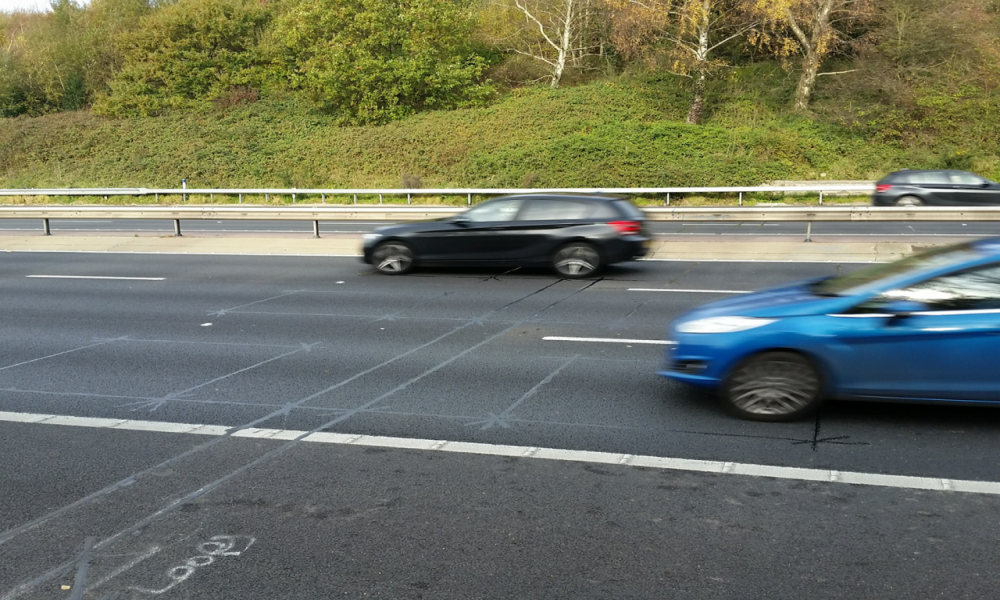
Image of inductive vehicle detection loops on a UK motorway, MIDAS system

Inductive Loop Vehicle Detection
The Backbone of Intelligent Transport Systems

Ever seen rectangular, diamond or chevron black lines in the asphalt surface of a road and wondered what they are?
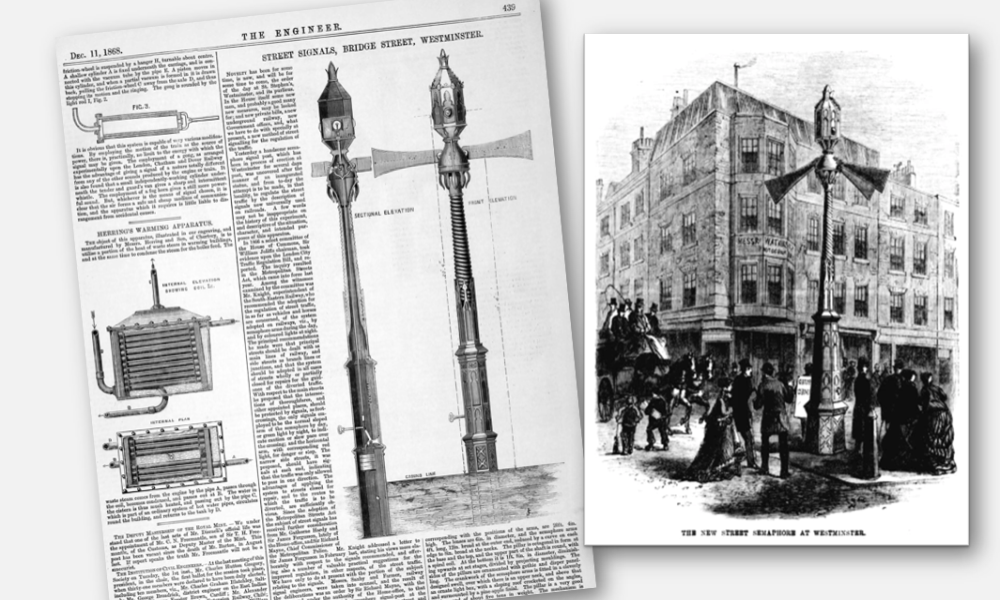
Image of an old fashioned vehicle detection system

The History of Traffic Signals
The history of traffic signals and how they came to be used on our roads as far back as 1868

Many people assume that traffic signals emerged alongside the rise of motor vehicles, yet the foundations of modern signalisation were laid decades earlier. Long before roads were dominated by cars, engineers and scientists were grappling with the challenge of how to communicate movement, warning and control, at a distance.

Image of an old fashioned vehicle detection system

History of Detection
From Police Control to Intelligent Systems

Technologies such as radar, video analytics, and connected vehicle data are now commonplace, yet the foundations of traffic detection were laid nearly a century ago. The history of detection is one of steady innovation, driven by the need to respond to growing traffic volumes, improve safety, and make better use of road space.

Image of a typical signalised junction in London

Traffic Signals - Phases and Stages
Part 1 - Introduction to Traffic Signal Principles

This article introduces the key concepts of aspects, phases, stages, streams, and cycle time, and explains how they work together to manage traffic safely and efficiently.

Aerial view of a signalised urban junction

Traffic Signals - Interstage
Part 2 - Introduction to Traffic Signal Principles

Among the most critical safety mechanisms within a Traffic Signal Controller (TSC) are the definitions of conflicts between traffic movements and the inter-green timings that separate them.

Image of traffic queue at traffic signals in Westminster

Traffic Signals - Saturation & Capacity
Part 3 - Introduction to Traffic Signal Principles

Saturation and capacity are two of the most important concepts in traffic signal design, as they directly determine how well a junction can accommodate traffic demand.

Image of pedestrians crossing when the Red Standing Figure is displayed

Traffic Signals - Modes - Man, VA & FXT
Part 4 - Introduction to Traffic Signal Principles

We explore how operating modes are structured within a controller, how priority is assigned between them, and how timetable entries influence their use. We then look in detail at three fundamental modes of operation: Manual, Fixed Time, and Vehicle Actuated control.

image of fibre optic cable strands

Detecting Vehicles with a Strand of Glass
From Discrete Sensing to Continuous Intelligence with Distributed Fibre-Optic Sensing (DFOS)

The arteries of modern society, our motorways and freeways, demand meticulous and proactive management to ensure the lifeblood of commerce and personal mobility flows unimpeded.


< Top