150x150.png)
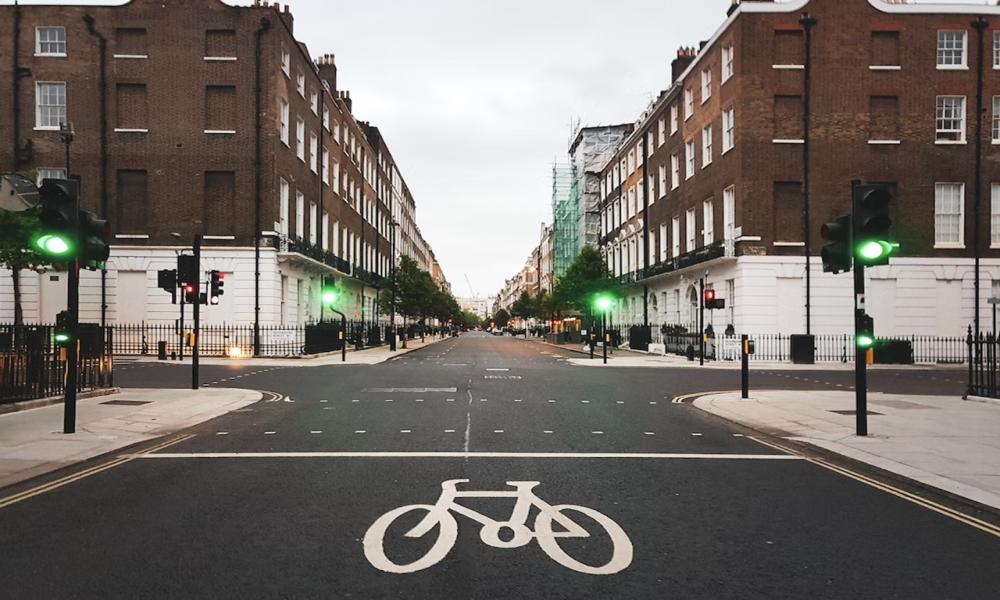
Traffic signals are one of the most familiar pieces of transport infrastructure, yet the principles that govern how they operate are often poorly understood outside the traffic engineering profession. In this ITS Now educational article, we explore the fundamental building blocks of traffic signal operation, using terminology and conventions as they are applied in the United Kingdom. While specific terms and regulations can vary internationally, the underlying concepts described here are relevant to signalised junctions around the world.
Understanding how signals are structured and controlled is essential for anyone involved in highway design, traffic management or intelligent transport systems. This article introduces the key concepts of aspects, phases, stages, streams, and cycle time, and explains how they work together to manage traffic safely and efficiently.
Vehicular traffic signals in the UK are made up of three coloured lights, referred to as aspects. These are red, amber, and green. While other countries may refer to amber as yellow or orange, the function remains the same. Each aspect communicates a specific instruction to drivers and plays a vital role in maintaining safety at junctions.
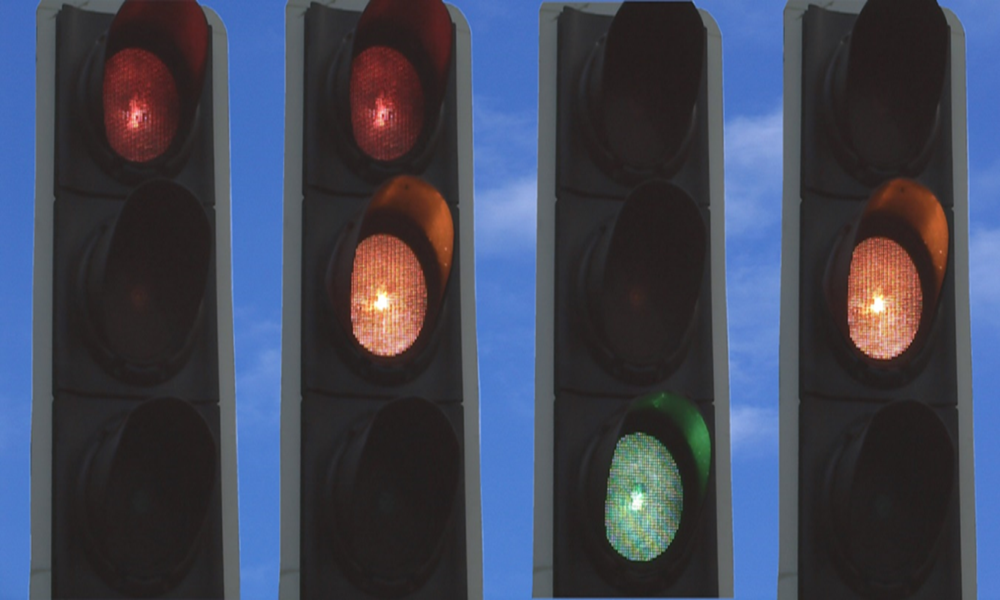
The sequence in which these aspects appear varies between countries, but in the UK the standard sequence is well defined:
A distinctive feature of UK traffic signals is that the amber aspect appears twice in the signal sequence.

When amber appears together with red, it is known as the Starting Amber. This period warns drivers that the signal is about to change to green and is prescribed at exactly two seconds by UK regulations. This timing is fixed and cannot be altered.
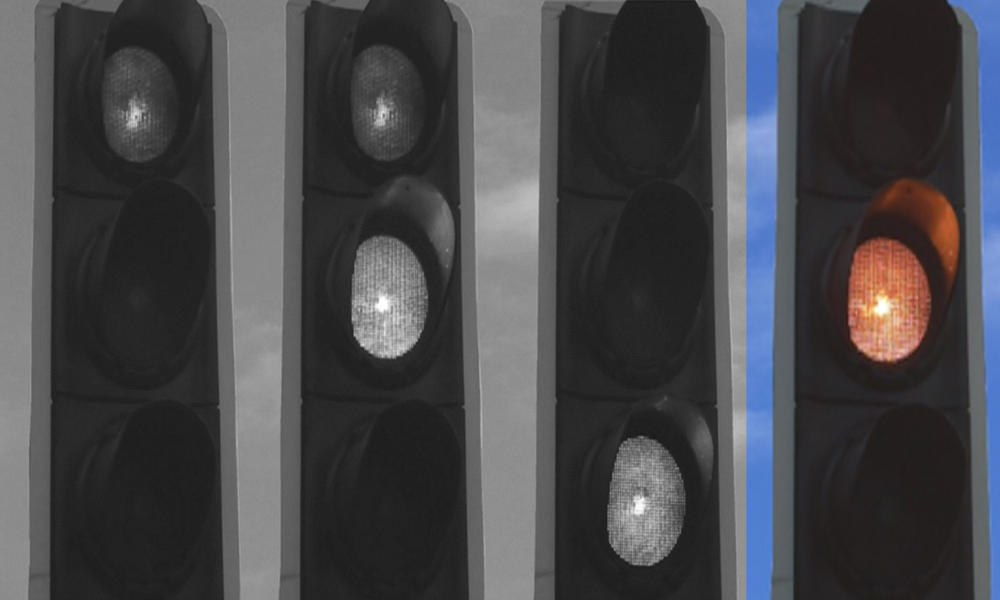
The second appearance of amber occurs after the green aspect and before red. This is known as the Leaving Amber and lasts for three seconds. Like the Starting Amber, this timing is fixed by regulation. These two amber periods are the only signal timings in the UK that are prescribed in this way; all other timings are determined through design and controller settings.
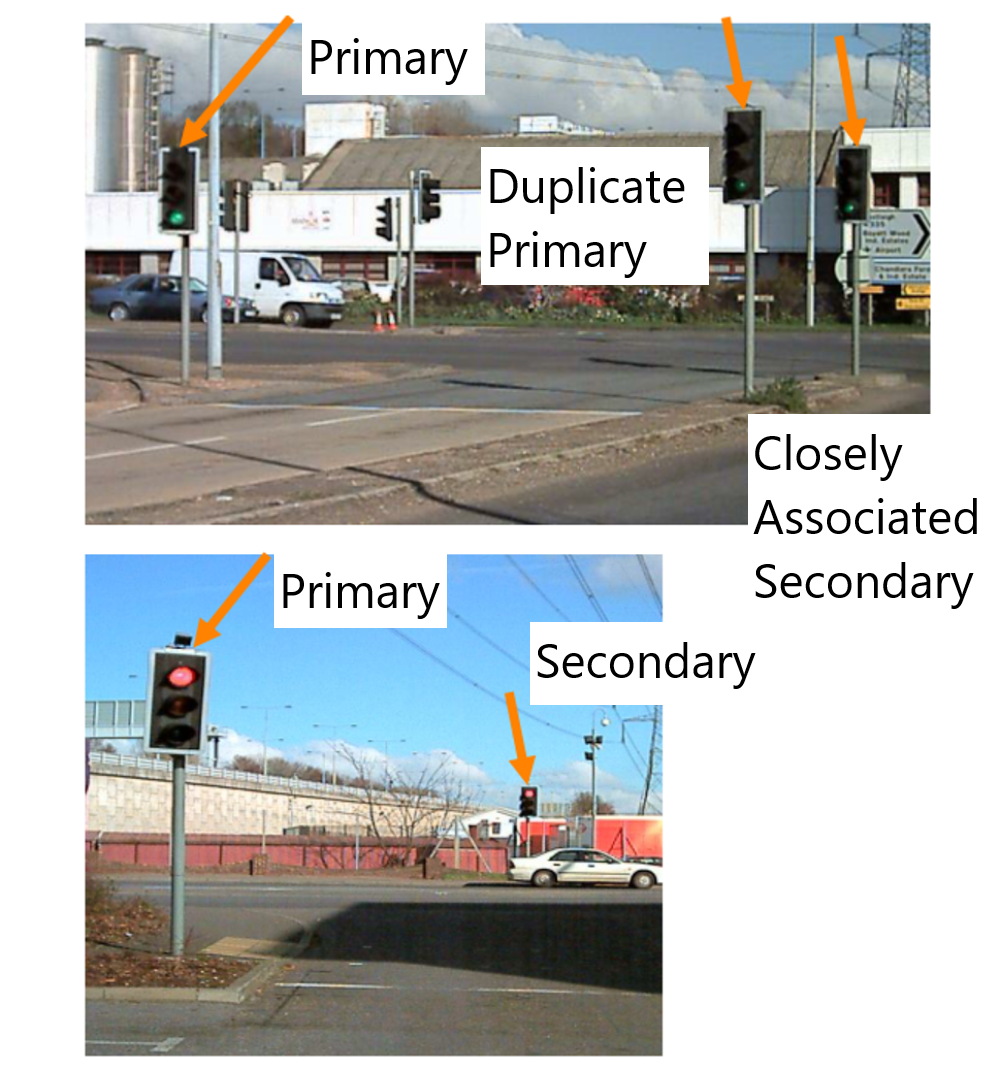
Each approach to a signalised junction is equipped with more than one signal head to ensure good visibility for drivers. The primary signal is typically located on the nearside of the carriageway, adjacent to the stop line. The stop line itself is a solid white line across the road surface that indicates where vehicles must stop when the red aspect is displayed.
In many cases, a duplicate primary signal is also provided on the offside of the approach, often mounted on a central island or on the opposite side of the carriageway. This arrangement is common on one-way streets or slip roads. In addition to primary signals, secondary signals are installed beyond the stop line, usually on the far side of the junction, to maintain signal visibility for drivers who are waiting at the line.
Sometimes secondary signals are positioned closer to the stop line, between the primary signals and the junction itself. These are known as closely associated secondary signals and are typically used on one-way roads or where a central island separates opposing flows. The overall aim of this arrangement is to ensure that drivers always have a clear view of the signal display.
In UK traffic signal terminology, a phase refers to a single signalised movement or group of signal heads that operate together. For every signalised movement, there will always be a primary signal and at least one additional signal head. All of these signal heads display the same aspects at the same time and collectively form a phase.
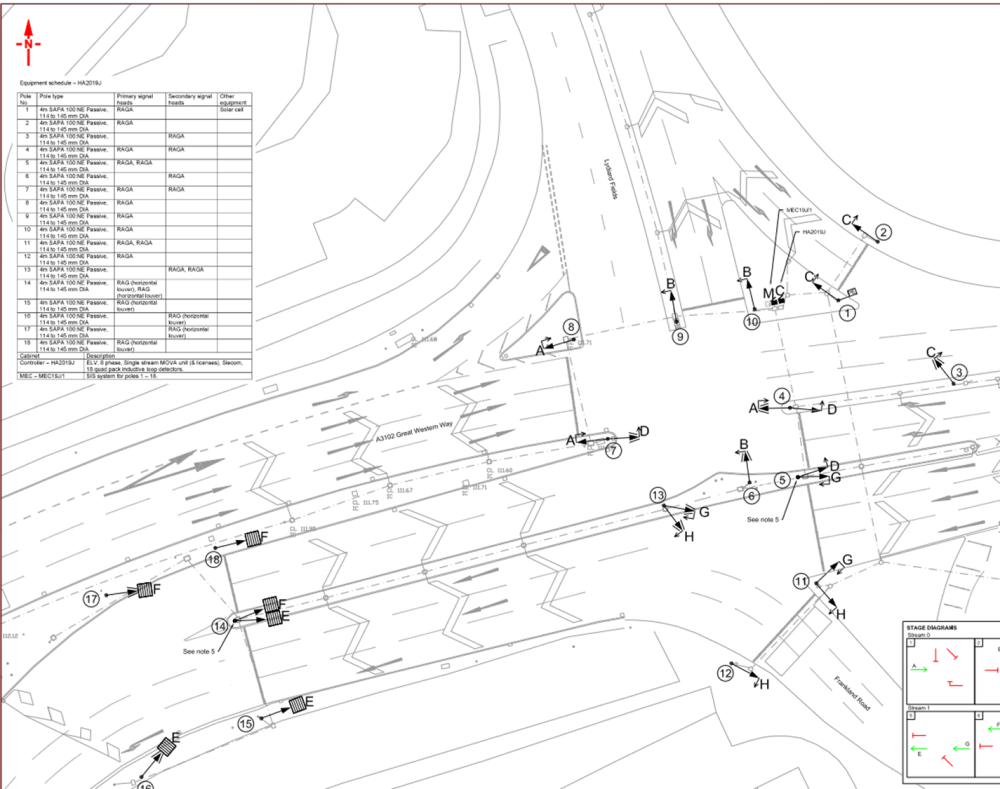
Phases are given letter designations, starting from A, to allow them to be easily identified within the controller. These letters are typically assigned based on the busiest approaches or arranged sequentially in a clockwise direction around the junction. Pedestrian phases are often assigned after vehicular phases, and any dummy or unused phases are designated last.
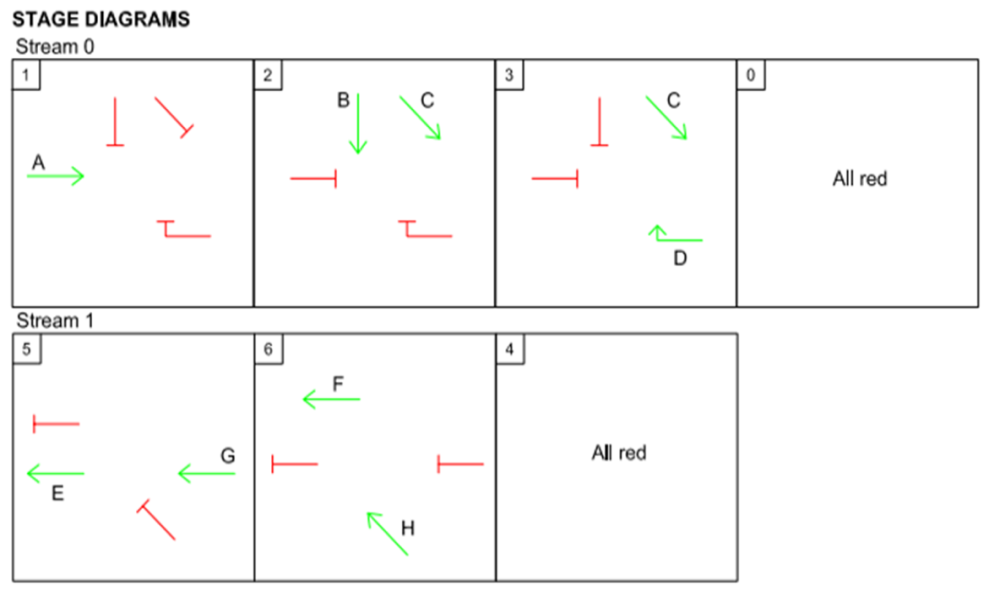
At any given moment, more than one phase may be running simultaneously, provided the movements do not conflict. The Traffic Signal Controller groups compatible phases together into stages. A stage represents a specific combination of phases that are active at the same time and collectively give right of way to particular traffic movements.
A stage begins when all of its constituent phases show green and ends when the first of those phases loses its green aspect. Stages are numbered, with Stage 0 commonly reserved for an all-red condition. This all-red stage can be used in manual mode to stop traffic on all approaches, for example during incidents or police control, and may also be used as a quiescent or revertive stage.
Stage 1 is typically used as the start-up or revertive stage. When a signal installation is switched on, it will usually start in this stage. In vehicle-actuated operation, if no demands are present from vehicle detectors or pedestrian push buttons, the controller will revert back to this nominated stage.
Historically, the start-up stage was often associated with the main road or dominant traffic flow through a junction. However, modern practice sometimes uses alternative stages, such as an all-red or pedestrian stage, to calm traffic or provide priority to vulnerable road users. The choice of revertive stage is therefore an important design consideration.
The sequence of stages at a junction is known as the cycle, and the cycle time is the total duration of all stages combined. Cycle times typically fall in the range of 60 to 90 seconds, although this depends heavily on junction layout and traffic demand. Shorter cycle times allow more responsive control but must still provide sufficient green time for all movements.
Long cycle times, particularly those exceeding 120 seconds, are generally discouraged. While it may seem intuitive that longer green times increase capacity, they often lead to inefficient traffic flow once the initial platoon of vehicles has passed. Ending a stage earlier can allow other movements to run while traffic reforms into platoons for the next cycle.
A stream refers to a complete sequence of stages serving a particular junction or part of a junction. Most signalised junctions operate as a single stream, but modern traffic signal controllers are capable of operating multiple streams simultaneously. This allows one controller to manage several nearby but non-conflicting signal installations.
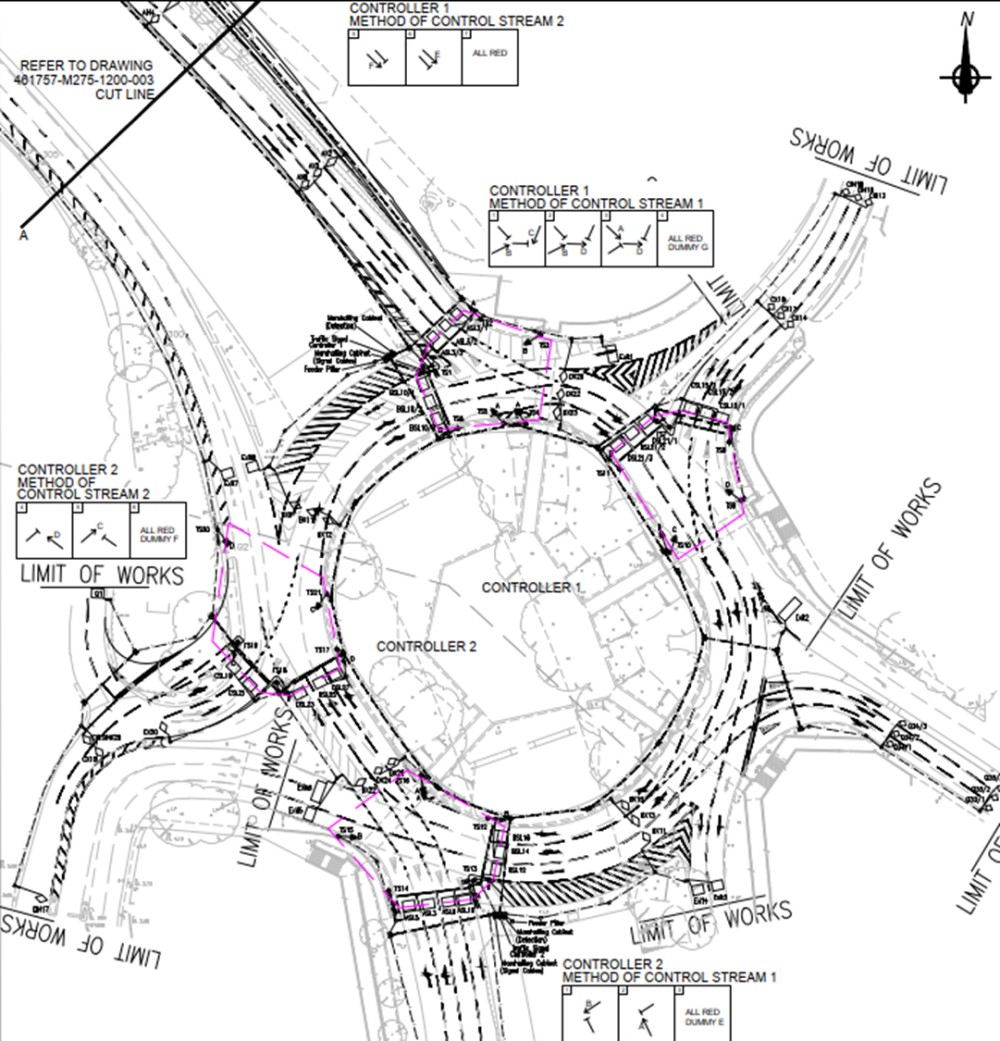
In practice, physical constraints such as cable lengths and voltage drop often limit how many streams can be operated from a single controller cabinet. For this reason, large modern junctions and roundabouts are frequently controlled using multiple controllers, each operating one or more streams to ensure reliable and efficient operation.
The key concepts covered in this article — aspects, phases, stages, streams, and cycle time — form the foundation of traffic signal operation in the UK. While terminology and detailed practices vary internationally, these principles underpin signalised junction design worldwide.
A solid understanding of these ideas is essential for anyone working with traffic signals, whether in design, operation, or policy. By breaking down how signals are structured and controlled, we can better appreciate the complexity behind what most road users experience as a simple set of red, amber, and green lights.
To find out lots more about traffic signal principles, try watching our video about Phases and Stages on the @ITSNow YouTube Channel -Click the buttons below to see more articles:
See all ArticlesIndustry InsightEventsITS Thought LeadershipITS Educational