
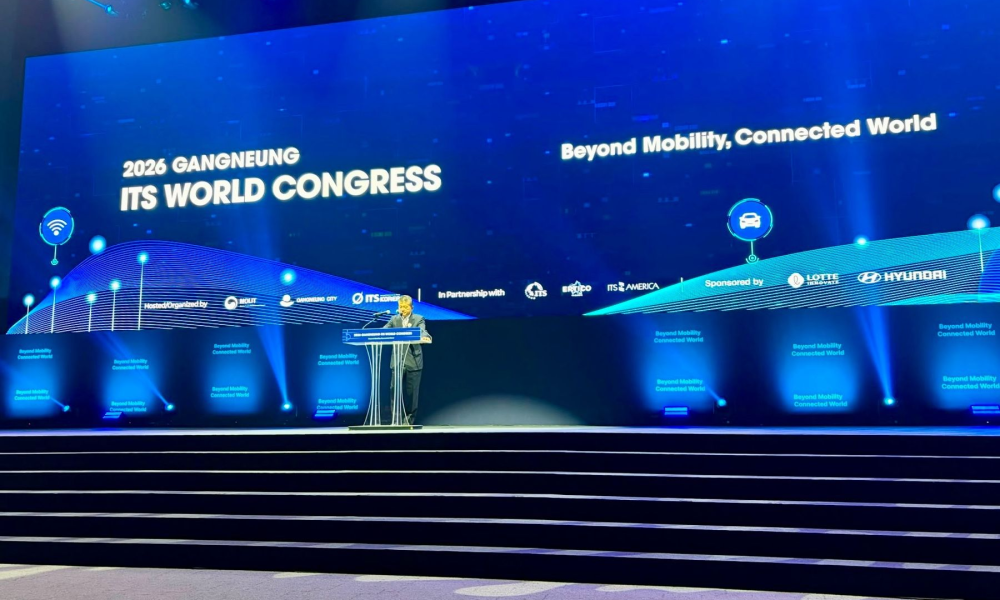
The first full day of the 2026 ITS World Congress in Gangneung began with a strong emphasis on safety as a foundational outcome for intelligent transport systems. Akio Yamamoto, Secretary General of ITS Asia-Pacific and President and CEO of ITS Japan, reminded delegates that safety remains one of the most frequently referenced concepts across the entire programme, appearing even more often than automation, data or infrastructure. His point resonated throughout the day, particularly as speakers explored how artificial intelligence, connected systems and digital infrastructure can be harnessed to deliver safer journeys and faster emergency responses. Technology is only meaningful when it improves lives, and the industry must continue to prioritise outcomes over novelty.
Laura Chace, President and CEO of ITS America, expanded on this idea by highlighting the significance of multiple technologies maturing simultaneously. Her argument that the next evolution of ITS will be defined by what these connections enable, rather than the connections themselves, framed several of the later discussions. Delegates were encouraged to consider how real-time sensing, communication and adaptation can create transport systems that serve communities more efficiently and equitably. This theme carried into the afternoon, where resilience featured prominently, particularly in relation to regions regularly affected by natural disasters. The call to explore how ITS can support preparation, response and recovery felt timely and relevant, especially given the increasing frequency of climate-related disruptions.
Joost Vantomme, Chief Executive of ERTICO – ITS Europe, described the Congress as a festival of ideas, a phrase that captured the atmosphere across the venue. Delegates moved between sessions with a sense of purpose, engaging in conversations that were both technical and collaborative. International partnerships were celebrated not as formalities but as essential mechanisms for addressing shared challenges. The encouragement to turn exchanges into action added a practical edge to the day’s discussions, reminding participants that the value of the Congress lies in what follows once everyone returns home.
While the academic sessions provided depth, the exhibition halls offered a vivid illustration of how the industry is evolving. More than 100 companies showcased next-generation technologies, with autonomous driving and cooperative ITS drawing the largest crowds. Lotte Innovate, the main sponsor of this year’s Congress, commanded attention with a central exhibition space that demonstrated four strands of its ITS work: autonomous shuttles, mobility infrastructure, smart tolling and electric vehicle charging. The remote-driving experience zone proved particularly popular, allowing visitors to operate an autonomous shuttle located 300 kilometres away in Daegu. The demonstration illustrated the potential of remote operation in controlled environments and prompted discussions about future applications in logistics and public transport.
Cooperative ITS also featured prominently, with Lotte Innovate showcasing an urban safety network built on two-way communication between field sensors and central control facilities. Delegates were reminded that conventional ITS relies on one-way data flows, whereas C-ITS enables real-time exchanges that can reduce risks and improve incident response. The company’s involvement in 21 demonstration projects underscored the maturity of the technology and its relevance to cities seeking to enhance safety and efficiency.
The broader exhibition reflected the diversity of the sector. Automakers such as Toyota and Honda presented their latest ITS capabilities, while suppliers including Hyundai Mobis and Qualcomm highlighted advances in components and connectivity. The sheer scale of the exhibition, with 428 booths representing 108 institutions and companies, created an environment where delegates could explore innovations ranging from smart infrastructure to advanced sensing systems. The energy across the halls suggested a sector that is both competitive and collaborative, with companies eager to demonstrate how their technologies contribute to a connected mobility ecosystem.
Academic sessions continued throughout the day, forming the backbone of the Congress. More than 190 sessions and around 440 paper presentations are scheduled across the week and today offered a glimpse of the breadth and depth of research being shared. Discussions ranged from autonomous vehicle deployment strategies to digital twins for transport networks, with presenters emphasising practical applications and measurable outcomes. The focus on real-world implementation rather than theoretical exploration gave the sessions a sense of urgency and relevance.
Outside the conference rooms, Gangneung Olympic Park provided a backdrop for hands-on demonstrations. The outdoor technology events attracted steady interest from delegates and local visitors. The interaction between industry experts and the public added a community dimension to the Congress, reinforcing the idea that intelligent transport systems are not abstract concepts, but tools designed to improve everyday life.
Throughout the day, conversations returned repeatedly to the importance of connecting ideas, data and people. The Congress has always been a place where global perspectives converge, but today’s discussions felt particularly aligned. Whether exploring safety, resilience, convergence or cooperation, delegates approached the programme with a shared understanding that the challenges facing transport systems are universal. The solutions, therefore, must be shaped collectively.
As the day drew to a close, the atmosphere across the venue remained lively. Delegates lingered in the exhibition halls, continued conversations over coffee and prepared notes for tomorrow’s sessions. The sense of momentum was unmistakable. Today offered a clear view of where the industry stands, what it values and how it intends to move forward. It was a day defined by substance, collaboration and a commitment to delivering meaningful outcomes through intelligent transport systems.
Click the buttons below to see more articles:
See all ArticlesIndustry InsightEventsITS Thought LeadershipITS Educational