
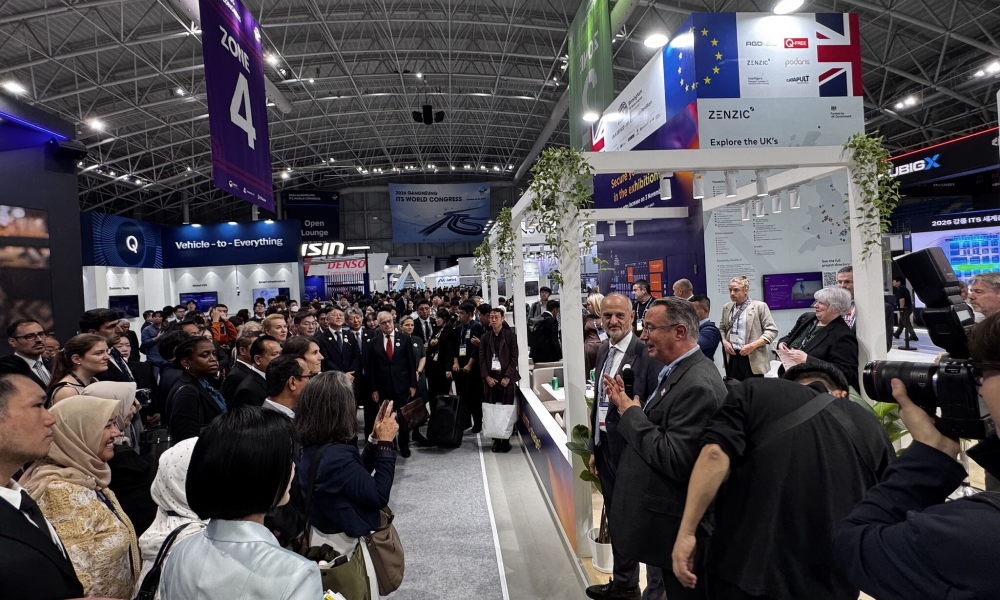
By the time delegates arrive at the Gangneung Olympic Park for the third day, the 2026 ITS World Congress will be fully up to speed. Day Three is traditionally when an ITS World Congress finds its voice. The energy shifts from introductions to substance, attention turns away from broad visions and towards the practical realities of delivering safer, smarter and more sustainable transport systems. Across the conference programme, exhibition floor and demonstration areas, the focus in Gangneung will increasingly centre on the question that now dominates the global mobility sector: how do we move from innovation to implementation?
Artificial intelligence is expected to feature heavily throughout the day. Across the transport sector, AI has rapidly evolved from an emerging capability into a mainstream operational tool. Delegates will be examining how artificial intelligence can improve traffic management, optimise public transport, support predictive maintenance, increase safety and help authorities make better decisions based on real-time information.
Discussions surrounding data will be equally prominent, for many years the ITS sector concentrated on generating ever larger volumes of information. Today's challenge is rather different. Transport authorities and operators now possess vast quantities of data but are increasingly focused on extracting actionable intelligence. Throughout Wednesday's programme, speakers and panellists will be exploring how data can be transformed into meaningful outcomes for travellers, network operators and policymakers.
Few countries have embraced intelligent transport technology with the same level of ambition as South Korea, making Gangneung an ideal setting for discussions around vehicle automation, connected infrastructure and next generation mobility services. Congress participants will be looking closely at developments in vehicle to infrastructure communications, automation strategies and the role that intelligent road networks will play in supporting future transport systems.
Resilience will provide another important thread running through the day's programme. Recent years have demonstrated that transport networks face unprecedented pressures. Climate events, cyber security threats, changing travel patterns and evolving economic conditions have forced operators to rethink traditional approaches to network management. Sessions throughout the day are expected to examine how digital technologies can help create transport systems that are not only smarter but also more adaptable and more resilient.
Away from the conference theatres, attention will inevitably be drawn towards the exhibition. World Congress exhibitions have always provided a glimpse into the future of mobility, yet the most memorable displays are often those demonstrating technologies that are delivering measurable benefits today. Gangneung promises plenty of both. Exhibitors from around the world will be showcasing advances in traffic management systems, connected mobility platforms, roadside technologies, mobility services, vehicle automation and transport analytics. Delegates will have opportunities to experience many technologies first hand, giving them an immediate understanding of how innovation is progressing beyond research projects and into operational deployment.
The demonstration programme is likely to be one of the busiest areas of the event. Nothing captures attention quite like seeing technology perform in real world conditions. Technical visits and live demonstrations provide a valuable opportunity to move beyond presentations and observe how systems operate in practice. For transport professionals facing the challenge of modernising ageing networks while managing limited budgets, those practical examples are often among the most valuable elements of the entire Congress.
European expertise will once again have a strong presence with ERTICO, as one of the principal organisers of the ITS World Congress alongside ITS America and ITS Asia-Pacific, continues to play a vital role in connecting regions, industries and disciplines. Its influence can be seen throughout the programme, bringing together public authorities, research organisations and private sector innovators to address shared challenges and accelerate deployment. Much of the European contribution this year is expected to focus on interoperability, data sharing, cooperative mobility and large-scale implementation. Those are areas in which Europe has built considerable expertise, and Gangneung provides a valuable global platform for sharing lessons learned with colleagues from Asia-Pacific, North America and beyond.
British voices will also be heard across the Congress, the United Kingdom continues to punch above its weight in intelligent transport systems, particularly in traffic management, connected vehicle research, road safety, mobility data and transport innovation. Representatives from local authorities, consultancies, technology companies and industry organisations are expected to contribute across numerous sessions and discussions. Many international delegates continue to look towards the UK for practical examples of innovation being delivered within complex operational environments. Whether discussing digital traffic management, connected corridors, AI applications or the integration of emerging mobility services, British expertise remains highly respected on the global stage.
Beyond the formal programme, Wednesday is also the day when networking reaches its peak. Meetings that began as introductions on Monday have matured into meaningful conversations. New partnerships begin to take shape. Research collaborations gain momentum. Business discussions move closer to commercial reality. Some of the most important conversations at an ITS World Congress never appear on the official agenda. They take place over coffee between sessions, during exhibition visits, at networking receptions or while walking between venues. Those exchanges help explain why the Congress remains such an influential event despite the growth of virtual engagement and online collaboration tools.
Gangneung itself continues to provide a compelling backdrop. The city combines a reputation for technological innovation with the experience of hosting major international events, creating an environment well suited to the world's largest gathering of intelligent transport professionals. Delegates are not simply discussing the future of mobility in a conference centre. They are doing so within a city that is actively demonstrating how technology, connectivity and infrastructure can work together.
As Day Three draws to a close, the mood across the Congress is likely to be one of increasing optimism. Major challenges remain. Congestion, decarbonisation, safety, affordability and resilience continue to test policymakers and transport operators around the world. Yet the conversations taking place in Gangneung suggest a sector increasingly focused on solutions rather than problems.
Wednesday promises to showcase exactly why the ITS World Congress remains the industry's most important global gathering. Ideas will be challenged. Partnerships will be strengthened. Technologies will be tested against operational reality. Most importantly, the intelligent transport community will continue doing what it does best, by bringing together expertise from around the world to build the connected future of mobility.
Click the buttons below to see more articles:
See all ArticlesIndustry InsightEventsITS Thought LeadershipITS Educational