
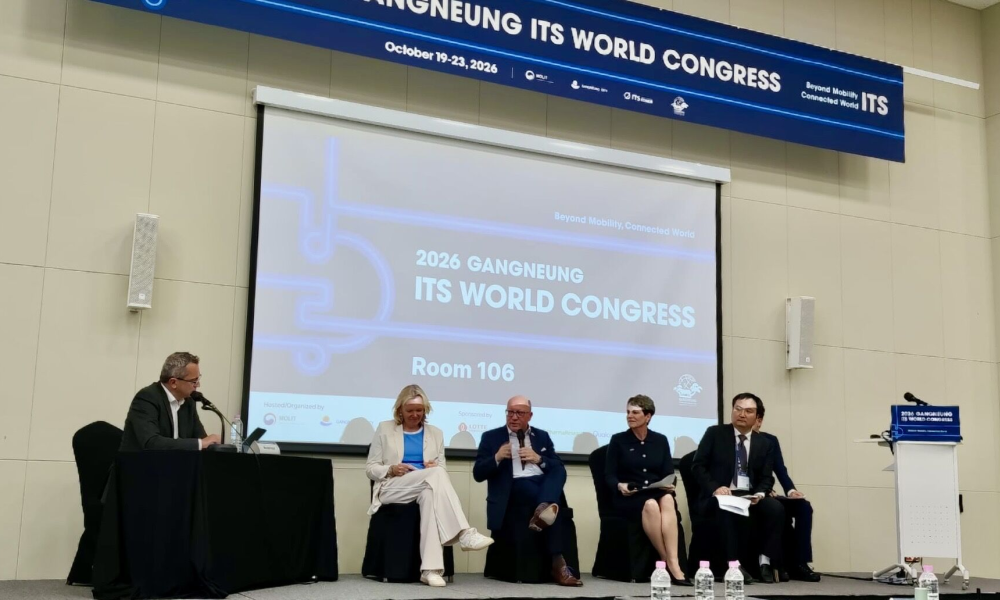
Set against the backdrop of the former Olympic Park, Gangneung continues to make a strong case for itself as a host city that embodies the very principles being debated inside the conference halls. Intelligent transport systems are not simply being discussed here. They are visible throughout the city, from connected infrastructure and smart intersections to autonomous vehicle services that have become part of daily life for residents. That real world context gives many of the congress discussions additional credibility, grounding theoretical concepts in operational experience.
Across the conference programme, artificial intelligence remains firmly at the centre of the mobility conversation. While previous generations of ITS debate often focused on connectivity alone, discussions in Gangneung increasingly reflect a sector that is now exploring how connected data can be turned into actionable intelligence. Delegates spoke about AI enabled traffic management, predictive operations, network resilience and new approaches to extracting value from vast quantities of transport data. The emphasis is no longer on collecting information. Instead, attention has turned to how transport authorities and operators can use that information to make better decisions in real time.
Several technical sessions examined the relationship between data analytics and mobility outcomes. Researchers presented work exploring public transport efficiency, travel behaviour, accessibility challenges and the use of digital twins to support freight and logistics operations. The diversity of subjects demonstrated how far the ITS sector has evolved. Conversations once dominated by highway operations are now just as likely to encompass social inclusion, behavioural analysis, environmental performance and multimodal journey planning.
Autonomous mobility also remained high on the agenda. Rather than focusing on futuristic concepts, many discussions concentrated on deployment pathways, safety assurance and operational integration. Delegates appeared increasingly interested in understanding what comes after successful pilots. Questions surrounding governance, regulation, public trust and business sustainability featured prominently as speakers examined how automated services can become routine components of everyday transport networks. The message emerging from Gangneung is that technological capability alone is no longer enough. Long term success will depend upon integration with wider mobility ecosystems and public policy objectives.
The exhibition floor reflected that same sense of maturity. More than a showcase of impressive hardware and software, the exhibition has become a demonstration of how different technologies can work together. Major global companies and public sector organisations are presenting solutions covering connected vehicles, AI platforms, traffic management systems, digital infrastructure and next generation mobility services. What stands out is the growing emphasis on interoperability. Few exhibitors now speak about isolated products. Most discussions centre on integrated systems, shared data environments and collaborative operating models.
For many international visitors, one of the most impressive aspects of this year's congress is the way Korea continues to position itself as a living laboratory for transport innovation. The country has invested heavily in autonomous driving infrastructure, connected mobility services and smart city development, and those investments are increasingly visible in real world deployment. Congress participants have repeatedly highlighted the value of seeing technologies operating beyond demonstration environments and within active urban transport networks.
Another recurring theme throughout today's proceedings was inclusion. Multiple sessions explored how intelligent transport systems can improve accessibility for older citizens, vulnerable users and those who have traditionally been excluded from mobility innovation. Such discussions provided an important reminder that technology should ultimately serve people rather than simply advance technical capability. Several presenters argued that success should be measured not only through efficiency gains but also through broader societal outcomes including accessibility, equity and quality of life.
Sustainability remained closely intertwined with these conversations. Green ITS solutions, electrification support systems and demand responsive mobility featured regularly throughout the programme. Delegates increasingly appear to recognise that connectivity, automation and sustainability are no longer separate agendas. Instead, they form interconnected elements of a larger mobility transformation that seeks to improve transport performance while reducing environmental impact.
Away from the formal sessions, the real value of a World Congress continued to emerge in the spaces between the scheduled programme. Corridors, exhibition stands and informal meeting areas were filled with discussions between city leaders, technology providers, researchers and transport operators. Partnerships are often born in these settings, where practical experience can be exchanged without presentation slides or prepared remarks. Gangneung has provided an atmosphere that encourages precisely those interactions.
The social programme also played its part in strengthening international connections. Conversations from technical sessions flowed naturally into evening gatherings, where delegates had the opportunity to continue discussions in a more relaxed setting. The congress gala dinner provided a fitting showcase of Korean hospitality while reinforcing the international character of the event. Business cards changed hands as readily as stories and experiences, creating the sort of personal relationships that frequently underpin future collaboration.
There was also a strong sense of optimism throughout the evening. Despite ongoing challenges facing transport systems worldwide, including funding pressures, climate commitments and rapidly evolving technologies, delegates generally appeared confident about the sector's direction of travel. That confidence was reflected in both formal speeches and private conversations, many of which focused on opportunity rather than uncertainty.
Perhaps the most striking impression from today's proceedings is that the ITS community is becoming increasingly pragmatic. Grand visions remain important, but the conversation has clearly evolved. Attention is shifting towards implementation, scalability and measurable outcomes. Stakeholders are asking tougher questions about deployment, governance and public benefit. In many ways, that maturation may be one of the most significant developments visible in Gangneung this week.
As the congress passes its midpoint, today's discussions revealed a sector that is growing more confident in its purpose and more realistic about the challenges ahead. The technology continues to advance at remarkable speed, yet the dominant message emerging from Gangneung is not about machines or software. It is about creating transport systems that are safer, more inclusive, more sustainable and better connected to the needs of the people they serve. That, ultimately, is the story that resonated most strongly across the halls, exhibition spaces and dinner tables of the 2026 ITS World Congress today.
Click the buttons below to see more articles:
See all ArticlesIndustry InsightEventsITS Thought LeadershipITS Educational