
For more than twenty years, the idea of the Smart City has captured the imagination of governments, technology suppliers and transport planners alike. Promises of cleaner air, smoother traffic, safer roads and more efficient public services have helped justify billions of pounds of investment across the globe. Sensors, connected infrastructure, integrated control centres and data platforms have become familiar features of urban development strategies from Singapore to Barcelona, from Seoul to London.
Yet as economic pressures intensify and local authorities face growing scrutiny over public spending, a fundamental question is increasingly being asked whether Smart City investments are actually working?
The answer is neither a straightforward yes nor a definitive no. Instead, evidence suggests that success depends less on technology itself and more on how technology is deployed, whether it addresses clearly defined transport challenges and whether citizens can see tangible improvements in their daily lives. For the Intelligent Transport Systems sector, that distinction is particularly important. Some of the most successful Smart City programmes have delivered measurable mobility benefits, while others have become expensive demonstrations of technology searching for a purpose.
Barcelona is often cited as one of the world's leading Smart City success stories. Following the financial crisis that severely affected Spain, city leaders sought ways to improve services while reducing operational costs. Beginning in the early 2010s, Barcelona introduced a range of connected systems covering transport, parking, street lighting and waste management. The city built upon an extensive fibre network and deployed sensors across key urban services, creating what became one of the most recognised urban digitalisation programmes worldwide. Studies of the programme found significant operational savings, improved public services and enhanced mobility management, particularly through smart parking and real-time transport information systems. From a transport perspective, the parking initiatives were particularly notable. Real-time parking information helped reduce the amount of traffic generated by motorists circulating in search of spaces, a well-known contributor to urban congestion. Coupled with improved public transport information services, digital mobility management became an integral part of the city's broader urban strategy.
Singapore provides perhaps the strongest example of a city where Smart City principles have become embedded within transport policy rather than existing as standalone technology projects. Guided by its Smart Nation strategy, Singapore has systematically integrated Intelligent Transport Systems into the operation of its road network. Electronic Road Pricing, comprehensive traffic monitoring, connected control centres and predictive traffic management have enabled authorities to optimise limited road space while supporting wider sustainability goals. The city-state's Intelligent Transport Systems network uses extensive sensor coverage, cameras and data analytics to manage congestion, improve safety and support informed travel decisions. What makes Singapore particularly interesting is that technological investment has remained focused on solving practical transport problems. Rather than promoting technology as an end in itself, the emphasis has consistently been on improving mobility outcomes. Smart parking systems, integrated public transport information, traffic management platforms and urban data exchanges all support broader policy objectives relating to accessibility, sustainability and economic productivity.
Such examples demonstrate where Smart City investment can generate real value. They also highlight a crucial lesson for transport authorities. Success is usually achieved when technology becomes largely invisible to users. Travellers care far more about journey reliability, reduced congestion and better travel information than they do about sensor networks or digital platforms. However, not every Smart City programme has delivered on its promises.
One of the most famous examples is the Toronto Quayside development, led by Sidewalk Labs, a Google-affiliated company. Announced with considerable fanfare in 2017, the project promised a neighbourhood built around advanced digital technologies, autonomous mobility systems, connected infrastructure and extensive environmental monitoring. The vision included smart roads, automated services and a highly data-driven urban environment. Despite the ambitious plans, the project collapsed in 2020. Economic uncertainty contributed to its cancellation, but public concerns around governance, data ownership, privacy and the role of technology companies in urban management played a significant role throughout its development. Critics questioned whether the project was genuinely responding to citizen needs or simply creating an urban laboratory for technology experimentation. The Toronto experience offers a valuable warning for transport technology planners. Public acceptance cannot be assumed simply because a technology is innovative. Citizens increasingly expect transparency regarding how mobility data is collected, stored and used. Trust has become just as important as technical capability.
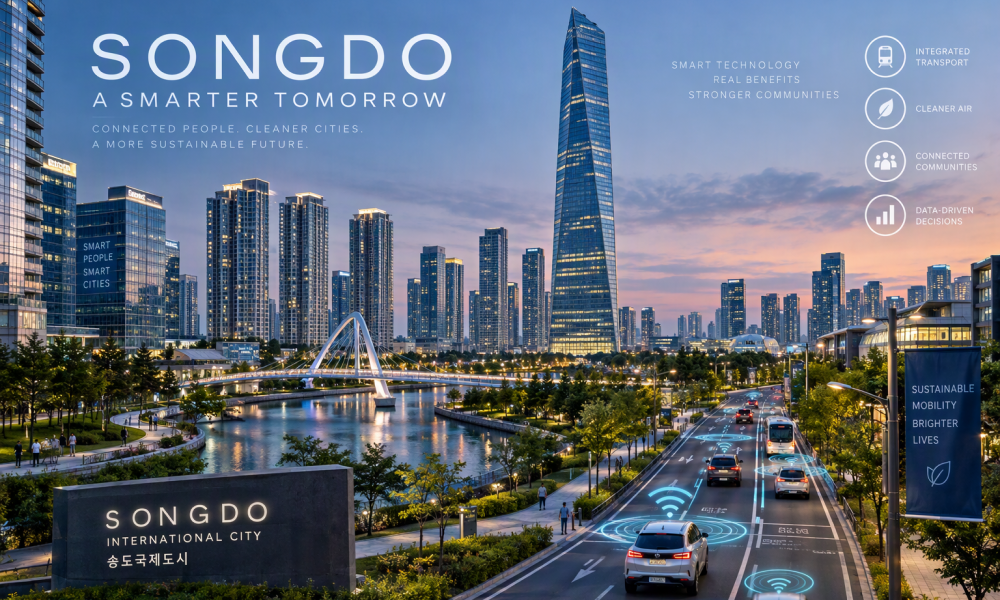
South Korea's Songdo provides another instructive case. Frequently described as one of the world's first purpose-built smart cities, Songdo was developed with extensive digital infrastructure integrated into transport, utilities and public services. The city remains an impressive technological achievement and is often regarded as one of the most advanced Smart City developments ever constructed. Yet it has also faced criticism for failing to achieve some of its original ambitions. Population growth has been slower than anticipated, while commentators have questioned whether technological sophistication alone is sufficient to create vibrant urban communities. Studies have pointed to challenges around urban vitality, social inclusion and the balance between technology and human experience. The lesson here is particularly relevant for mobility practitioners. Smart infrastructure cannot substitute for good urban planning. Connected roads, intelligent traffic signals and mobility platforms can significantly improve transport performance, but they are most effective when supporting attractive, accessible and well-designed places.
Increasingly, this understanding is shaping the next generation of Smart City investments. Rather than pursuing large-scale technology deployments for their own sake, cities are focusing on specific outcomes. Congestion reduction, emissions management, active travel support, public transport integration and electric vehicle infrastructure have become priority areas. This evolution aligns closely with the direction of the ITS sector. Modern Intelligent Transport Systems are moving beyond individual technologies towards integrated mobility ecosystems. Connected vehicle services, Mobility as a Service platforms, adaptive traffic management, digital twins and AI-driven network optimisation all have the potential to deliver measurable improvements when deployed against clear objectives.
Perhaps the most important conclusion from two decades of Smart City investment is that success should not be measured by the amount of technology installed. It should be measured by outcomes:
Where cities can answer those questions positively, Smart City investments have largely justified themselves. Barcelona and Singapore offer strong evidence that carefully targeted digital investments can improve transport operations and support wider urban goals. Where projects have struggled, including Toronto and aspects of Songdo, the difficulties have often stemmed from weak public engagement, unclear governance structures or a tendency to prioritise technological ambition over practical outcomes.
For ITS professionals, that finding should be encouraging. The future of Smart Cities is unlikely to be defined by ever greater quantities of sensors or larger control rooms. Instead, it will be determined by the ability of technology to solve real mobility problems in ways that are measurable, trusted and visible to the people who use transport networks every day. In that regard, the smartest cities may ultimately be those that talk least about being smart and focus instead on delivering better mobility.
Click the buttons below to see more articles:
See all ArticlesIndustry InsightEventsITS Thought LeadershipITS Educational