150x150.png)
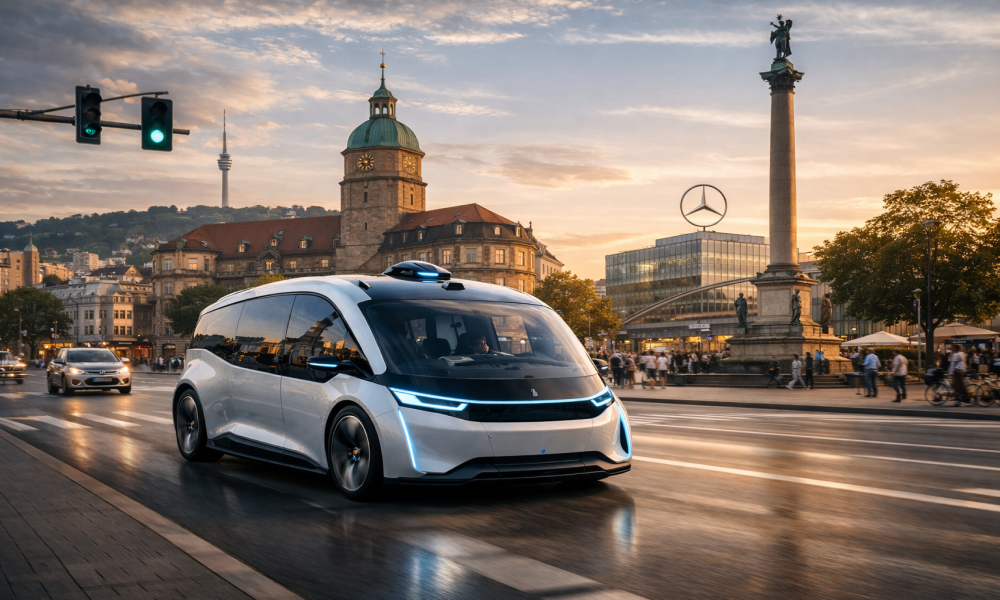
Stuttgart has always been a city where engineering ambition feels almost atmospheric, but this week’s Autonomous Vehicle Tech Expo 2026, which is now a core pillar of the newly unified Vehicle Tech Week Europe, felt like a decisive moment in the sector’s evolution. With more than 100 solution providers, thousands of industry specialists and a conference programme shaped by OEMs, regulators and global technology leaders, the event offered a panoramic view of where autonomous mobility is heading next.
For the Intelligent Transport Systems (ITS) community, the Expo delivered a rich seam of news, with advances in simulation, breakthroughs in sensing, new architectures for software-defined vehicles and a renewed focus on safety, cybersecurity and validation. What emerged was a sector that is no longer simply experimenting with autonomy, it is now industrialising it.
This year marked the first time that the Autonomous Vehicle Tech Expo was formally integrated into Vehicle Tech Week Europe, bringing it under one roof with the Automotive Testing Expo and Automotive Interiors Expo. The result was a cross-pollination of ideas that mirrored the industry’s own convergence across autonomy, testing, in-cabin experience and software-defined architectures. These are no longer separate domains but interdependent layers of the same mobility ecosystem.
As Peter Massey of UKi Media & Events put it, the industry’s transformation is dissolving old silos and the expo’s new format reflects that shift. The ITS sector, which thrives on interoperability and system-level thinking, is arguably the biggest beneficiary of this new collaborative environment.
If one theme dominated Stuttgart this week, it was simulation, specifically the drive to make virtual testing more realistic, more scalable and more tightly integrated with physical validation.
aiMotive unveiled aiSim 6, the latest generation of its ISO 26262-certified simulation platform. The standout innovation is its dynamic neural reconstruction capability, which uses AI to generate highly realistic virtual environments with physical fidelity that supports safety-critical testing. This is a significant step toward closing the gap between simulated and real-world driving conditions, especially for complex urban scenarios.
Meanwhile, rFpro presented new findings from Sim4CamSens2, a collaborative research project advancing sensor validation. Their work focuses on improving the realism of camera-based perception testing, which is an essential component for automated mobility in cities where lighting, weather and occlusion can dramatically affect sensor performance.
Simulation is no longer a supporting tool; it is becoming the backbone of autonomous vehicle development. The Expo made that abundantly clear.
Autonomous mobility depends on robust perception and Stuttgart delivered several notable advances.
Xavveo drew significant attention with its photonic distributed radar, a technology capable of producing ultra-dense point clouds with exceptional resolution in all weather and lighting conditions. For regions with challenging climates, this kind of resilience is essential for reliable automated driving and roadside sensing.
Thermal imaging also made headlines. Exhibitors showcased ASIL-B-rated thermal infrared cameras designed to improve pedestrian automatic emergency braking (PAEB) and enhance safety in low-visibility conditions. As cities increasingly adopt Vision Zero strategies, these sensing innovations align directly with policy-driven safety goals.
The shift toward software-defined vehicles (SDVs) was another defining theme. The Expo’s conference programme featured deep dives into SDV architecture, AI-enabled decision-making and the integration of cloud-native development practices into automotive engineering.
One of the most talked-about developments came from Foretellix, which showcased the integration of its Foretify physical AI toolchain with Nvidia Drive AV, including Alpamayo open reasoning models and Nvidia’s world foundation models. This integration promises a more unified workflow for scenario generation, virtual testing and safety validation, an area where ITS and automotive engineering increasingly overlap.
In parallel, an interview with Mircea Gradu highlighted how AI-driven connected vehicle platforms are reshaping urban mobility by enabling real-time data exchange between vehicles and city infrastructure. This is precisely the kind of system-level connectivity that ITS practitioners have long advocated.
With vehicles becoming rolling data centres, cybersecurity is no longer optional, it is foundational. Apriorit showcased new automotive cybersecurity solutions, including firmware-level protections and tools for extracting detailed system information to support vulnerability analysis. These developments reflect a growing recognition that autonomous mobility cannot scale without robust, verifiable cyber resilience.
For ITS operators managing roadside units, traffic management systems and connected infrastructure, the alignment between vehicle cybersecurity and broader network security is becoming increasingly important. Stuttgart underscored that this integration is finally happening.
Another major announcement came from Vcarsystem, which introduced a PCIe-based high-performance data logger designed for next-generation ADAS validation. With autonomous systems generating terabytes of data per hour, scalable logging solutions are essential for training AI models, validating edge cases and ensuring regulatory compliance.
This is particularly relevant for organisations involved in pilot deployments, where data capture and analysis underpin everything from safety assessments to operational optimisation.
The Expo also highlighted the growing importance of collaboration between academia and industry. The Birla Institute of Technology & Science, Pilani presented work on SDV transformation, emphasising how advanced architectures and new engineering paradigms are reshaping vehicle development.
For a sector facing skills shortages and rapid technological change, these partnerships are becoming essential pipelines for innovation and talent.
The conference agenda was a who’s who of global mobility leadership, with speakers from Ford, TÜV/PAVE, FISITA, Forvia, ASAM, the European Commission, SAE ITC AVSC, Here Technologies, Renault, Hella, VinFast and Mercedes. Sessions covered:
This breadth reflects a sector that is no longer debating whether autonomy will scale, but how.
The Vehicle Tech Week Awards, held on 24 June, brought together recognition programmes from across the three co-located expos. The ADAS & Autonomous Vehicle International Awards celebrated breakthrough technologies shaping safer, smarter mobility, many of which directly intersect with ITS priorities.
What made Stuttgart 2026 feel different was the sense that autonomous mobility is entering a new phase. The technologies on display were not speculative, they were deployable. The conversations were not about distant futures, they were about integration, validation and scaling.
For the ITS community, the message was clear that the future of autonomous mobility will be built on the foundations of interoperability, simulation, sensing, cybersecurity and data-driven decision-making.
Click the buttons below to see more articles:
See all ArticlesIndustry InsightEventsITS Thought LeadershipITS Educational