
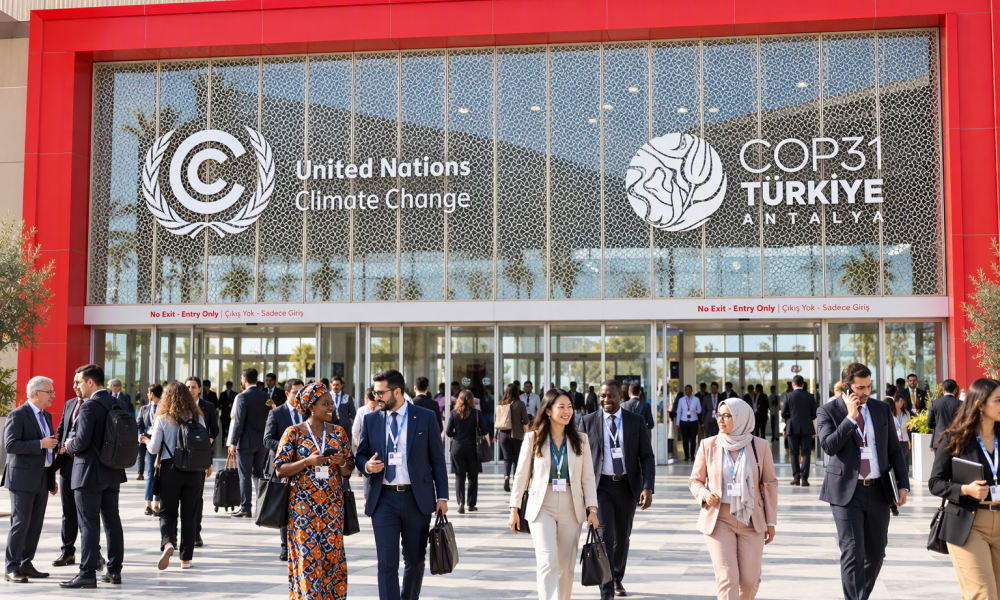
Climate conferences can often feel distant from the day-to-day realities of transport professionals. Negotiations over finance mechanisms, emissions targets and international agreements may appear far removed from the decisions being made in traffic control centres, transport authorities and highways departments across the world. Yet the discussions that took place at COP31 in Antalya, Türkiye, last week reinforced a reality that is becoming impossible to ignore, that transport remains one of the most challenging sectors to decarbonise, and Intelligent Transport Systems (ITS) technologies are increasingly central to the solution.
Held under the banner of accelerating the global energy transition, COP31 placed significant emphasis on electrification, resilient cities and the practical steps required to reduce dependence on fossil fuels. The conference highlighted not only the need for cleaner vehicles, but also the necessity of creating more efficient, better connected and more intelligently managed transport networks capable of reducing emissions while supporting economic growth.
This marks an important shift in thinking. For many years, climate discussions surrounding transport focused heavily on vehicle technology. The debate largely centred on replacing internal combustion engines with electric alternatives. While electrification featured prominently once again at COP31, there was growing recognition that achieving net zero mobility requires far more than simply changing what powers vehicles. The intelligence that underpins transport systems is becoming just as important as the energy source itself.
Anyone travelling through a major city understands the cost of inefficiency. Congestion wastes time, increases fuel consumption, damages air quality and undermines productivity. Even at COP31 itself, transport congestion around the conference venue became something of an unintended symbol of the challenge facing policymakers, with traffic delays and overcrowded transport services highlighting the broader difficulties associated with managing mobility in growing urban areas.
For the ITS sector, this serves as a timely reminder that reducing transport emissions is not solely an environmental objective. Improving network efficiency delivers immediate benefits regardless of climate considerations. Adaptive traffic signal control, connected vehicle technologies, intelligent corridor management and real-time traveller information systems all help transport authorities maximise the performance of existing infrastructure. When implemented effectively, these systems reduce unnecessary delays, smooth traffic flows and contribute to lower emissions without requiring major physical expansion of the road network.
Such measures become increasingly important as governments pursue ambitious climate targets. Many countries are discovering that road capacity alone cannot solve growing mobility demand. Urbanisation continues to place pressure on transport systems, while public expectations for seamless, reliable travel continue to rise. Climate resilience introduces another layer of complexity, requiring networks to withstand increasingly frequent extreme weather events.
One of the strongest themes emerging from COP31 was the growing focus on cities. For the first time, urban resilience occupied a more prominent position within climate discussions, reflecting the reality that most transport emissions, economic activity and population growth are concentrated within urban areas.
This has significant implications for mobility technology providers and transport authorities alike. Smart cities are no longer simply technology demonstrations designed to showcase innovation. Increasingly, they are being viewed as essential tools for achieving environmental, economic and social objectives simultaneously. Connected transport platforms, multimodal journey planning, integrated ticketing, digital traffic management systems and sophisticated data analytics are all becoming key components of urban climate strategies.
Data, in particular, is emerging as one of the most valuable assets in the transition towards sustainable mobility. Modern transport networks generate vast quantities of information from sensors, connected vehicles, cameras, mobile devices and infrastructure assets. When analysed effectively, this data enables operators to understand travel patterns, predict congestion, optimise public transport services and respond rapidly to incidents.
Artificial intelligence is likely to accelerate this trend further. Machine learning systems are increasingly capable of identifying network inefficiencies and predicting travel demand with remarkable accuracy. As transport authorities seek to maximise the return on infrastructure investment while simultaneously reducing emissions, AI-driven traffic management could play an increasingly important role over the coming decade.
Electrification was another recurring theme throughout COP31. Speakers highlighted the importance of expanding electric transport, reducing dependence on imported fossil fuels and creating more resilient energy systems. Whilst electric vehicles often dominate public attention, the ITS sector understands that charging infrastructure management may prove just as important as vehicle adoption itself. Large-scale electrification introduces new challenges for transport and energy networks. Charging demand must be coordinated, managed and integrated into wider mobility systems. Digital platforms capable of monitoring charger availability, balancing network demand and guiding drivers towards suitable charging facilities will become increasingly critical.
This points towards greater convergence between transport technology and energy technology. Historically, these sectors have often operated independently. Future mobility systems, however, are likely to require far closer integration. Connected vehicles, smart charging infrastructure, distributed energy generation and intelligent network management systems will need to communicate seamlessly if countries are to maximise the benefits of electrification.
Resilience also featured prominently in discussions throughout the conference. Climate-related disruptions are becoming more frequent and more severe, creating substantial risks for transport infrastructure. Flooding, wildfires, storms and extreme temperatures all have the potential to disrupt mobility networks and undermine economic activity.
The relevance for ITS professionals is clear. Digital monitoring systems, predictive maintenance technologies and real-time operational platforms provide transport authorities with tools that can improve preparedness and accelerate recovery when incidents occur. Networks that can detect problems early, communicate effectively with travellers and adapt dynamically during disruption are inherently more resilient than those reliant on manual intervention.
Looking ahead, perhaps the most significant message emerging from COP31 is that climate policy and transport policy are becoming increasingly inseparable. Success will not be measured solely by the number of electric vehicles sold or the quantity of renewable energy deployed. Equally important will be the ability to operate transport systems more intelligently, making better use of infrastructure, data and technology.
For the global ITS community, this creates both responsibility and opportunity. The technologies needed to improve transport efficiency already exist in many cases. What is required now is broader deployment, stronger integration and a willingness to view digital mobility solutions not as optional enhancements but as essential components of climate action.
As governments refine their pathways towards net zero, the role of intelligent transport is set to become more prominent than ever. Climate conferences may continue to be dominated by discussions of energy, finance and international diplomacy, yet beneath those headline debates lies a growing recognition that the future of sustainable mobility depends as much on intelligence as it does on infrastructure.
COP31 demonstrated that the journey towards a lower-carbon future will not be achieved solely through cleaner vehicles or greener fuels. The ability to move people and goods efficiently, safely and sustainably will increasingly depend on connected systems, real-time information and the intelligent application of technology. For the ITS sector, that represents both a challenge and a validation of work that has been decades in the making.
Click the buttons below to see more articles:
See all ArticlesIndustry InsightEventsITS Thought LeadershipITS Educational