
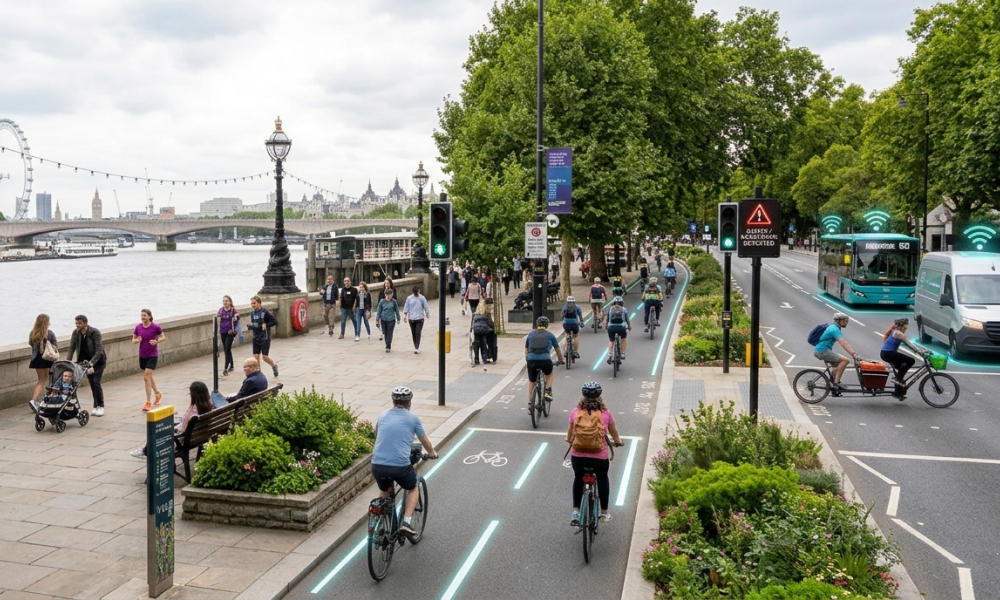
Road safety has always reflected the priorities of society. Over the past century, engineering, legislation, education and enforcement have combined to reduce casualties and make travel safer for millions of people. Today, another chapter is being written as connected technologies begin to reshape how roads, vehicles and infrastructure interact with one another. For advocates of Intelligent Transport Systems (ITS), the emergence of connected pedestrian and cyclist safety systems represents a significant opportunity to address some of the most persistent risks facing vulnerable road users. Yet while these technologies offer considerable promise, there is also a growing recognition that a systems-led approach cannot be viewed as a substitute for creating places that are inherently safer, more attractive and more intuitive for people to use.
The concept behind connected safety systems is relatively straightforward. Vehicles equipped with advanced sensors, communications technologies and processing capabilities can identify pedestrians and cyclists in their vicinity, predict potential conflicts and intervene where necessary. Infrastructure can also play a role, sharing information with vehicles and road users through roadside units, connected traffic signals and intelligent crossings. Together, these technologies create an ecosystem in which information moves continuously between users and the transport network, helping to prevent collisions before they occur.
Such systems are becoming increasingly sophisticated. Modern vehicles already incorporate cameras, radar and lidar technologies capable of identifying cyclists alongside moving traffic or pedestrians stepping into the carriageway. Cooperative Intelligent Transport Systems, often referred to as C-ITS, extend this capability further by allowing vehicles and infrastructure to exchange data directly. A cyclist approaching a junction, for example, could be detected by roadside systems that then warn an approaching driver or adjust signal timings to reduce conflict. Likewise, pedestrians using connected devices may eventually receive alerts when entering potentially hazardous situations.
From an ITS perspective, the advantages are compelling. Human beings remain prone to distraction, misjudgement and error. Connected systems offer the prospect of supplementing human awareness with machine intelligence that never tires, never looks away and can process information faster than any individual road user. For busy urban environments where interactions between vehicles, cyclists and pedestrians occur continuously, this additional layer of awareness has enormous potential.
Benefits extend beyond collision prevention. Better detection and monitoring of active travel users can provide transport authorities with valuable insights into travel patterns, enabling more responsive network management and investment decisions. Signalised junctions can be adapted dynamically to prioritise vulnerable road users during peak periods. Public confidence in walking and cycling may increase if people feel that the transport network is actively monitoring and protecting them. In turn, this can support wider policy objectives around decarbonisation, public health and sustainable mobility.
Despite these advantages, it would be a mistake to view connected safety systems as a complete solution to vulnerable road user safety. Technology is often most effective when addressing symptoms rather than underlying causes. Many of the risks faced by pedestrians and cyclists stem from decisions made long before any sensors or communications systems are introduced. Street layouts, road geometry, traffic volumes, vehicle speeds and land use patterns all influence safety outcomes, sometimes in ways that technology alone cannot fully mitigate.
Consider the example of a busy urban corridor where narrow footways, multiple traffic lanes and limited crossing opportunities create an intimidating environment for pedestrians. A connected warning system may reduce the likelihood of collisions, but it does not alter the fundamental experience of the street. People may still feel uncomfortable walking there. Older users, children and those with mobility impairments may continue to avoid the route altogether. Technology can help manage risk, but it cannot transform an inherently hostile environment into a welcoming public space.
Similar challenges arise for cyclists. A connected vehicle may successfully detect someone riding alongside it, yet the cyclist remains exposed if forced to share space with high-speed traffic on a poorly designed road. Separation, visibility and intuitive infrastructure often do more to improve safety and comfort than the addition of ever more sophisticated technological interventions. A rider's experience is shaped by the quality of the environment around them, not simply by the capabilities of nearby vehicles.
There is also the issue of systems dependency. Many connected safety concepts assume high levels of technology adoption across vehicles, infrastructure and, in some cases, personal devices. Real-world transport networks are rarely so uniform. Vehicle fleets turn over slowly. Infrastructure upgrades require substantial investment. Pedestrians and cyclists may not carry compatible devices or may choose not to engage with connected services. Benefits therefore emerge gradually and can be unevenly distributed, particularly during long transition periods when connected and non-connected users coexist.
Reliability presents another consideration. Technology can fail. Sensors may be obscured by adverse weather conditions. Communications links can be interrupted. Algorithms may misclassify objects or behave unpredictably in unusual circumstances. Although such systems continue to improve, no technology can currently guarantee perfect performance. A transport network that relies excessively on technological safeguards risks creating vulnerabilities if those safeguards are unavailable or ineffective.
Practical implementation therefore requires a balanced and layered approach. Connected safety systems should be viewed as part of a broader Safe System philosophy in which infrastructure, vehicles, road users and operational management all contribute to reducing risk. Investment in digital technologies should sit alongside physical improvements that make roads inherently safer for people walking and cycling.
Low-speed urban environments remain one of the most effective safety interventions available. Reducing vehicle speeds not only lowers collision severity but also creates conditions in which active travel becomes more attractive. Well-designed crossings, continuous footways, protected cycle tracks and clear route legibility can reduce conflict before technology becomes necessary. Junction designs that minimise crossing distances and improve visibility often provide immediate benefits that are understood intuitively by all users.
Reallocating street capacity is often one of the most challenging aspects of delivering meaningful improvements for vulnerable road users. Connected technologies can reduce risk within the existing highway environment, but they do little to address the underlying question of how limited urban space is allocated. Creating protected cycle infrastructure, wider footways, safer crossings and more attractive public spaces frequently requires difficult decisions about road space previously dedicated to general traffic lanes, parking or vehicle movements. Such measures can be politically contentious, particularly where concerns exist regarding congestion, access and economic impacts. Nevertheless, experience from towns and cities across Europe and beyond suggests that where street space is carefully rebalanced in favour of walking and cycling, safety, comfort and overall place quality can improve significantly. Technology may enhance these environments, but it cannot replace the need to make strategic decisions about how the street itself functions.
Place making has a particularly important role to play. Streets are not merely transport corridors. They are public spaces where social interaction, commerce and everyday life take place. Successful urban environments encourage walking and cycling because they feel comfortable, attractive and safe. Trees, seating, active frontages, appropriate lighting and high-quality public realm design all influence behaviour in ways that technology cannot replicate. A connected crossing may enable someone to cross the road more safely, but a pleasant and inviting street encourages them to make the journey in the first place.
This distinction is important because the ultimate objective is not simply to reduce collisions. Success should be measured by creating environments where active travel becomes a natural and desirable choice. Overreliance on technology risks narrowing the conversation to operational safety metrics alone, overlooking wider societal outcomes such as health, inclusion, accessibility and community wellbeing.
The future of vulnerable road user safety is therefore unlikely to be defined by a choice between digital systems and physical design. Instead, the greatest benefits will come from combining both approaches intelligently. Connected technologies can provide an additional layer of protection, improve situational awareness and support more responsive network management. Good place making can address the root causes of many safety concerns by creating environments that naturally reduce conflict and encourage positive behaviour.
As connected mobility continues to evolve, ITS professionals have an opportunity to champion this integrated perspective. Technology should enhance good design rather than compensate for its absence. Streets that are safe because they are well designed, supported by intelligent systems that help prevent mistakes when they occur, offer a far more compelling vision than either approach could achieve in isolation. Equally important is the willingness to create streets that prioritise people through thoughtful place making and, where appropriate, the reallocation of street capacity towards active travel modes rather than relying solely on technology to accommodate existing traffic patterns. For pedestrians and cyclists, that combination may ultimately prove to be the most important connection of all.
Click the buttons below to see more articles:
See all ArticlesIndustry InsightEventsITS Thought LeadershipITS Educational