
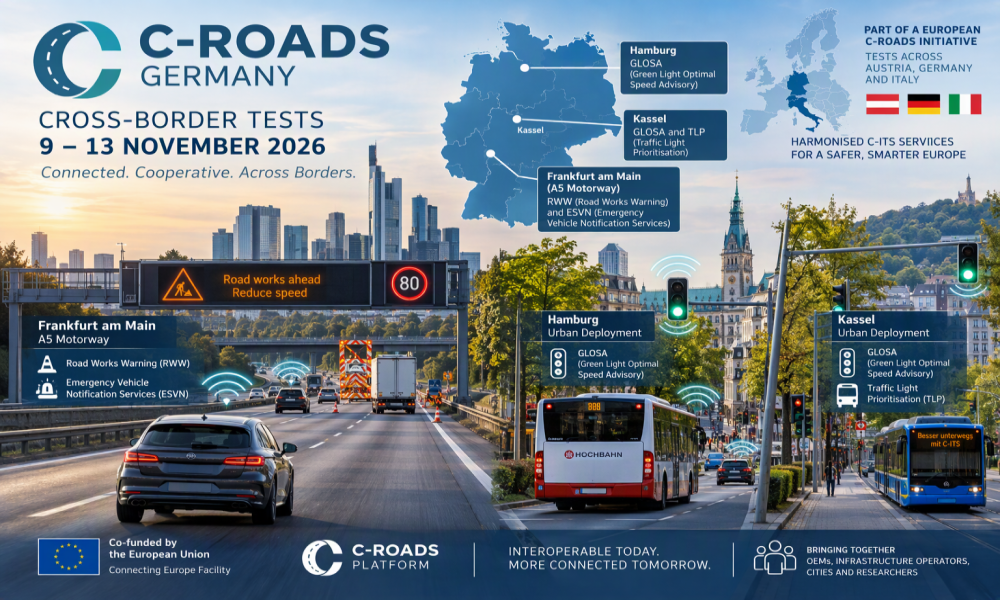
The promise of connected mobility has always rested on a deceptively simple principle. Information must flow seamlessly between vehicles, infrastructure and traffic management systems, regardless of who built them, who operates them, or which side of a national border they happen to be on. While significant progress has been made in developing Cooperative Intelligent Transport Systems (C-ITS) across Europe, the real measure of success lies not in laboratory demonstrations or pilot deployments, but in proving that these technologies can function reliably in complex, real-world conditions.
That challenge moves firmly into the spotlight this week with the official commencement of the C-Roads Germany Cross-Border Tests, running from 9 to 13 November 2026. Bringing together automotive manufacturers, infrastructure operators and technical research organisations from across Europe, the initiative represents one of the most important interoperability exercises currently taking place within the connected mobility ecosystem. At its heart, the programme is focused on validating harmonised, multi-vendor C-ITS services under live operational conditions. This may sound like a technical undertaking, yet its implications extend far beyond engineering verification. Successful interoperability is fundamental to the future deployment of connected and automated mobility, ensuring that vehicles can receive consistent, trustworthy and actionable information wherever they travel.
For many years, one of the principal concerns surrounding connected vehicle deployment has been the potential for fragmentation. Different manufacturers, software providers, infrastructure operators and communications platforms have all evolved at slightly different speeds, creating a risk that services could operate effectively within individual environments while struggling to communicate across networks. The C-Roads initiative has been established specifically to address these concerns, providing a framework through which common standards and operational procedures can be tested, refined and validated.
This week's activities demonstrate how far Europe has progressed in moving from isolated deployments towards a genuinely integrated connected transport environment. Among the most significant test locations is the A5 motorway corridor near Frankfurt am Main, where teams are concentrating on high-speed motorway operations. Motorways represent one of the most valuable environments for cooperative systems because of the speeds involved and the importance of timely information delivery. Several use cases are under active evaluation, including Road Works Warning services and Emergency Vehicle Notification Services. Both applications illustrate the practical benefits that C-ITS can deliver for drivers and road operators alike.
Road Works Warning systems provide advance notification of maintenance activities, lane restrictions and temporary traffic management measures. By communicating this information directly to connected vehicles, the system can provide earlier awareness than conventional roadside signage alone. Drivers receive timely alerts that allow them to prepare for changing conditions, while automated driving systems gain access to additional information that can support safer operational decisions.
Equally important are Emergency Vehicle Notification Services, which enable approaching emergency vehicles to communicate their presence to surrounding traffic. In busy motorway environments, particularly where traffic density is high or visibility is limited, advance notification can help create safer conditions for emergency response teams and reduce delays caused by uncertainty among motorists. Although these applications are often described individually, their true value emerges when they operate as part of an integrated ecosystem. Every successful interaction reinforces confidence that connected infrastructure and connected vehicles are capable of sharing critical information accurately, consistently and within the stringent timing requirements demanded by road transport operations. While motorway testing captures attention because of its scale and speed, the urban deployments taking place in Hamburg and Kassel may prove equally significant from a mobility perspective.
Cities present a far more complex environment for connected systems. Multiple transport modes interact continuously, signalised junctions must balance competing priorities and traffic conditions can change rapidly throughout the day. Introducing connected services into this environment requires careful coordination between vehicles, public transport operators and municipal traffic management systems. The focus in these locations centres on Green Light Optimal Speed Advisory, commonly known as GLOSA, and Traffic Light Prioritisation services. Both technologies seek to improve the relationship between vehicles and traffic signals, creating a more intelligent and responsive transport network. GLOSA provides drivers with speed recommendations designed to help them approach intersections during favourable signal phases. Rather than accelerating towards a red light and stopping unnecessarily, drivers can adjust their speed smoothly to pass through the junction more efficiently. The benefits extend beyond convenience. Reduced stop-start driving can lower fuel consumption, decrease vehicle emissions and contribute to a more comfortable driving experience.
Traffic Light Prioritisation addresses another critical challenge, particularly for public transport services. By enabling buses and other authorised vehicles to communicate directly with signal control systems, valuable seconds can be saved at key intersections, improving service reliability and journey time predictability. When deployed effectively, these capabilities support broader urban mobility goals by making public transport more attractive and competitive.
What makes the current testing particularly noteworthy is the emphasis on validating these functions within existing municipal signal control hierarchies. Urban traffic networks have evolved over many years and incorporate complex operational priorities. Connected vehicle services must integrate into these established systems without compromising network performance or safety. Demonstrating that such integration can be achieved consistently is an essential step towards large-scale deployment.
Beyond the individual applications being tested, the wider significance of the C-Roads programme lies in its contribution to confidence building across the industry. Transport authorities, vehicle manufacturers and mobility service providers all recognise the potential benefits of connectivity, yet widespread deployment depends on trust. Stakeholders must be confident that systems developed by different organisations can interact seamlessly and reliably under operational conditions. That issue becomes even more important as artificial intelligence assumes a growing role within transport management and mobility services. AI-based applications increasingly rely on high-quality, real-time data streams to support predictive traffic management, network optimisation and operational decision making. Interoperable connected vehicle ecosystems provide exactly the kind of rich, trusted data environment these applications require. Accurate traffic projections, dynamic network modelling and intelligent incident response systems all benefit when data can flow freely across organisational and geographical boundaries. In many respects, the work taking place this week can be viewed as foundational preparation for the next generation of AI-enabled mobility services.
Looking ahead, the lessons emerging from Frankfurt, Hamburg and Kassel will extend well beyond Germany. As vehicles routinely travel across regional and national borders, the ability to maintain service continuity becomes a defining requirement for future mobility systems. Drivers should not need to consider whether a connected safety warning originated from one supplier or another, nor whether a particular service functions only within a specific jurisdiction. The ultimate objective is a transport environment where interoperability becomes invisible because it simply works. That vision remains ambitious, but initiatives such as the C-Roads Germany Cross-Border Tests demonstrate that the sector is steadily moving in the right direction. Rather than focusing solely on technological innovation, the programme highlights the importance of collaboration, harmonisation and operational validation.
For the ITS community, this week's activities represent far more than a series of technical demonstrations. They provide tangible evidence that Europe continues to build the foundations for a connected, cooperative and increasingly intelligent mobility ecosystem, one capable of supporting safer roads, more efficient transport networks and the data-driven services that will shape the future of mobility.
Click the buttons below to see more articles:
See all ArticlesIndustry InsightEventsITS Thought LeadershipITS Educational