
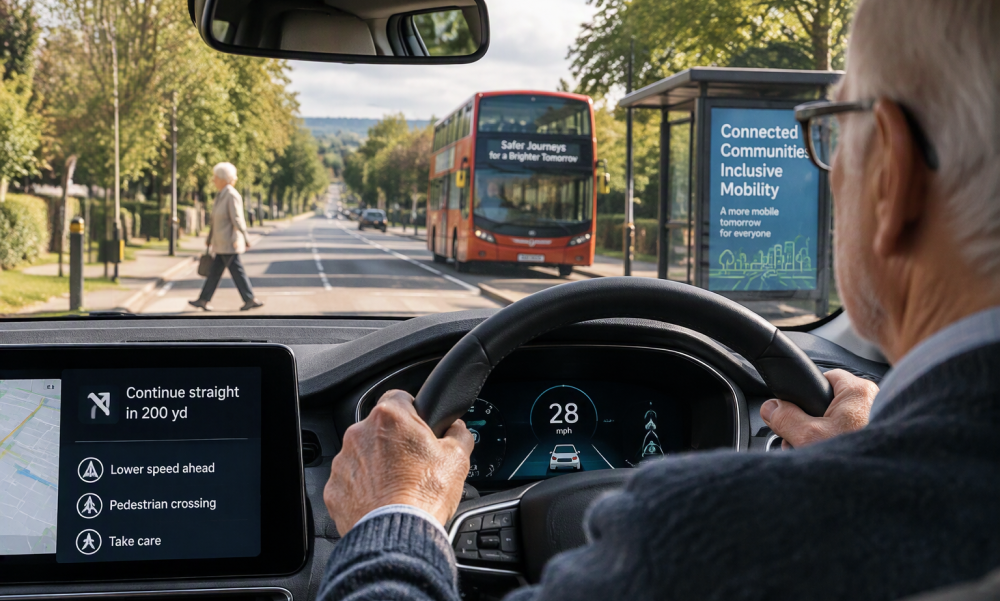
As populations age across much of the developed world, transport planners and technology providers are facing a challenge that is becoming impossible to ignore. Older people now represent one of the fastest-growing groups of road users, yet much of the transport technology deployed over recent decades has been designed with a different audience in mind. Digital natives may adapt quickly to changing interfaces, connected services and app-based mobility, but for many older road users the pace of technological change can create barriers as readily as benefits. This presents a significant question for the Intelligent Transport Systems sector. How can technology be designed not simply for efficiency, connectivity and automation, but for accessibility, confidence and independence?
The answer begins with recognising that older road users are not a specialist group sitting at the margins of transport policy. They are increasingly representative of the populations that transport systems serve. Many continue driving well beyond retirement age, while others depend upon public transport, community transport schemes, walking, cycling or emerging shared mobility services. Maintaining mobility is not merely a transport objective. It is closely linked to health, wellbeing, social inclusion and economic participation. A loss of mobility frequently creates a cascade of wider challenges, limiting access to healthcare, reducing opportunities for social interaction and increasing isolation. Against that backdrop, the role of ITS extends well beyond traffic management and network performance. Intelligent technologies have the potential to help people remain active, connected and independent for longer, provided those technologies are designed with real users in mind.
Much of the challenge stems from the assumptions that frequently underpin transport technology development. Physical changes associated with ageing, such as declining eyesight, reduced hearing sensitivity, slower reaction times and decreased dexterity, can all influence how individuals interact with infrastructure, vehicles and digital systems. Cognitive changes may also affect how quickly information can be processed, particularly within complex or unfamiliar environments where multiple decisions must be made simultaneously. Technology cannot prevent these changes from occurring, but it can be designed to accommodate them. Some of the most effective interventions are often the simplest. Clearer information displays, larger text sizes, stronger colour contrast and intuitive iconography can dramatically improve usability. Variable message signs, journey information systems and in-vehicle alerts are now commonplace across many transport networks, yet their effectiveness depends entirely upon users being able to understand and act on the information being presented.
Practical examples already demonstrate what good inclusive design looks like. Transport for London has continued to enhance its real-time passenger information systems, providing clear and predictable information that helps passengers make decisions with confidence and reduces uncertainty during journeys. Across parts of Scandinavia, pedestrian crossings have been designed with longer crossing periods and more responsive push-button systems that recognise the needs of older and less mobile users. In the Netherlands, where the interaction between transport planning and demographic change has received increasing attention, road layouts, signal timings and urban design approaches are being adapted to support an ageing population while maintaining efficiency for all road users. These interventions may appear modest, yet their impact can be profound. A road sign that is easier for a seventy-five-year-old driver to read is invariably easier for every driver to understand. A crossing that provides sufficient time for somebody walking more slowly creates a safer environment for families, visitors and people with temporary mobility impairments. Inclusive design therefore becomes not a specialist discipline but a route towards improving the overall user experience.
This principle becomes even more important as transport services continue their digital transformation. Journey planning applications, integrated ticketing platforms and demand responsive transport systems offer considerable opportunities to improve convenience and flexibility. At the same time, they risk creating new forms of exclusion if accessibility is not prioritised from the outset. Many modern mobility services assume a level of digital confidence that cannot be taken for granted. Booking a journey through a smartphone app may appear straightforward to some users but can place the service entirely beyond the reach of others. Several UK demand responsive transport schemes have recognised this challenge by retaining telephone booking channels alongside their digital platforms, ensuring that access to mobility is not dependent on smartphone ownership or digital literacy. This dual approach acknowledges an important reality. Innovation should expand access rather than create a new barrier to participation. Creating a genuinely inclusive mobility ecosystem therefore requires retaining alternatives. Telephone booking services, simplified user interfaces and accessible customer support channels remain essential components of the transport system rather than temporary transitional measures.
Connected and automated vehicle technologies present another area where the needs of older road users deserve greater attention. Advanced driver assistance systems such as lane keeping support, collision warning systems, blind spot detection and intelligent speed assistance offer considerable potential to improve safety. For many drivers, these technologies can provide reassurance and help compensate for some of the natural changes that occur with age. Research has consistently highlighted the value of features such as blind spot monitoring and rear cross-traffic alerts for drivers whose neck mobility or peripheral awareness may be reduced. Vehicle manufacturers are increasingly recognising that one size does not fit all, introducing the ability to tailor alert volumes, display layouts and warning settings to individual preferences. The result may be greater confidence behind the wheel and an extended period of safe independent driving. Success, however, is not guaranteed simply because the technology exists. Poorly designed interfaces, excessive alerts or inconsistent system behaviour can undermine trust and create frustration. Some users choose to disable safety features altogether if they perceive them to be intrusive or difficult to understand. Achieving the intended benefits therefore requires equal attention to human factors, usability and education alongside technical performance.
Trust emerges as one of the defining themes in the relationship between older people and transport technology. Popular assumptions sometimes portray older users as resistant to innovation, yet the reality is frequently far more nuanced. Many embrace new technologies when the benefits are clear and the systems are straightforward to use. Reluctance often arises not from the technology itself but from uncertainty surrounding how it operates or concerns about losing control. Building trust requires transparency. Systems must communicate clearly, behave predictably and make users feel confident that they remain in charge of decisions affecting their journey. This consideration becomes particularly important as artificial intelligence begins to play a greater role within transport systems. AI-powered mobility assistants, personalised journey planning tools and increasingly sophisticated vehicle automation could transform mobility for older people. Future systems may tailor routes according to individual needs, avoid stressful traffic conditions, adapt information presentation to suit user preferences and ultimately provide new mobility opportunities for those who are no longer able to drive. Yet such benefits will only be realised if the technologies remain understandable and accessible to the people expected to use them.
Beyond the vehicle itself, intelligent infrastructure can also make a meaningful contribution. Smart pedestrian crossings capable of adapting crossing times, connected infrastructure that improves situational awareness and intelligent traffic signals that respond dynamically to user needs all offer opportunities to create safer and more accommodating environments. Some pedestrian detection systems are already capable of identifying when a crossing user requires additional time and automatically extending the pedestrian phase, alleviating the pressure that many older pedestrians experience when crossing busy roads. The UK’s widely installed PUFFIN style signalised crossings are equipped with detection equipment which will automatically extend the crossing period if users are taking longer to cross. This operation is invisible to users and doesn’t rely on them having special apps or concession cards to activate an extended period for the crossing. This type of responsive operation will therefore work for any user that needs longer to cross, including children, wheelchair users and people with temporary mobility impairments. Looking ahead, connected vehicle-to-infrastructure systems could develop this concept further, enabling vehicles and roadside equipment to work together to improve awareness of vulnerable road users and reduce collision risks at complex junctions.
Behind many of these developments sits an increasingly sophisticated use of data. Understanding travel patterns, identifying locations where difficulties occur and evaluating the effectiveness of interventions can help transport authorities make better-informed decisions. Data-driven insights will undoubtedly play a vital role in designing future transport systems for ageing populations. Nevertheless, collecting data must be balanced with appropriate safeguards around privacy, transparency and public trust. Users need confidence not only in the services they interact with but also in how their information is handled.
Perhaps the most important lesson for the ITS sector is that designing for older road users should never be viewed as an afterthought. Too often, engagement occurs late in the development process, once key decisions have already been made. Genuine inclusive design begins much earlier. Involving older people throughout planning, development, testing and evaluation provides insights that cannot be replicated through modelling or technical analysis alone. Co-design approaches are increasingly demonstrating their value, helping identify barriers that may otherwise go unnoticed and producing solutions grounded in real-world experience. As societies continue to age across Europe and beyond, transport systems that fail to reflect these demographic realities risk becoming progressively disconnected from the communities they serve.
Designing ITS for older road users is therefore not about creating a separate transport system for a particular demographic. It is about creating a better transport system for everyone. By combining intelligent technologies with inclusive design principles and a genuine understanding of user needs, the sector has an opportunity to deliver mobility that remains accessible, intuitive and empowering throughout every stage of life. The most successful ITS deployments will not necessarily be those showcasing the most advanced technology. Rather, they will be the schemes that use technology thoughtfully to help people travel safely, confidently and independently for longer. In an ageing society, that may prove to be one of the most important measures of success.
Click the buttons below to see more articles:
See all ArticlesIndustry InsightEventsITS Thought LeadershipITS Educational