150x150.png)
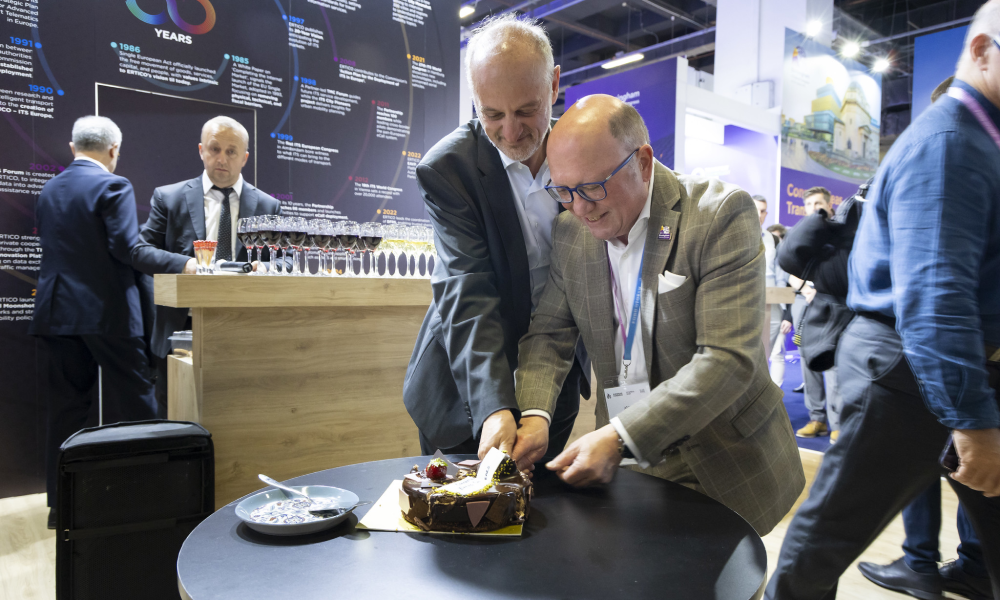
Alistair Gollop sat down with Joost Vantomme, CEO of ERTICO, during the organisation’s 35th anniversary year to discuss progress in 2026 and the wider direction of intelligent transport. What emerged was less a conventional question-and-answer review than a reflection on a sector moving from ambition into delivery, and on the role collaboration must play if intelligent mobility is to make a visible difference to everyday journeys.
For Vantomme, the anniversary is a moment to acknowledge the distance travelled, but not simply to look back. “Celebrating 35 years of ERTICO is more than marking an anniversary; it is celebrating 35 years of collaboration, innovation and shared commitment to transforming mobility across Europe and beyond. ERTICO's success has always been built on the strength of its public-private partnership, bringing together industry, public authorities, research and users to turn ideas into real-world deployment.” As mobility is reshaped by artificial intelligence, connectivity, automation, climate targets and new user expectations, he sees ERTICO’s legacy as both credibility and responsibility: to keep shaping trusted, human-centric and sustainable transport systems.
The first half of 2026 has reinforced that view. The annual partner gathering in June was both a celebration and a working session, reminding participants that intelligent transport is no longer judged only by promising pilots or emerging technologies. It is increasingly judged by whether those technologies can be deployed safely, scaled effectively and trusted by the people and organisations that depend on them.
That sense of common purpose was visible at the ITS European Congress in Istanbul, which Vantomme describes as one of the clearest signs of momentum this year. Istanbul was a fitting stage: a city connecting continents and reflecting many of the pressures facing modern transport systems. The Congress brought the international community together around a shared challenge: how to turn innovation into systems that work reliably in the real world.
The message he took from Istanbul was not that the sector lacks ideas, but that ideas now need to be organised around impact. Data sharing, artificial intelligence, automated driving, smart charging, urban logistics and connected infrastructure are all advancing quickly. Their value, however, depends on how they are governed, integrated and understood. The aim must be safer journeys, cleaner mobility, better use of infrastructure, more efficient freight movement and services shaped by citizens’ needs rather than technological novelty.
This is why Vantomme returns repeatedly to public-private partnership. Recent months have broadened expertise across shared mobility, digital transport, AI, parking, infrastructure and public-sector innovation. He sees strength not simply in the number of organisations involved, but in the way their perspectives can be connected. A city access policy, a charging strategy, an automated vehicle trial and a mobility data space may appear to belong to different domains, yet each depends on trusted data, clear governance, interoperable systems and user acceptance.
Policy is also moving closer to deployment. Vantomme points to the need for a stronger European funding framework for transport, both to protect competitiveness and to advance climate neutrality and digital sovereignty. Dedicated investment in intelligent transport infrastructure, research and deployment will be essential if Europe is to close the gap between promising concepts and widespread implementation. The same applies to connected and automated vehicles, where work on software-defined vehicles, data, AI and cross-border testing is helping to shape a more coherent industrial roadmap.
As regulation evolves, speed must be matched by care. AI can support safer traffic management, more efficient logistics and better traveller information, but public trust will depend on systems that are transparent, proportionate and secure. The same is true for automated mobility. Technical readiness is only one part of the equation; deployment also needs operational evidence, clarity around responsibility and acceptance from the communities that will experience these systems first hand.
Urban mobility remains one of the hardest tests. Cities must manage limited space, competing demands, environmental targets, economic pressures and the daily need to keep people and goods moving. Work on city access, smart charging, demand response and automated parking shows how digital systems can support more efficient and liveable urban environments. Yet Vantomme’s point is that technology cannot be separated from behaviour, governance or local reality. Successful deployment must fit the street as well as the strategy.
The conversation also ranged beyond Europe. Vantomme sees the global agenda expanding as national ITS communities and international events exchange lessons about resilience, safety and digital transformation. Climate events, cyber risk, ageing infrastructure, skills shortages and shifting travel behaviour all demand new forms of preparedness. Intelligent transport has a vital role not only in optimising networks during normal operation, but also in helping them anticipate, absorb and recover from disruption.
At project level, the first half of the year has brought both new beginnings and completed work across clean mobility, logistics, road safety, automated transport, inclusive public spaces, data exchange, charging, simulation and connected infrastructure. For Vantomme, the common thread is capability. The most valuable projects move beyond research outputs and leave behind methods, tools, evidence and partnerships that others can use.
Data is one of the clearest examples of this transition. Mobility data spaces, road safety data sharing and connected vehicle information are becoming central to the way transport systems are managed. Better information can help prevent incidents, improve traffic flow, support cleaner choices and make services more responsive. But data only creates public value when it is trusted, usable and shared under rules that protect the public interest.
The same applies to artificial intelligence. The sector is moving beyond broad enthusiasm towards practical questions: where AI can genuinely improve safety or efficiency, how systems can be validated, how responsibilities should be allocated and how citizens can understand decisions that affect their journeys. Vantomme argues that thought leadership is essential because transport is a public system, even when many of its components are privately developed.
Looking ahead, the international calendar will keep that momentum alive. The next World Congress in South Korea will place automated driving, smart infrastructure and data-centric systems in the spotlight, while preparations for Birmingham in 2027 are already gathering pace. Vantomme sees Birmingham as an opportunity to demonstrate how intelligent transport can support human-centred mobility, sustainability, breakthrough technologies and business innovation.
There is a useful discipline in this shift from ambition to delivery. In Vantomme’s framing, the sector must ask what changes for the user, the operator, the city and the wider economy. Does a system make travel safer? Does it reduce emissions? Does it help freight move more efficiently? Does it improve access for people who are too often overlooked? Does it strengthen public services and support competitiveness? These questions are likely to define the next decade of intelligent mobility.
After 35 years, collaboration is not diminishing in importance. If anything, Vantomme believes it is becoming more central. Intelligent mobility is now shaped by software, energy, telecommunications, public policy, infrastructure, behavioural change and new business models. The boundaries of the sector have widened, and so has the need for a shared language that allows different organisations to align around practical outcomes while bringing their own expertise and priorities.
The first half of 2026 has therefore been more than a busy period of meetings, projects and events. Seen through Vantomme’s perspective, it has demonstrated a sector entering a more mature phase. The foundations built over decades are now being tested in real-world conditions, and the direction is clear: Europe’s mobility ecosystem must become more connected, resilient, inclusive and capable of turning innovation into everyday benefit.
As the anniversary year continues, the central message is not nostalgia, but responsibility. ERTICO’s 35th anniversary arrives when intelligent transport has the tools, experience and partnerships to shape tomorrow’s mobility systems. The task now is to keep moving from shared ambition to concrete delivery, ensuring that digital and intelligent transport solutions improve lives, strengthen economies and support a safer, cleaner and more connected future.
Click the buttons below to see more articles:
See all ArticlesIndustry InsightEventsITS Thought LeadershipITS Educational