
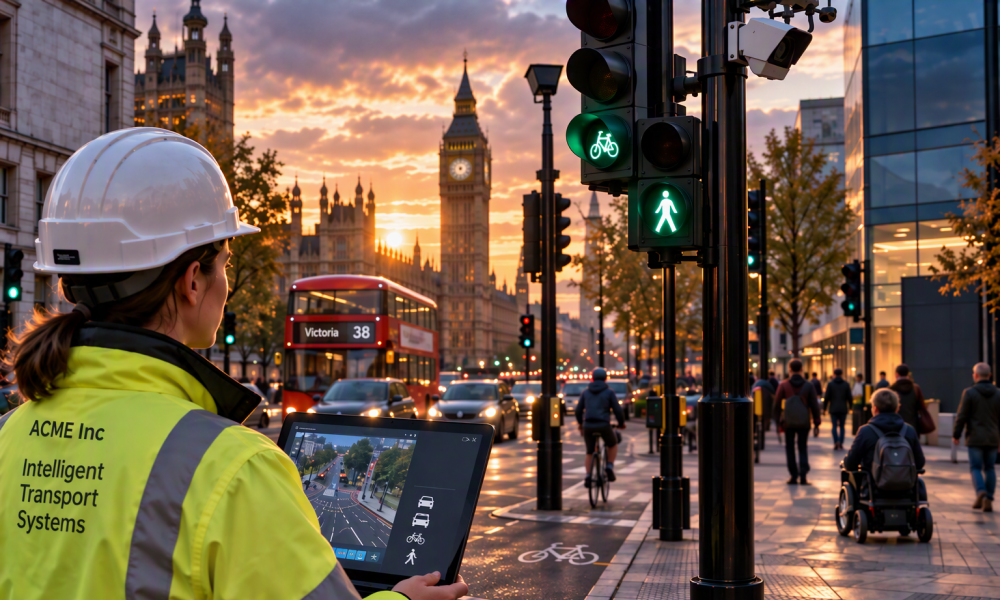
Traffic signals are among the most visible pieces of transport technology in our towns and cities, yet their complexity is often overlooked. To the average road user, a set of signals may appear to be little more than red, amber and green lights controlling the flow of traffic. Behind every junction, however, sits a carefully balanced combination of engineering judgement, technical expertise, human factors and increasingly sophisticated intelligent transport systems. The best traffic signal engineers understand that their role extends far beyond simply managing vehicle movements. They are responsible for creating safe, efficient and accessible spaces that work for everyone.
At first glance, the profession appears highly specialised. Traffic signal engineers must develop an in-depth understanding of traffic signal controllers, detection technologies, communications systems and software platforms. Modern junctions often incorporate equipment from multiple manufacturers, each with their own operating philosophies, capabilities and limitations. A good engineer must be comfortable working across different controller families, understanding how each can be configured, optimised and integrated into wider network management systems.
Technical knowledge forms the essential foundation. Signal engineers must understand not only how equipment works, but also where it works best. Above-ground detection technologies such as radar, thermal imaging and video analytics each offer distinct advantages. Radar may provide reliable performance in adverse weather conditions, while video detection can offer richer data and flexibility. Thermal technologies may be particularly useful in challenging lighting environments. Selecting the right technology requires more than an understanding of equipment specifications. It demands an appreciation of the location, traffic conditions, maintenance implications and long-term operational requirements.
The rise of connected and intelligent transport systems has further expanded these responsibilities. Signal engineers are increasingly expected to understand how traffic signals fit within wider urban mobility networks. Junctions no longer operate as isolated assets. They form part of integrated systems that may include adaptive traffic control, bus priority, cycle detection, connected vehicle services and real-time traffic management platforms. Achieving the best outcomes requires engineers who can think beyond individual junctions and understand network-wide impacts.
Technical competence alone, however, is not enough. A great traffic signal engineer develops a deep understanding of how people move through transport networks. Vehicles may be the most visible users of the road, but they represent only one part of a much larger picture. Pedestrians, cyclists, mobility scooter users, wheelchair users, public transport passengers and freight operators all have different needs and expectations.
This is where engineering becomes both a science and an art. Signal timing decisions that improve vehicle capacity may create difficulties for pedestrians. Reducing waiting times for one user group can increase delays elsewhere. Providing dedicated facilities for cyclists may affect junction capacity. Every decision involves compromise, and the best engineers understand how to balance competing priorities.
Accessibility represents a particularly important consideration. Engineers must appreciate the needs of people with mobility impairments, visual impairments and other accessibility challenges. Features such as tactile paving, audible crossing signals, rotating cones and appropriately designed crossing times are essential components of inclusive mobility. Designing effective signal-controlled crossings means understanding real-world human behaviour rather than relying solely on theoretical traffic models.
Successful traffic signal engineering also requires an appreciation of road safety principles. Collisions often occur where different movements intersect or where driver expectations do not align with road layouts. Signal engineers must understand how junction design, staging arrangements, inter-green periods and visibility can influence safety outcomes. Knowledge of collision investigation and road safety auditing provides valuable insight into how infrastructure can be improved to reduce risk.
Perhaps one of the most underestimated aspects of the profession is the need to collaborate across multiple engineering disciplines. Traffic signal engineers rarely work in isolation. Every project involves interaction with highways designers, transport planners, civil engineers, structural engineers, electrical engineers and network managers.
Transport planners may focus on broader mobility objectives such as mode shift, development impacts or public transport accessibility. Highways designers concentrate on geometric layouts, lane arrangements and road geometry. Civil engineers must consider drainage, construction requirements and physical constraints. Structural engineers become involved where signals are mounted on large gantries, bespoke structures or complex urban installations.
A good traffic signal engineer understands enough about each discipline to contribute meaningfully to discussions while recognising their own specialist role within the wider delivery team. This interdisciplinary awareness often separates competent practitioners from exceptional ones. Rather than viewing projects solely through the lens of signal control, the best engineers consider the wider engineering context and seek solutions that benefit the overall scheme.
Knowledge of underground infrastructure presents another critical requirement. Urban environments are crowded with statutory undertakers' equipment, including utilities for electricity, gas, water, telecommunications and fibre networks. Installing signal equipment frequently involves navigating these constraints. Detector loops, signal poles, feeder pillars and communication ducts all require careful coordination.
An engineer who fails to consider buried services may develop technically elegant designs that prove impossible or prohibitively expensive to construct. Understanding utility constraints, wayleave requirements and construction implications therefore becomes just as important as understanding signal phasing or controller configurations.
The increasing use of digital technologies has added yet another layer of complexity. Signal engineers must now engage with data analytics, remote monitoring platforms and performance management tools. Modern traffic management increasingly relies on evidence-based decision making, with engineers expected to analyse traffic flows, review performance metrics and identify opportunities for optimisation.
The ability to interpret data effectively is becoming a defining characteristic of the profession. Large volumes of information are now available from detectors, connected vehicles, journey time systems and network management platforms. The challenge lies not in obtaining the data but in transforming it into actionable insight. Strong analytical skills allow engineers to identify inefficiencies, understand emerging trends and deliver meaningful improvements.
Communication skills are equally important. Traffic signal engineers frequently engage with stakeholders who may have little technical knowledge. Residents, elected members, developers and members of the public often judge schemes based on their personal experience rather than engineering data. Explaining complex technical decisions in clear and accessible language becomes essential.
Strong communication also supports collaboration within project teams. Engineers must articulate risks, justify design decisions and build consensus among professionals with different priorities. Technical brilliance alone rarely guarantees successful project delivery.
Looking ahead, the role will continue to evolve as mobility technologies advance. Automated vehicles, connected infrastructure, artificial intelligence and increasingly sophisticated traffic management systems will create new opportunities and challenges. Future signal engineers will need to remain adaptable, continuously expanding their knowledge as technologies mature and transport systems become more interconnected.
Ultimately, what makes a good traffic signal engineer is not mastery of a single technology or discipline. It is the ability to bring together technical expertise, operational understanding, human factors, accessibility, safety and systems thinking. The best practitioners combine detailed knowledge of controllers, detection technologies and traffic behaviour with a broader appreciation of transport planning, infrastructure design and urban mobility.
Traffic signals sit at the intersection of technology, engineering and human movement. Managing that intersection successfully requires professionals who can see both the smallest technical detail and the bigger picture. In an era where intelligent transport systems play an increasingly important role in shaping mobility, the traffic signal engineer has become far more than a junction designer. They are a systems integrator, a problem solver and, increasingly, an architect of how people and goods move through modern society.
Click the buttons below to see more articles:
See all ArticlesIndustry InsightEventsITS Thought LeadershipITS Educational