150x150.png)
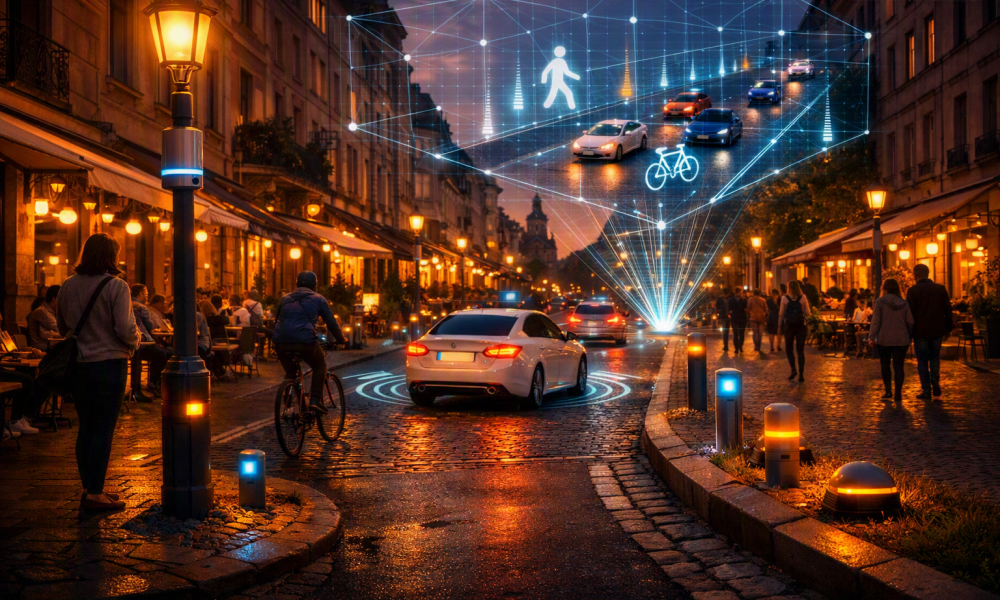
Highways have always been physical things. They are poured, rolled, compacted and surfaced. They are inspected, repaired and renewed. They are shaped by geography, weather, politics and budgets. Yet the next great shift in mobility is quietly transforming them into something else. Roads are becoming digital environments. Every metre is becoming a data point. Every journey is becoming a source of insight. The sensorisation of highways is no longer a speculative idea. It is emerging through connected vehicles, intelligent infrastructure and the growing need to provide assurance to automated systems. The question is not whether roads will become data rich. The question is how far this transformation will go and what it will mean for the future of mobility.
The idea of a fully sensorised highway has hovered around the ITS sector for decades. Early visions imagined corridors lined with embedded sensors, roadside units and fibre networks. They imagined infrastructure that could see, hear and interpret movement. They imagined a network that could understand its own condition and respond to events with intelligence. Those visions were ambitious, expensive and often unrealistic. Yet they captured a truth that is now becoming unavoidable. Highways will need to understand what is happening on them if they are to support connected and automated vehicles. They will need to provide assurance. They will need to provide context. They will need to provide trust.
However, the arrival of connected vehicles changes the equation. Instead of building sensors into every metre of road, the vehicles themselves become the sensors. They report speed, braking, traction, location, hazard perception and environmental conditions. They share information about congestion, incidents and near misses. They provide a moving, distributed sensing network that covers the entire corridor. A road equipped with connected vehicles is already sensorised. It already sees. It already listens. It already understands. The infrastructure does not need to be saturated with hardware because the vehicles provide the data.
This shift is profound. It means sensorisation is not a construction project. It is a data ecosystem. It is a relationship between vehicles, infrastructure and operators. It is a flow of information that moves constantly and adapts to conditions. It is a network that becomes more intelligent as more vehicles participate. It is a system that grows organically rather than through large capital programmes. The sensorisation of highways is happening because connected vehicles are already here and already sharing data.
Yet connected vehicles alone cannot provide complete assurance. Automated vehicles will need more than vehicle generated data. They will need infrastructure that confirms what they see. They will need signals that broadcast phase information. They will need roadside units that provide hazard alerts. They will need digital twins that interpret network behaviour. They will need verification that the environment is safe, predictable and understood. Assurance is not a luxury. It is a requirement. Automated vehicles cannot rely solely on their own sensors because those sensors have limits. They cannot rely solely on other vehicles because those vehicles may not be present. They need infrastructure that participates in the sensing process.
This is where sensorisation becomes more complex. Roads will need to provide data that vehicles cannot. They will need to detect vulnerable users who are not connected. They will need to monitor weather impacts that affect surface conditions. They will need to understand structural health, drainage performance and environmental change. They will need to provide information about temporary works, lane closures and emergency activity. They will need to offer a baseline of situational awareness that supports automated decision making. This baseline cannot come only from vehicles. It must come from the infrastructure itself.
The challenge is to determine how much sensing is necessary. Full sensorisation of every metre of highway is unlikely. Although sensing technologies are getting smaller and lighter, and require less power or communications infrastructure, it would still be expensive, intrusive and difficult to maintain. Yet selective sensorisation is already happening.
These systems provide assurance where it matters most. They create pockets of intelligence that support both operators and vehicles. They form the backbone of a wider sensing network that does not need to be continuous to be effective.
The future will be shaped by the interaction between connected vehicles and intelligent infrastructure. Vehicles will provide granular, real time data across the entire network. Infrastructure will provide targeted, high value sensing where vehicles cannot. Together they will create a hybrid sensing environment that is richer than either could achieve alone. This environment will allow roads to understand conditions with clarity. It will allow operators to manage incidents with precision. It will allow automated vehicles to behave safely and confidently. It will allow cities to plan corridors that support resilience, sustainability and human centred design.
On a motorway in the near future, thousands of connected vehicles move along it, each reporting speed, braking and environmental conditions. A sudden patch of heavy rain reduces grip. Vehicles detect traction loss and share the information instantly. The infrastructure receives the data and adjusts variable speed limits. Operators receive alerts and monitor conditions through a digital twin. Automated vehicles receive guidance that helps them navigate safely. The road behaves with intelligence because it is sensorised through both vehicles and infrastructure.
In a busy urban corridor, pedestrians cross at a junction equipped with intelligent sensors. Cyclists approach from a side street. A bus arrives slightly behind schedule. Connected vehicles report their trajectories. Infrastructure detects vulnerable users. Signals adjust timings to support safe movement. Automated vehicles receive cooperative messages that help them navigate the junction. The corridor behaves with clarity because sensorisation provides shared awareness.
Picture a long term planning exercise. Engineers use data from connected vehicles and infrastructure sensors to understand how the network behaves. They analyse flow patterns, climate impacts and safety trends. They simulate future scenarios through digital twins. They design corridors that support cooperative mobility, climate resilience and automated systems. Sensorisation becomes a tool for strategic planning rather than just operational management.
The sensorisation of highways will not be uniform. It will not be symmetrical. It will not be complete. Yet it will be transformative. Roads will become digital environments that understand their own behaviour. Vehicles will become sensing platforms that enrich the network. Infrastructure will provide assurance that supports automation. Operators will gain clarity that improves safety and efficiency. Cities will gain insight that shapes future mobility.
The question of whether every metre of road will become a data point is almost beside the point. The network will be sensorised through a combination of vehicle data, infrastructure sensing and digital modelling. The exact distribution of sensors will vary. The level of detail will depend on context. The purpose will remain constant. Roads will need to understand what is happening on them. They will need to provide assurance. They will need to support connected and automated mobility.
Sensorisation is not a technological ambition. It is a practical necessity. It is emerging because the future of mobility demands it. It is becoming part of the fabric of highways. It is shaping the next chapter of ITS.
Click the buttons below to see more articles:
See all ArticlesIndustry InsightEventsITS Thought LeadershipITS Educational