
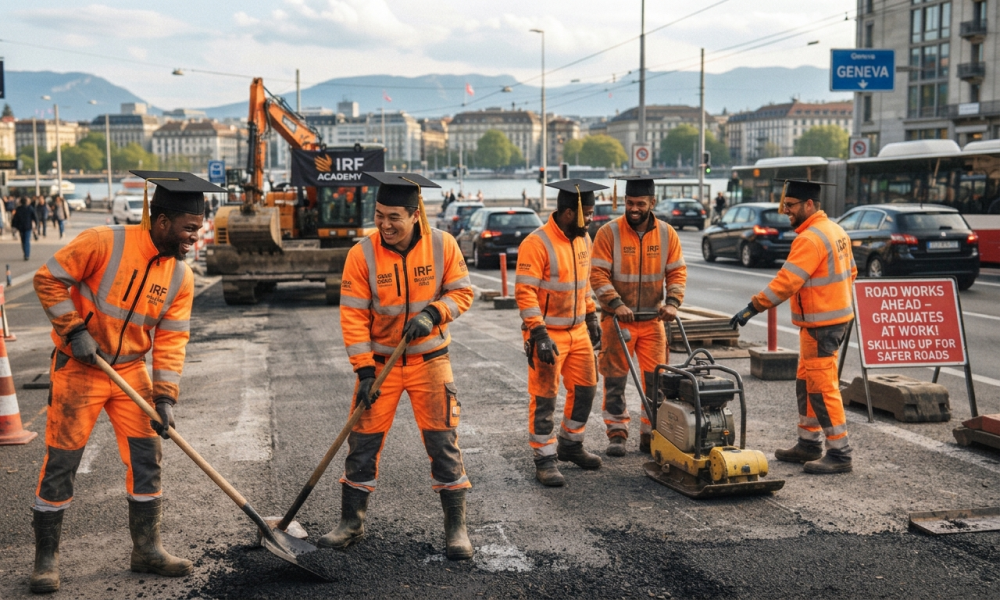
The global transport and road infrastructure sector stands at a pivotal juncture where traditional civil engineering converges with rapid digital transformation. For decades, the construction, maintenance, and operation of highway networks relied primarily on physical durability, mechanical signalling, and conventional civil works. Today, that paradigm has shifted fundamentally as road authorities, municipal planners, and private operators contend with mounting congestion, ambitious decarbonisation targets, and an urgent imperative to eliminate road fatalities. Meeting these demands requires far more than pouring asphalt or erecting static signage; it demands an intelligent, responsive, and deeply interconnected mobility ecosystem. Recognising the growing complexity of this landscape, the International Road Federation (IRF) has formally launched the IRF Academy, a structured global learning initiative designed to deliver continuous professional development and technical upskilling across the highway and transport engineering sectors.
At the heart of this new educational framework lies a recognition that institutional knowledge across the road sector must evolve alongside the technologies being deployed at the roadside. Organised around five core learning pillars, the IRF Academy intentionally positions Traffic Engineering and Intelligent Transport Systems (ITS) alongside Delivering Safer Roads and broader road design, asset management, and sustainability disciplines. By weaving ITS directly into the foundational fabric of highway engineering rather than treating it as an isolated, secondary speciality, the initiative reflects the modern reality of network operations. Engineers can no longer afford to view physical pavement design and digital traffic management as separate domains when smart infrastructure, connected vehicles, and automated enforcement increasingly dictate how corridors are planned, built, and maintained.
Nowhere is this need for multidisciplinary competence more acute than in the rapid transition of Intelligent Transport Systems from experimental testbeds into routine municipal and strategic highway operations. Over the past decade, roadside sensing technologies, high-definition radar, thermal imaging, and artificial intelligence-driven video analytics have matured considerably. Municipalities and national road agencies are deploying these tools daily to monitor real-time traffic flows, detect stationary vehicles, classify fleet compositions, and dynamically adjust signal timings to ease bottlenecks. Yet procuring advanced hardware represents only the initial step in modernising a transport network. Without engineers who understand sensor calibration, edge-computing latency, data fusion, and automated incident detection algorithms, costly roadside investments risk operating well below their potential or generating fragmented, unusable data streams.
Compounding this operational challenge is the accelerating rollout of cooperative intelligent transport systems and vehicle-to-everything (V2X) communications. As automakers equip new vehicle fleets with short-range wireless modules and cellular connectivity capable of exchanging safety-critical messages with infrastructure, road operators are effectively becoming telecommunications managers. Deploying roadside units, managing cryptographic security credentials, ensuring low-latency message broadcasting, and integrating signal phase and timing data into urban control centres require a distinct skill set that rarely featured in traditional university civil engineering curricula. Through structured modules dedicated to ITS and traffic engineering, the IRF Academy aims to equip practitioners with the architectural fluency needed to bridge the historical divide between legacy traffic signal technicians and modern communications engineers.
Data-driven traffic control and digital asset management further underscore why lifelong technical training has become indispensable for transport authorities. Modern control rooms now ingest vast quantities of floating car data, connected telemetry, environmental metrics, and structural health readings from bridges and tunnels. Translating these continuous streams into actionable operational decisions requires familiarity with predictive modelling, digital twins, and integrated mobility platforms. Simultaneously, cybersecurity has emerged as a paramount concern for road operators, since every connected traffic controller, variable message sign, and roadside transceiver represents a potential vulnerability if improperly configured. Structured continuing professional development ensures that professionals responsible for procuring, integrating, and maintaining these digital assets understand both their functional capabilities and their systemic risks.
Equally significant is the direct relationship between advanced mobility technologies and the global road safety agenda, which forms another cornerstone of the IRF Academy's five-pillar architecture. Achieving Vision Zero targets requires shifting from reactive crash analysis to proactive risk mitigation, a transition heavily reliant on ITS applications. Automated speed management, wrong-way driver detection, vulnerable road user warning systems at urban intersections, and adaptive weather-responsive speed limits all depend on seamless integration between physical road geometry and intelligent electronics. When highway designers and safety auditors possess a rigorous grounding in how ITS interventions alter driver behaviour and reduce conflict points, they can specify holistic solutions that protect pedestrians, cyclists, and motorists alike.
From a broader sector perspective, the establishment of a standardised, globally accessible training platform addresses severe talent bottlenecks and regional disparities in technical capacity. Many mature transport markets face an impending wave of retirements among senior traffic engineers, creating an urgent need to transfer institutional expertise while simultaneously introducing cutting-edge digital methodologies to younger cohorts. Conversely, rapidly urbanising regions across Asia, Africa, and Latin America are constructing thousands of kilometres of new highway capacity and have a unique opportunity to leapfrog legacy systems by embedding ITS architecture from the outset. Having a unified, internationally recognised curriculum allows public agencies, consultancies, and contractors across diverse geographies to benchmark competencies, establish shared technical standards, and foster cross-border collaboration.
For the wider mobility ecosystem, the long-term impact of the IRF Academy will likely be measured in smoother project delivery, smarter procurement, and more resilient transport networks. Too often, public-private partnerships and municipal smart city tenders falter because contracting authorities lack the in-house technical literacy to define clear interoperability requirements, open data standards, or realistic lifecycle maintenance schedules. Upskilling the engineering workforce empowers road authorities to act as informed clients, ensuring that newly acquired mobility technologies integrate cleanly with existing legacy infrastructure rather than locking cities into proprietary silos.
Ultimately, the true value of any intelligent transport system resides not merely in the sophistication of its algorithms or the precision of its roadside sensors, but in the capability of the people who plan, deploy, and govern it. As automated mobility, cooperative infrastructure, and data-centric network management continue to reshape global highways, static qualifications earned at the start of an engineering career are no longer sufficient. By institutionalising lifelong learning around ITS, road safety, and modern asset management, the International Road Federation has taken a decisive step toward ensuring that the human capital driving the road sector keeps pace with the technology transforming it.
Click the buttons below to see more articles:
See all ArticlesIndustry InsightEventsITS Thought LeadershipITS Educational