150x150.png)
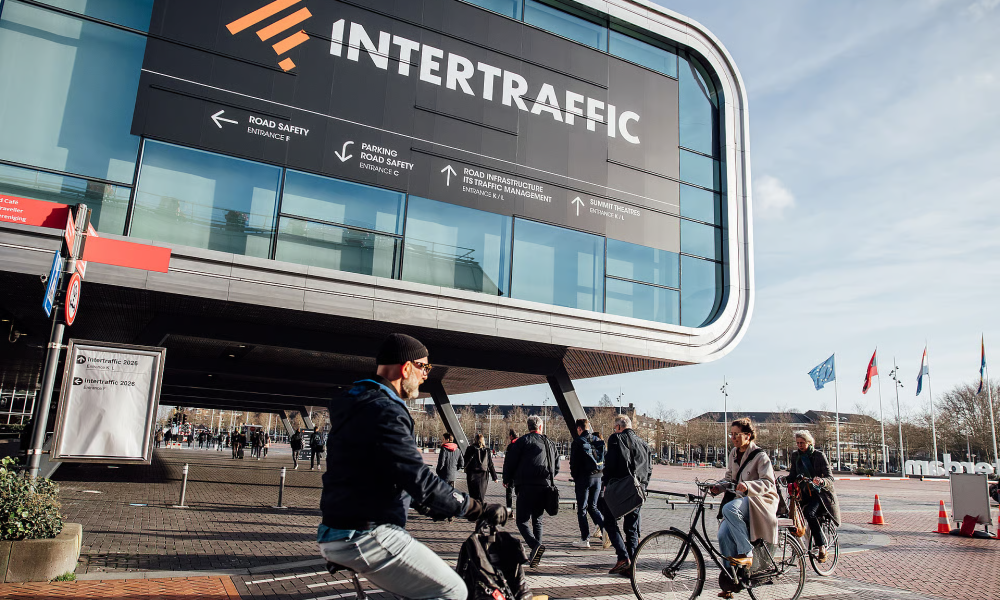
As the doors begin to close on the RAI Amsterdam for another two years, the 2026 edition of Intertraffic has cemented its status not just as the premier trade show, but as the primary pulse-check for the global transport industry. If 2022 was about recovery and 2024 was about the "promise" of AI, 2026 has been defined by one word: Deployment.
Over the course of this week, the industry moved past the pilot phase. We are no longer discussing what might happen with connected vehicles or digital twins, we are witnessing the industrial-scale rollout of technologies that are actively decarbonising cities and saving lives.
1. From "Smart" to "Cognitive", AI as the Invisible Infrastructure
The most visible shift this week was the evolution of Artificial Intelligence. In previous years, AI was a buzzword tacked onto hardware. This week, companies like Yunex Traffic and Swarco demonstrated that AI is now the "brain" within the controller.
Yunex Traffic's Yutraffic awareAI and Swarco's integration of Large Language Models (LLMs) into traffic management interfaces showed a move toward "Cognitive Traffic Management". We saw systems that don't just react to traffic congestion but predict it 20 minutes in advance by scanning environmental data, social events and historical patterns. The launch of Swarco's €24m contract with Asfinag to provide 2,100 intelligent LED displays across Austria serves as a massive validation that authorities are finally ready to invest in long-term, AI-ready hardware.
2. The Rise of "Ghost-Busters", High-Stakes Enforcement
A significant portion of the news cycle this week was dominated by the "darker" side of traffic management: enforcement. As vehicle cloning and "stealth" number plates become a global headache for authorities, the MAV Systems took centre stage.
Their MAV AiQ platform, an Intertraffic Inspiration Award finalist, became one of the most talked-about technologies on the floor. By using "GhostPlate" technology to identify cloned plates with 99% accuracy, MAV is solving a billion-euro leakage problem for toll operators and law enforcement. When combined with the launch of MAV Mobile, which identified that 35% of vehicles in some urban test zones were untaxed or uninsured, the message was clear: the era of "anonymous" traffic violations is ending. Data is now too fast, and the cameras are too smart.
3. Digital Twins, The Move from Planning to Operations
For years, Digital Twins were relegated to the "planning" phase, static models used by consultants. At Intertraffic 2026, we saw the Digital Twin become an operational tool.
Exhibitors demonstrated how real-time Digital Twins are being used to simulate "what-if" scenarios in seconds. If a tunnel closes in Amsterdam, the Digital Twin can simulate the diversion impact on three neighbouring boroughs before the first barrier even drops. Kapsch TrafficCom and Movyon showcased how these models are being used to manage Dynamic Lane Management (DLM). Movyon's work with the Autostrade per l'Italia Group (managing 75% of Italy's roads), highlighted that digital infrastructure is now as critical as the physical asphalt it mirrors.
4. Vulnerable Road Users (VRUs) and the "Inclusive City"
Perhaps the most heartening theme of the week was the industry's pivot toward those outside the car. The 2026 conference tracks placed a heavy emphasis on "The Inclusive City".
We saw this in the hardware, AGD Systems showcased AI detectors that can distinguish between a cyclist, a pedestrian and a person in a wheelchair, adjusting signal timings accordingly. Meanwhile, the Intertraffic Award winners highlighted solutions like NavTac's tactile films for the visually impaired. A smart city that only works for motorists isn't actually smart. The "Gold Standard" for 2026 is a multi-modal intersection that prioritises safety for the most vulnerable first.
5. Decarbonisation and the "Green Charging" Convergence
Finally, the walls between "Traffic Management" and "Energy Management" have officially collapsed. This year saw a record number of exhibitors focusing on EV Charging Infrastructure (EVCI) integration.
The discussion has moved beyond simply "where to put the chargers" to "how to manage the grid". Software platforms like the TLEX Interchange are now facilitating data exchange between charging points and traffic signals. The goal is a "Green Wave" for electric heavy-goods vehicles, ensuring that a 40-tonne electric truck doesn't have to stop and start at five consecutive red lights, thereby wasting massive amounts of battery energy.
Walking through Hall 2, the UK-ERTICO Pavilion and the Nordic+ Pavilion felt like a glimpse into the future of international collaboration. With the 33rd ITS World Congress heading to Birmingham in 2027, the UK delegation used Intertraffic 2026 to signal its leadership in C-ITS (Cooperative Intelligent Transport Systems). Companies like Telent were at the heart of these discussions, proving that the future of transport isn't just about individual gadgets, but about a seamless, interoperable "System of Systems".
As we pack up the stands, the sentiment in Amsterdam is one of cautious optimism. The technology is here, the AI is proven and the awards have been handed out. The challenge for the next 18 months (leading up to the ITS World Congress), will be interoperability.
How do we ensure that a MAV camera in London speaks the same language as a Yunex controller in Berlin or a Swarco display in Vienna?
The 2026 Intertraffic Exhibition proved that we have the tools. Now, as we head into the second half of the decade, the industry's job is to build the bridges.
The traffic is moving. Are you keeping up?
Click the buttons below to see more articles:
See all ArticlesIndustry InsightEventsITS Thought LeadershipITS Educational