150x150.png)
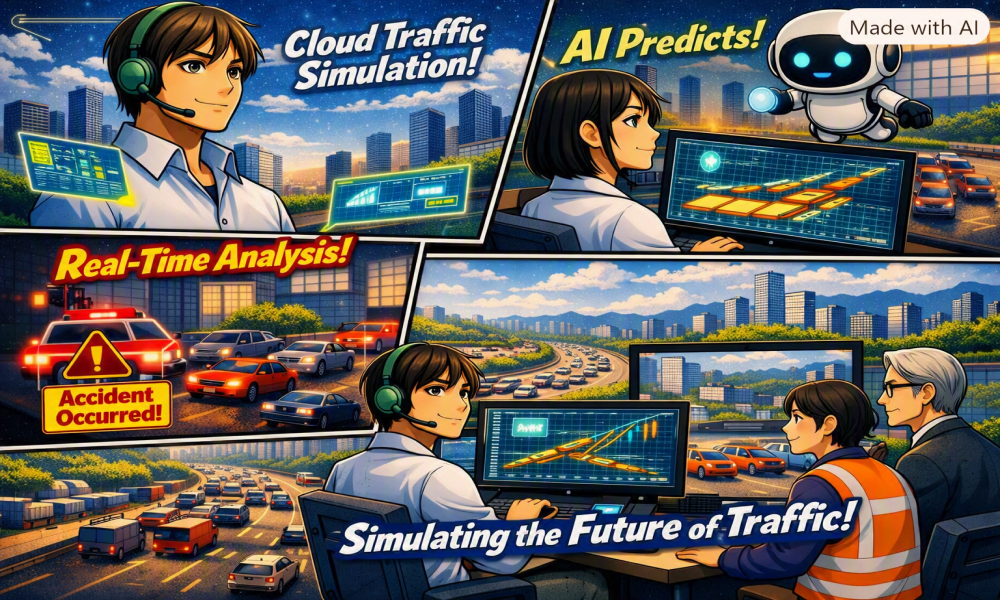
Traffic simulation has always been a quiet workhorse of the transport profession. It has sat behind strategy documents, business cases and operational plans, shaping decisions without ever demanding attention. For years it remained a largely specialist pursuit, defined by desktop software, long run times and carefully prepared scenarios. Recently, however, a shift has been taking place. It has not arrived with fanfare or dramatic announcements. Instead, it has emerged gradually through new tools, new expectations and new ways of working. The result is a quiet revolution that is beginning to reshape how engineers, planners and operators understand the network. Cloud native platforms, AI assisted modelling and real time simulation are changing the nature of the craft.
Cloud-native design has been the most visible part of this transition. Traditional simulation tools were built for single machines and local processing. They required careful configuration and often demanded significant hardware resources. Cloud based systems remove those constraints. They allow simulations to run across distributed infrastructure, scaling automatically to meet demand. This shift has made it possible to model larger networks, explore more scenarios and integrate live data streams without worrying about local capacity. It has also changed how teams collaborate. Instead of passing files between machines, engineers can work together on shared environments, viewing results instantly and adjusting parameters in real time. The cloud has turned simulation from a static process into a dynamic, iterative workflow.
AI has added a further layer of capability. Machine learning has become increasingly common in traffic analysis, particularly for demand estimation, travel time prediction and incident impact assessment. Sources highlight how supervised learning supports demand inference and travel time prediction, while reinforcement learning enables adaptive control in real time. These methods allow simulations to respond to patterns that would be difficult to capture through rule-based logic alone. They also help reduce the time required to explore complex scenarios. Surrogate models can approximate the behaviour of detailed micro-simulators, providing rapid insights that feed into broader planning or operational decisions. AI does not replace traditional modelling. Instead, it enhances it by adding adaptivity, pattern recognition and speed.
Real time modelling has become increasingly important as cities adopt more connected infrastructure. Digital twins have moved from concept to practice, supported by advances in data availability and computational power. Sources describe how digital twin technology mirrors physical parameters and integrates live data from detectors, cameras and navigation systems to calibrate simulations and improve precision. This integration allows simulations to reflect current conditions rather than relying solely on historical averages. It also enables predictive modelling, where the system anticipates how the network will behave in the next few minutes or hours. Real time simulation is not simply about speed. It is about relevance. It provides a live picture of the network that can support operational decisions, incident response and performance monitoring.
The combination of cloud native architecture, AI assistance and real time capability has begun to change expectations across the sector. Simulation is no longer seen as a tool used only for major schemes or long-term planning. It is becoming part of everyday operations. Local authorities are exploring how real time modelling can support signal optimisation, congestion management and event planning. National agencies are considering how predictive simulation can help manage strategic corridors. Consultants are using cloud-based platforms to collaborate with clients more effectively, sharing results instantly and refining models during workshops. The boundaries between planning, design and operations are becoming less rigid as simulation becomes more accessible and more responsive.
This quiet revolution has also influenced the culture of modelling. Historically, simulation required significant preparation. Networks needed to be coded carefully, demand patterns had to be defined precisely and calibration demanded patience. Cloud native tools have reduced some of that burden by offering automated processes, integrated data sources and shared libraries. AI has helped streamline calibration by identifying patterns in observed data and adjusting parameters accordingly. Real time systems have encouraged a more iterative approach, where models evolve continuously rather than being updated only when major projects require them. The craft remains important, but the workflow has changed. Modellers are becoming curators of data, designers of scenarios and interpreters of insights rather than solely builders of networks.
The implications for training and professional development are significant. Engineers entering the field now encounter tools that feel more like modern software platforms than traditional engineering packages. They work with cloud dashboards, machine learning pipelines and live data feeds. They collaborate with data scientists, software developers and operational teams. The skill set required for simulation is expanding. It still demands an understanding of traffic theory, network behaviour and modelling principles. It now also requires familiarity with data engineering, AI methods and cloud environments. The profession is adapting, and the next generation of practitioners will bring a broader perspective to the discipline.
Despite these advances, the fundamentals of simulation remain important. The quality of the data still determines the reliability of the results. Sources emphasise that AI models depend on high-quality training data from detectors, cameras, GPS traces and mobile networks, and that measured data is essential for both training and calibration. The structure of the network still shapes how traffic behaves. The assumptions built into the model still influence the outputs. Cloud native platforms and AI assisted tools do not remove the need for careful judgement. They simply provide more powerful ways to apply it. The quiet revolution is not about replacing expertise. It is about amplifying it.
The future direction of simulation appears increasingly clear. Cloud infrastructure will continue to expand, offering greater scalability and more integrated services. AI will become more embedded, supporting scenario generation, adaptive control and predictive modelling. Real time simulation will become standard for operational environments, feeding into digital twins and connected management systems. The boundaries between simulation, optimisation and control will continue to blur. The network will be modelled, monitored and managed through a unified set of tools that operate continuously rather than intermittently.
This evolution will not be dramatic. It will continue quietly, shaped by incremental improvements, new capabilities and changing expectations. The tools will become more intuitive. The workflows will become more integrated. The insights will become more immediate. Traffic simulation will remain a foundational part of the profession, but it will feel different. It will be faster, more collaborative and more connected to the real world. The quiet revolution will continue, and the sector will continue to adapt.
Click the buttons below to see more articles:
See all ArticlesIndustry InsightEventsITS Thought LeadershipITS Educational