150x150.png)
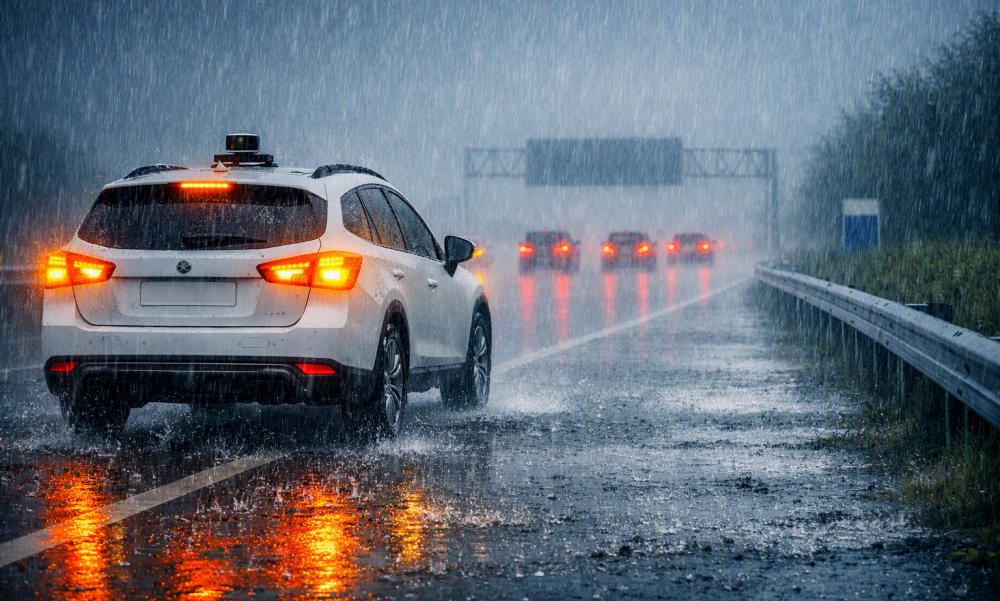
The Bavarian town of Roding is not the sort of place that usually draws the automated-driving world’s attention. Yet on 19 August 2026 it became a focal point for Europe’s most persistent technical challenge, which is how to make automated vehicles behave safely and predictably when the weather turns against them. The ROADVIEW Final Event, held at the AVL Mobility and Sensor Centre and streamed to a hybrid audience across Europe, was the culmination of a Horizon Europe project that has spent its life wrestling with the realities of rain, fog, snow and low-visibility environments, the conditions that expose the limits of today’s perception stacks and the fragility of current deployment assumptions.
What made the day compelling was not simply the promise of better sensors or cleverer algorithms, but the sense that ROADVIEW’s consortium had reached a point of validated maturity. The project’s architecture, which is a fusion of advanced perception systems, intelligent control and decision-making algorithms, V2X communication and cross-scenario validation, has been shaped explicitly around degraded visibility. It is not automation designed for ideal conditions with adverse weather bolted on afterwards, it is automation built from the ground up to survive the messy realities of European climates.
The morning sessions set the tone. Speakers from across the consortium framed the challenge with refreshing candour: automated driving has made impressive progress, but its weakest point remains the moment the environment becomes unpredictable. Heavy rain blinds cameras, fog diffuses LiDAR returns, snow obscures lane markings, spray confuses radar reflections. The industry has long known this, but ROADVIEW’s work has been to quantify, confront and engineer around these limitations rather than simply acknowledge them. The project’s perception stack, presented in detail during the technical briefings, has been designed to remain resilient when visibility collapses, a multi-modal approach that treats adverse weather not as an exception but as a baseline.
There was a clear emphasis on robustness rather than novelty. The consortium’s engineers walked participants through the architecture’s weather-adaptive behaviour, showing how sensor inputs are filtered, fused and re-weighted when conditions deteriorate. This uses intelligent control algorithms to adjust vehicle behaviour to maintain safety margins. V2X communication can supplement local perception when the environment becomes too noisy for onboard sensors alone. These are not theoretical constructs. ROADVIEW has validated its system across urban, highway and winter environments, and the event was the first time the full architecture had been presented in a public, integrated form.
The highlight, inevitably, was the live demonstration. Automated urban driving demonstrations are not new, but seeing one executed under realistic adverse-weather conditions is still rare. The AVL Mobility and Sensor Centre provided a controlled but convincing environment, and the ROADVIEW vehicle performed with a calmness that contrasted sharply with the usual fragility of prototype systems. Observers noted how the vehicle maintained stable behaviour even when visibility was deliberately degraded, a testament to the project’s focus on sensor reliability, weather-adaptive control and noise-filtering techniques. The German Sensorik network, which previewed the event in July, had highlighted the importance of robust radar, LiDAR and camera performance under heavy rain and fog, and the demonstration made clear that these were not aspirational claims but validated outcomes.
Beyond the technical showcase, the event carried a strong sense of sector relevance. Automated mobility is moving steadily toward higher levels of autonomy, but the industry knows that deployment cannot scale until adverse-weather reliability is addressed. ROADVIEW’s results speak directly to this gap. The project’s validated architecture offers a pathway toward certifiable behaviour in poor visibility, which was a topic that dominated the panel discussions on regulation and market readiness. Policymakers and regulators in attendance pressed the consortium on how these results could feed into future approval frameworks, particularly around scenario-based testing and the integration of V2X as a compensatory mechanism when sensors degrade.
There was also a notable shift in tone compared with earlier Horizon Europe projects. ROADVIEW’s partners were keen to emphasise deployment pathways rather than purely research outcomes. The networking sessions and poster presentations were filled with conversations about integration, scalability and commercialisation.
The hybrid format ensured that remote participants (including universities, innovation clusters and EU project teams) could join the debate, with live Q&A sessions extending discussions well beyond the scheduled agenda.
What emerged across the day was a sense of clarity about the remaining challenges. ROADVIEW has demonstrated that adverse-weather automation is achievable, but scaling it will require continued work on certification, interoperability and cost reduction. The consortium was transparent about these gaps, outlining future research directions and encouraging collaboration across Europe’s automated-mobility ecosystem. The project’s validated results provide a foundation, but the sector will need to build on them quickly if automated driving is to move beyond favourable climates and controlled pilot zones.
The significance of the ROADVIEW Final Event lies in its realism. Automated driving has often been presented as a technology that will simply improve until it becomes universally reliable. ROADVIEW’s work shows that reliability in adverse weather is not a natural consequence of better sensors or more powerful AI. It is the result of deliberate architectural choices, rigorous validation and a willingness to confront the hardest problems directly. The project’s final event in Roding was not a celebration of perfection but a demonstration of progress, the kind of progress that moves automated mobility closer to everyday viability.
As Europe prepares for its next wave of automated-driving initiatives, ROADVIEW’s results will likely become a reference point. The project has shown that adverse-weather automation can be validated, demonstrated and communicated with confidence. It has also shown that collaboration across research, industry and policy is essential if automated mobility is to scale safely. The Roding event captured that spirit, a blend of technical achievement, sector engagement and pragmatic optimism.
In the end, the ROADVIEW Final Event was less about unveiling a single breakthrough and more about demonstrating a coherent, deployable architecture for one of automated driving’s most stubborn challenges. It offered a glimpse of a future where automated vehicles behave predictably even when the weather does not, a future that feels a little closer after what was showcased in Bavaria.
Click the buttons below to see more articles:
See all ArticlesIndustry InsightEventsITS Thought LeadershipITS Educational