
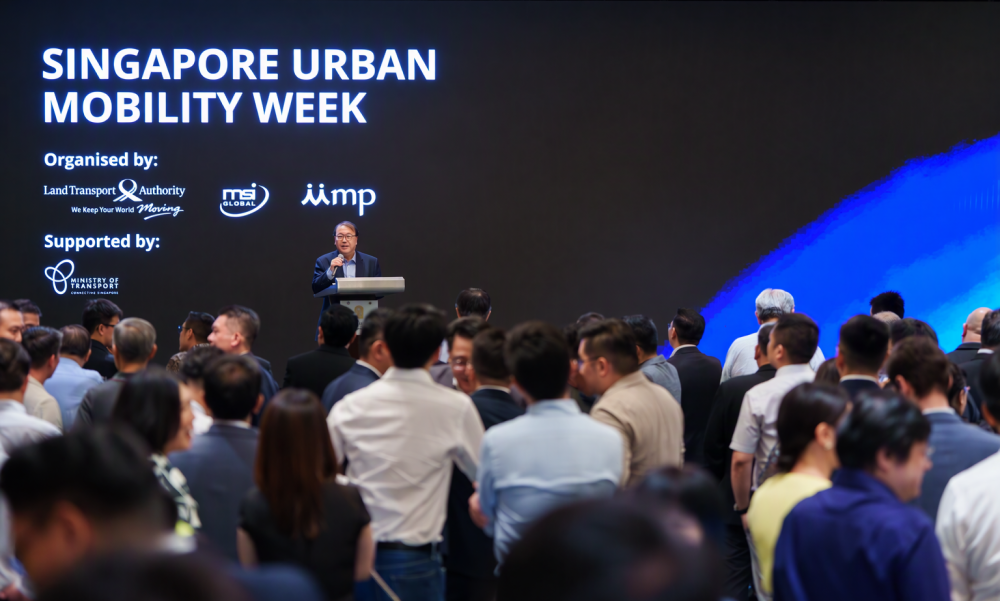
When delegates arrive for the opening day of Singapore Urban Mobility Week 2026 on 4th November, many will already have gained an early glimpse of the innovations shaping one of the world's most sophisticated urban mobility ecosystems. The event officially begins on Wednesday, but the journey really starts a day earlier through a series of technical visits that have become an important part of the experience.
These visits offer something that presentations and panel discussions alone cannot provide. They allow transport professionals to see intelligent mobility technologies operating in the demanding environment of a modern city. Singapore has earned its reputation as a global leader not through ambitious concepts alone, but through a willingness to deploy, evaluate and continually refine new approaches to mobility. Whether examining traffic management operations, connected infrastructure, public transport systems or emerging mobility services, delegates have the opportunity to witness first-hand how policy objectives are translated into practical outcomes.
That experience is likely to shape much of the discussion that follows throughout the week. Participants returning from the technical tours will arrive at the conference sessions with fresh perspectives on the opportunities and challenges associated with operating a highly connected urban transport network. In many ways, the visits form the perfect introduction to the themes expected to dominate Singapore Urban Mobility Week 2026: integration, intelligence, sustainability and the continuing evolution of mobility technologies.
With those real-world examples still fresh in delegates' minds, attention now turns to the formal opening of the event. This year's gathering takes place at a pivotal moment for the transport sector. Cities around the world are facing growing pressure to improve mobility while reducing emissions, tackling congestion and responding to changing travel behaviours. Public authorities are being asked to achieve more with finite resources, while travellers increasingly expect transport services to be seamless, reliable and digitally enabled.
Against this backdrop, Singapore once again provides an ideal venue for examining how Intelligent Transport Systems are evolving to meet these expectations. The city-state has spent decades building an integrated approach to transport management, making it one of the most influential reference points for policymakers, transport operators and technology suppliers worldwide.
One of the strongest themes likely to emerge from the opening day is the growing role of artificial intelligence within transport operations. Over the past few years, the conversation around AI has shifted considerably. Initial excitement about its potential is gradually being replaced by practical discussions about deployment, performance and operational value.
Transport authorities are increasingly exploring how machine learning can support traffic management, incident detection and network optimisation. Rather than relying solely on human operators to interpret growing volumes of data, AI systems are providing new ways to identify patterns, anticipate disruption and support faster decision-making. Yet perhaps the most interesting discussion is no longer about the technology itself. Instead, attention is turning towards how artificial intelligence can be integrated into wider mobility ecosystems to improve the efficiency and resilience of entire transport networks.
This naturally leads to another major theme: the development of connected infrastructure. Much public attention continues to focus on autonomous vehicles, but many transport professionals recognise that some of the most significant progress is taking place within the infrastructure that surrounds them.
Roadside sensors, intelligent traffic signals, communication networks and connected corridor technologies are creating the foundations for a more responsive transport environment. These systems allow information to move more freely between vehicles, infrastructure operators and traffic management centres. The result is a transport network that is increasingly capable of understanding its own conditions and adapting accordingly.
For road authorities, this opens up significant opportunities. Congestion can be managed more proactively, incidents can be detected more rapidly and travellers can receive more accurate information about network conditions. Improvements to safety, efficiency and reliability often emerge long before higher levels of vehicle automation become commonplace.
As discussions progress throughout the day, delegates are likely to hear repeated references to integration. The era of stand-alone ITS deployments is gradually giving way to a more interconnected vision of mobility. Technologies that once operated independently are beginning to function as part of larger digital ecosystems.
Traffic management systems are being linked more closely with public transport operations. Mobility platforms are integrating journey planning, ticketing and payment services. Data from connected infrastructure is supporting both operational management and long-term planning activities. Success increasingly depends not on the performance of individual technologies but on how effectively different systems work together.
That same principle is likely to be reflected in conversations surrounding Mobility as a Service. After years of discussion, the concept continues to evolve as cities gain a clearer understanding of what is required to deliver genuinely integrated mobility experiences.
Much of the focus on day one is expected to move beyond theoretical models and towards practical implementation. Delegates will be interested in understanding how cities are overcoming challenges related to interoperability, data sharing and commercial viability. Questions surrounding user experience are also becoming increasingly important, particularly as transport authorities seek to encourage behavioural change and reduce dependency on private vehicles.
Sustainability will remain a constant thread running through virtually every discussion. Decarbonisation targets continue to influence policy decisions across the transport sector, creating demand for solutions that can deliver environmental benefits alongside operational improvements.
What is increasingly evident, however, is that technology alone cannot deliver these outcomes. Electrification remains a critical component of transport decarbonisation strategies, but delegates are expected to hear equally about the role of intelligent traffic management, multimodal integration and data-driven operations. Every reduction in delay, every improvement in network efficiency and every successful shift towards more sustainable modes contributes to broader environmental objectives.
Safety will also feature prominently throughout the opening sessions. Across the mobility sector there is growing recognition that digital technologies offer new opportunities to prevent incidents rather than simply respond to them. Advances in connected vehicle systems, video analytics and predictive safety tools are helping authorities identify risks before collisions occur.
This increasingly proactive approach aligns closely with Vision Zero ambitions being adopted in many cities around the world. Rather than relying solely on historical accident data, transport operators are beginning to use real-time information to understand where risks are emerging and what interventions might be most effective. Such capabilities highlight the increasingly important relationship between intelligent transport systems and wider road safety strategies.
Urban logistics is another area deserving close attention. The continuing growth of e-commerce has transformed travel patterns within cities, placing new demands on road networks, kerbside space and freight operations. Passenger mobility and goods movement can no longer be considered separately.
Singapore's position as a major international logistics hub makes it a particularly valuable setting for these conversations. Delegates will be examining how digital platforms, intelligent routing systems and connected logistics solutions can improve efficiency while reducing the impact of freight activity on already busy urban environments.
As the first day unfolds, a common theme is likely to become increasingly apparent. Artificial intelligence, connected infrastructure, sustainable mobility, road safety and smart logistics are often discussed as distinct topics, yet each forms part of a much broader transformation taking place across the transport sector.
Singapore Urban Mobility Week 2026 arrives at a time when the conversation is no longer centred on isolated technologies seeking attention. The real challenge now lies in bringing those technologies together to create mobility systems that are safer, cleaner and more responsive to the needs of growing cities.
That may ultimately be the most important message emerging from the opening day. The future of Intelligent Transport Systems will not be determined by individual innovations acting alone. Success will depend on how effectively technologies, transport operators and policymakers collaborate to create integrated mobility ecosystems capable of delivering meaningful outcomes for the people who use them every day. In a city that has built its international reputation on exactly that kind of joined-up thinking, there could be few better places to begin the conversation.
Click the buttons below to see more articles:
See all ArticlesIndustry InsightEventsITS Thought LeadershipITS Educational