
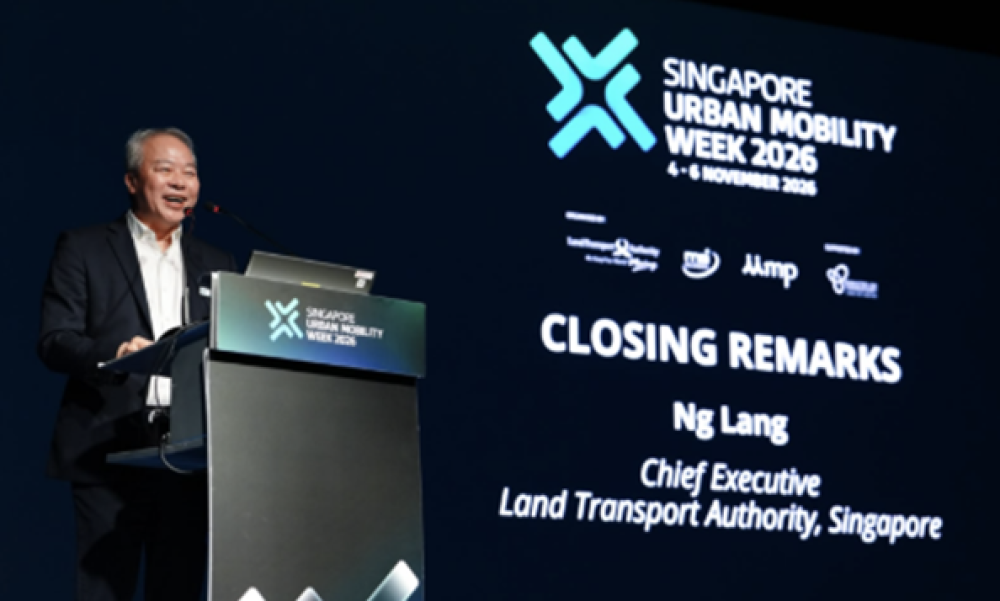
For a first edition, Singapore Urban Mobility Week 2026 carried an unusually high burden of expectation. New international transport events often spend years establishing credibility, attracting influential speakers and finding their place within an already crowded global calendar. SUMW arrived with rather different ambitions. Backed by Singapore's Land Transport Authority and supported by the Ministry of Transport, it was conceived not simply as another industry gathering but as a platform for shaping the future direction of urban mobility across Asia Pacific and beyond. With more than 8,000 participants from over 50 countries and over 200 exhibiting organisations filling the Suntec Singapore Convention & Exhibition Centre, the inaugural event immediately demonstrated the scale of its aspirations.
What became apparent over the course of the week was that the mobility sector has entered a noticeably different phase of its development. For many years industry conferences were dominated by discussions about what might be possible in the future. Autonomous vehicles, artificial intelligence, connected infrastructure and data-driven transport management were often presented as emerging concepts, fascinating in theory but still some distance from widespread deployment. The conversations taking place in Singapore suggested that perspective is rapidly changing. Across the conference programme and exhibition floor there was a growing sense that the debate is no longer centred on technological possibility. Attention is increasingly focused on implementation, integration and delivery.
That shift could be seen in the structure of the event's main discussions. Sessions explored topics including commuter-centred mobility, rail asset renewal, infrastructure digitalisation, workforce transformation and the realities of introducing autonomous vehicles into complex urban environments. Rather than treating technology as an end in itself, speakers repeatedly returned to the practical challenge facing transport authorities around the world of how can innovation deliver measurable improvements in safety, efficiency, reliability and customer experience? It was a refreshingly mature conversation that reflected the growing expectations placed upon both public authorities and technology providers.
Autonomous mobility naturally occupied a prominent place throughout the week. Singapore has spent years building a reputation as one of the world's most progressive environments for autonomous vehicle testing and deployment, making it a fitting location for discussions about the next stage of development. Yet what was particularly striking was the pragmatic tone adopted by many of the speakers and regulators. The industry appears to have largely moved beyond proving that autonomous technologies can function technically. Today's challenge is considerably more complicated. Questions surrounding regulation, liability, cybersecurity, public trust and integration with existing transport systems are becoming just as important as the vehicles themselves. The dedicated AV Regulators Forum reinforced this reality, bringing together authorities and policymakers to examine the frameworks needed to support large-scale deployment safely and effectively.
Underlying many of these discussions was a broader recognition that future mobility cannot be achieved through smarter vehicles alone. Intelligent infrastructure is increasingly emerging as the other half of the equation. Connected assets, digital management platforms, predictive maintenance systems and real-time analytics featured heavily throughout the programme, reflecting a growing understanding that transport networks themselves must become more intelligent if cities are to accommodate rising demand while maintaining reliability and resilience.
This was perhaps most evident in discussions surrounding rail renewal and infrastructure modernisation. While infrastructure investment often focuses public attention on new projects, many mature transport networks face a different challenge. Existing systems must continue operating efficiently while being upgraded to meet future requirements. The emphasis placed on digitalisation illustrated how transport authorities are increasingly turning to connected technologies, data platforms and advanced asset management systems to extend asset life, improve operational efficiency and minimise disruption to passengers. Such approaches are equally relevant to road networks, where the ability to monitor, predict and respond to network conditions in real time is becoming central to effective transport management.
The prominence of digitalisation throughout the Industry Forums further highlighted this trend. Sessions dedicated to Internet of Things technologies, connected mobility and intelligent operational systems reflected a growing consensus that data has become one of the transport sector's most valuable assets. Collecting information is no longer the objective. The real opportunity lies in translating that information into operational decisions that improve performance across increasingly complex transport ecosystems. From adaptive traffic management and connected corridors to predictive maintenance and multimodal integration, the ability to harness data effectively is becoming a defining characteristic of successful mobility strategies.
One of the most encouraging aspects of the event was the recognition that technological advancement alone will not guarantee success. Throughout the week there was considerable attention given to workforce development and organisational readiness. The transport sector's digital transformation is often described in terms of hardware, software and infrastructure, yet its success ultimately depends upon people. Engineers, planners, operators and maintenance teams are being asked to adapt to technologies that would have seemed extraordinary only a decade ago. Building those skills and capabilities is rapidly becoming one of the defining challenges facing transport authorities worldwide. Discussions in Singapore reflected an understanding that investment in people must accompany investment in technology if long-term transformation is to succeed.
Sustainability remained another important thread running through the event. From intelligent infrastructure and public transport modernisation to autonomous mobility and digital optimisation, many of the technologies on display were presented not only as tools for improving efficiency but also as mechanisms for reducing environmental impact. What was particularly notable was the practical nature of these conversations. Rather than focusing solely on ambitious long-term targets, speakers frequently addressed the operational and commercial realities of implementing sustainable mobility solutions. Cities face mounting pressure to decarbonise transport while maintaining affordability, reliability and accessibility. Technologies therefore need to demonstrate tangible value if they are to attract lasting investment and public support.
Viewed as a whole, Singapore Urban Mobility Week offered an insight into an industry that is becoming increasingly focused on outcomes rather than concepts. The dominant narrative was not one of disruption sweeping away existing transport systems. Instead, the discussions centred on integration, optimisation and evolution. Intelligent transport technologies are being harnessed to enhance established networks, strengthen operational performance and improve the experience of travellers, rather than replace everything that came before.
For Singapore itself, the event reinforced its position as one of the world's most influential mobility laboratories. Few cities have demonstrated such a consistent ability to combine long-term strategic planning with a willingness to embrace innovation. Hosting a major international gathering dedicated to autonomous mobility, smart infrastructure and future-ready transport systems therefore felt entirely appropriate.
The true legacy of the inaugural SUMW will become clearer over the coming years as ideas evolve into projects, partnerships mature and policies translate into real-world deployment. Nevertheless, the central message emerging from the event was already unmistakable. The future of mobility is no longer primarily about imagining what might be possible. The industry has entered a period in which success will increasingly be measured by how effectively innovative technologies can be integrated into everyday operations, delivering safer, more efficient and more sustainable transport systems. For the ITS community, that may ultimately prove to be the most important outcome of all.
Click the buttons below to see more articles:
See all ArticlesIndustry InsightEventsITS Thought LeadershipITS Educational