150x150.png)
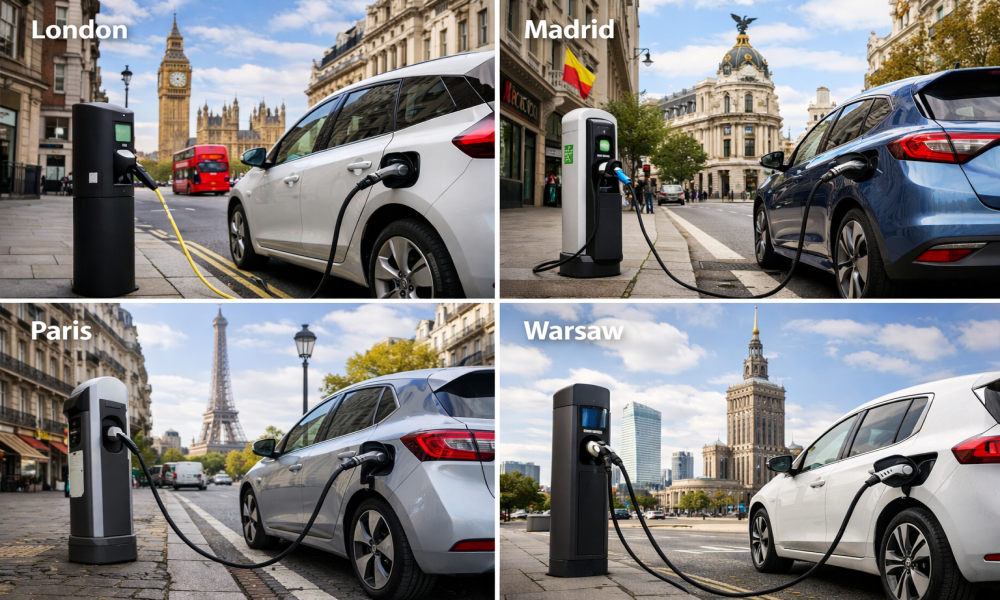
Europe’s electric transition is no longer a distant ambition. It is happening now, on real streets, in real neighbourhoods, shaped not by abstract national targets but by the practical realities of charging infrastructure. The Clean Cities Campaign’s Taking Charge briefing offers one of the clearest snapshots yet of how four major European cities (Greater London, Madrid, Paris and Warsaw), are progressing, where they are struggling, and what it will take to build charging networks capable of supporting mass electrification. It is a story of uneven progress, structural differences and the urgent need for strategic planning.
The report opens with a simple truth “Electrification can only happen at scale if charging is reliable, affordable and easy to access”. For millions of urban residents without driveways or garages, public charging is not a luxury but a lifeline. The four cities studied represent different geographies, different market maturities and different policy histories, but they share a common challenge. All must expand their public charging networks substantially before 2030, and further still by 2035, if they are to support the rapid growth of battery-electric vehicles.
Paris stands out immediately. With 5.3 charge points per 1,000 inhabitants, it has the densest public charging network of the four cities. Greater London follows with 3.2, while Madrid and Warsaw lag behind at 1.0 and 0.5 respectively. These numbers alone tell a story of early movers and late starters, but they do not tell the whole story. The installed capacity, which is how much power the network can deliver at any moment, narrows the gap. Paris and London still lead, at 58.7 kW and 52.3 kW per 1,000 inhabitants, but Madrid’s higher share of DC fast charging lifts its capacity to 39.8 kW, and Warsaw’s to 28.3 kW.
The cities have taken strikingly different technological paths. Paris and London have built networks dominated by slow AC charging, with Paris relying heavily on single-phase AC units, many of which are essentially reinforced household plugs delivering around 2.3 kW. London’s mix is similar, though with a slightly higher share of faster DC units. Madrid and Warsaw, by contrast, have leaned into medium-speed and fast charging. In Warsaw, only 1% of chargers are single-phase AC, instead, 63% are three-phase AC and 36% are DC fast chargers. Madrid sits between the two extremes, with roughly equal shares of single- and three-phase AC and a notably higher proportion of DC fast charging than Paris or London.
These choices matter. Slow AC charging is cheaper to install and well suited to overnight residential use. DC fast charging is more expensive but essential for drivers who cannot rely on long dwell times. Cities that have leaned heavily on one approach face different challenges as EV adoption accelerates. Paris must ensure its slow network can keep pace with rising demand. Warsaw must ensure its fast-charging-heavy network remains financially viable and equitably distributed.
Distribution is where the disparities become most visible. The report’s coefficient of variation analysis shows that chargers are concentrated in central districts across all four cities. Paris has the highest internal disparity, followed by London, Warsaw and Madrid. In Paris, higher-income districts tend to have more charge points, with a moderately strong correlation of 0.60. London and Madrid show weaker correlations, and Warsaw lacks district-level income data. But the pattern is clear enough, that commercial attractiveness and early EV ownership have shaped deployment more than equity.
The report is careful not to overstate this. Many lower-income districts are reasonably served, and some higher-income districts are not. The real equity issue is charging dependency. Residents without access to home charging, including those living in flats, rented homes or terraced streets, must have reliable, affordable public alternatives nearby. Without this, the transition risks entrenching existing inequalities.
Utilisation rates offer another lens. Paris leads with an overall utilisation of 29%, driven by strong residential demand for slow charging. London shows a balanced profile at 17%, suggesting a mature market with diverse charging behaviours. Warsaw sits at 14%, while Madrid lags at 7%, reflecting early-stage adoption and a network that has not yet found its equilibrium. Fast and high-power charging show different patterns across cities, but the midday peak is consistent. Paris shows the sharpest daily variation, while London’s slow charging is the most stable.
Pricing adds another layer of complexity. London is the most expensive city for ad-hoc public charging on a purchasing-power-adjusted basis, with AC charging at €0.60 per kWh and DC at €0.90. Madrid is cheapest, while Paris and Warsaw sit in the middle. Across all cities, DC charging carries a substantial premium, ranging from 20% to 51%. For residents who are dependent on public charging, these differences matter. They shape behaviour, influence adoption and determine whether electrification feels accessible or exclusive.
The modelling exercise is where the report becomes most forward-looking. All four cities must expand their networks significantly by 2035. Paris will need between 66,672 and 94,439 AC charge points depending on the scenario, and between 3,704 and 4,116 DC units. London’s requirements are even larger. Madrid and Warsaw face steep climbs from their current low baselines. But smarter policy can reduce the scale of expansion. Shifting demand towards workplaces, destinations and higher-power charging cuts projected requirements by around one fifth. Combining this with a 10% reduction in car ownership cuts them by more than a quarter.
This is a crucial insight. Charging infrastructure does not exist in isolation. It is part of a wider mobility ecosystem. Cities that align charging rollout with public transport investment, cycling infrastructure and shared mobility will need fewer chargers, spend less money and reclaim more public space. As the report puts it, “Rolling out charging infrastructure should not entrench car dependency in cities”.
The policy recommendations are pragmatic and grounded. Cities should plan strategically, not reactively, developing Charging Masterplans that map projected demand, identify grid constraints early and prioritise districts with high public charging dependency. They should shift demand away from the street, using spatial planning and procurement to steer residential charging towards workplaces, semi-public spaces and car parks. They should make charging affordable through transparent pricing and maximum ad-hoc rates. National governments must remove grid bottlenecks and introduce enforceable right-to-plug rules. At the EU level, predictable regulatory targets remain the single most important driver of EV adoption.
The message is clear, the electric transition will be won or lost in cities. Those that act early, plan well and build for everyone will turn electrification from a promise into a lived reality. Those that hesitate risk locking in higher emissions, higher costs and deeper inequalities.
Europe’s cities are taking charge. Now they need the tools, the investment and the political confidence to finish the job.
Read the full report here.
Click the buttons below to see more articles:
See all ArticlesIndustry InsightEventsITS Thought LeadershipITS Educational