150x150.png)
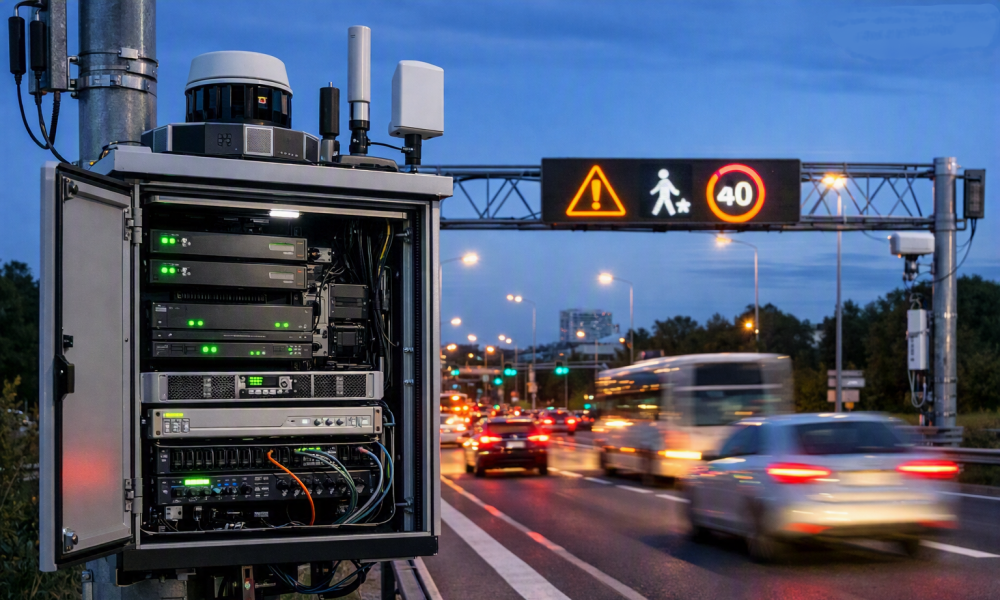
The roadside unit inhabits a curious presence in the ITS landscape. It sits quietly on a gantry, on a pole hidden in the verge, or humming away in a cabinet that most people never notice, yet it forms one of the most important touchpoints between connected vehicles and the digital systems that shape their journeys. These units have been treated as little more than communication beacons, built around Digital Short-Range Communications (DSRC) radios and narrow, single-purpose functions. They were part of an early connected vehicle vision that never quite reached its promised scale. The world has moved on, and the roadside unit is now undergoing a transformation that is far more profound than a simple upgrade. It is becoming a genuine edge platform, capable of hosting multiple services, speaking multiple protocols and acting as an intelligent node in its own right.
This shift is not happening because the industry has suddenly rediscovered enthusiasm for roadside hardware. It is happening because the demands placed on the network have changed. Modern mobility relies on data that is richer, faster and more contextual than anything DSRC was ever designed to handle. Vehicles expect to receive information about hazards, signal phases, lane closures, speed advice and environmental conditions. They also expect to share information back to the infrastructure, allowing operators to build a clearer picture of what is happening on the road. A single radio and a single service cannot support that level of interaction. The roadside unit has had to evolve into something more flexible, more powerful and more capable of running multiple applications at once.
The arrival of multi-protocol communication is one of the most significant steps in this evolution. DSRC may still exist in pockets, but C-V2X has become the dominant technology for connected vehicle communication. The roadside unit of the future will not choose between them. It will support both, along with whatever comes next. This is not simply a matter of adding extra radios. It requires a platform that can manage different message sets, different timing requirements and different security models. It also requires a design philosophy that treats communication as a service rather than a fixed feature. The roadside unit becomes a host for communication modules that can be updated, replaced or expanded without replacing the entire cabinet.
Multi-service capability follows naturally from this. Once a roadside unit can speak multiple languages, it can also run multiple applications. Traffic signal priority, hazard warnings, queue detection, environmental sensing, speed harmonisation and pedestrian safety can all sit on the same platform. Each service draws on shared processing power, shared storage and shared connectivity. This consolidation reduces cost and complexity for operators, but it also creates a more coherent digital environment for vehicles. Instead of receiving fragmented messages from different systems, they receive coordinated information from a single intelligent node. The roadside unit becomes a point of truth for the immediate road environment.
Edge computing is the final piece of the puzzle. The roadside unit is no longer a passive relay that simply forwards messages to a central server. It is becoming a place where data is processed, analysed and acted upon locally. This shift is driven by the need for lower latency and greater resilience. Many safety-critical applications cannot wait for cloud processing. They require decisions to be made within milliseconds, and they require those decisions to be made even if the backhaul connection is temporarily lost. Edge computing allows the roadside unit to run algorithms that detect incidents, classify hazards, optimise signal timings or adjust speed advice without relying on a remote system. It also allows operators to deploy new applications quickly, without waiting for large-scale upgrades to central infrastructure.
This local intelligence has another benefit. It helps address some of the privacy and data protection concerns that have grown around connected mobility. Vehicles generate vast amounts of data, much of it highly sensitive. Sending all of that information to a central server creates risks that are difficult to manage. Processing data at the roadside allows operators to extract only what is necessary, anonymise it and discard the rest. The roadside unit becomes a filter that protects personal information while still supporting operational needs. This approach aligns well with GDPR principles, which emphasise data minimisation and local processing wherever possible.
The future roadside unit will not be defined by its physical form. Cabinets will still exist, but the intelligence inside them will be far more modular and far more software-driven than anything seen before. Operators will be able to deploy new services through software updates rather than hardware replacements. They will be able to scale capabilities as demand grows, adding new processing modules or new communication protocols without redesigning the entire system. The roadside unit becomes part of a distributed computing environment that stretches across the network, complementing cloud systems rather than competing with them.
This transformation also changes the role of roadside infrastructure in the wider ITS ecosystem. The roadside unit becomes a partner to the vehicle rather than a simple transmitter. It provides context that the vehicle cannot easily obtain on its own. It offers insights into traffic conditions, signal timings, pedestrian movements and local hazards. It also acts as a guardian of network integrity, ensuring that messages are authentic, secure and relevant. Vehicles may become more autonomous, but they will still rely on infrastructure that understands the road environment in ways that onboard sensors cannot replicate.
The shift from DSRC relic to multi-protocol, multi-service edge platform is not just a technical upgrade. It is a reimagining of what roadside infrastructure can be. The roadside unit becomes a foundation for connected mobility, a place where intelligence resides and decisions are made. It becomes a flexible, scalable and secure platform that supports the needs of modern transport without locking operators into outdated technologies. It also becomes a bridge between the physical and digital worlds, helping vehicles navigate a road environment that is increasingly shaped by data.
This quiet revolution will not attract the same attention as autonomous vehicles or smart motorways, yet it will underpin much of the progress that follows. The roadside unit is becoming the backbone of future ITS, and its evolution marks a decisive step towards a network that is more responsive, more resilient and more capable of supporting the mobility systems of tomorrow.
Click the buttons below to see more articles:
See all ArticlesIndustry InsightEventsITS Thought LeadershipITS Educational