
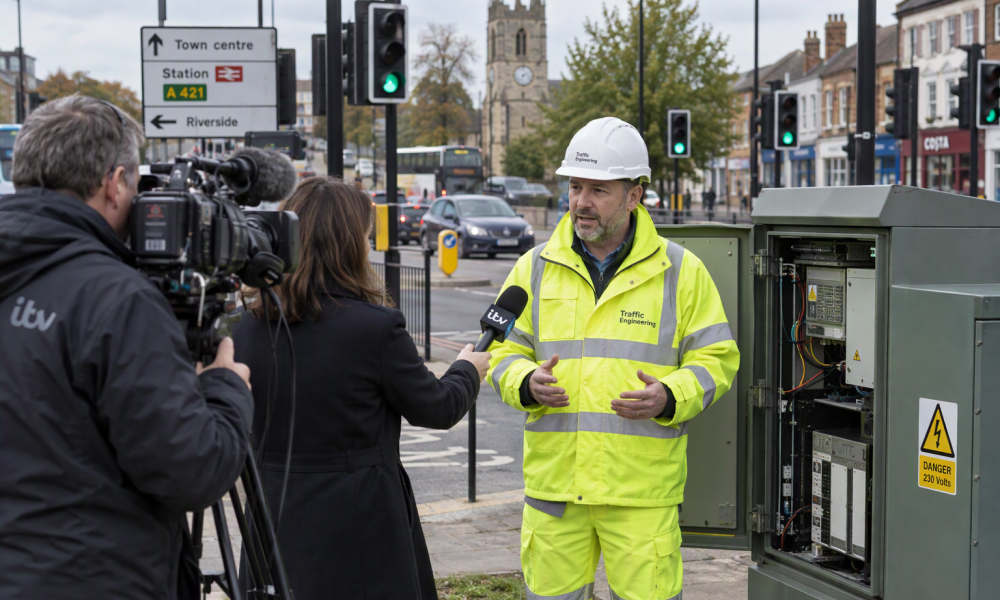
Public confidence, future talent and the reputation of transport technology depend on a more visible, proactive and human approach to communication.
The Intelligent Transport Systems sector has never been more important, yet it has rarely been less visible. Across the United Kingdom and much of the wider world, technology now influences almost every aspect of how people move. Traffic signals adapt to changing conditions in real time, vehicle detection systems monitor traffic flows, roadside sensors provide critical journey information, digital payment systems simplify public transport use, and connected infrastructure increasingly supports safer and more efficient travel. Despite this growing influence, most members of the public remain largely unaware of the industry behind these innovations. Even more concerning is the fact that when transport technology does make the headlines, it is often because something has become controversial rather than because something has quietly improved millions of journeys.
This presents a challenge that the sector can no longer afford to ignore. While engineers, technologists, consultants and public authorities have traditionally preferred to focus on delivery rather than publicity, the communication vacuum that results is increasingly being filled by misinformation, misunderstanding and, in some cases, outright conspiracy theories. If the ITS community wishes to maintain public trust, attract future talent and secure political support for innovation, it must become far more proactive in explaining what it does, why it matters and how it benefits society.
The debate surrounding Smart Motorways provides perhaps the clearest example of what can happen when the sector fails to engage public, media and political opinion. Regardless of where individuals stand on the policy itself, the wider discussion revealed significant challenges in communicating complex transport technology to a non-technical audience. Terms such as stopped vehicle detection, emergency refuge areas and variable speed management became highly technical subjects discussed across national media platforms. Nuance was often lost. Public concerns, whether justified or otherwise, were amplified by emotionally powerful stories, while the underlying engineering principles frequently struggled to gain similar attention. In the end, public rhetoric won over politicians, surprising authorities who were overtaken by events, resulting in new Smart motorway schemes being axed.
A similar pattern has emerged around London's Ultra Low Emission Zone and equivalent initiatives elsewhere. What began as a public policy measure aimed at improving air quality rapidly became entwined with broader debates around personal freedom, government intervention and surveillance. Camera enforcement infrastructure became a visible symbol of those disagreements. In numerous cases, equipment has been deliberately vandalised, damaged or removed. Social media channels amplified claims that frequently bears little resemblance to reality, yet these narratives often travel faster and further than factual explanations. The episode demonstrates how transport systems can become lightning rods for wider public anxieties about technology, data and governance.
The challenge extends beyond high-profile policy debates. Across the transport sector, roadside cabinets, sensors, cameras and communications equipment are increasingly becoming targets for vandalism. Some incidents arise from simple criminal damage, but others reflect genuine hostility towards infrastructure that people neither understand nor trust. When a member of the public sees a roadside camera, they may assume it exists solely to issue penalties or monitor personal activity. Far fewer people understand that similar technologies support traffic signal optimisation, incident detection, congestion management and air quality monitoring. If people only encounter transport technology when they receive a fine or hear a negative news story, it should not surprise anyone that public perceptions become distorted.
This raises an uncomfortable question for the sector. Have we spent so much time talking to ourselves that we have forgotten how to talk to everyone else?
Within industry conferences, professional journals and technical working groups, there is no shortage of discussion about innovation. Digital twins, connected vehicles, artificial intelligence, mobility data platforms and cooperative transport systems all generate considerable excitement among professionals. Outside those circles, however, many people have little idea what these terms mean or why they should care. For decades, the sector has largely assumed that good outcomes would speak for themselves. Unfortunately, the modern information environment no longer works that way. Visibility matters. Narrative matters. Public understanding matters.
Other industries provide useful lessons. Space agencies actively communicate scientific achievements through compelling storytelling. Technology companies invest heavily in public engagement. Renewable energy organisations increasingly focus on explaining environmental and social benefits in accessible language. By comparison, much of the ITS sector remains surprisingly modest about its achievements. Millions of hours of travel delay are avoided through intelligent traffic management every year. Road safety is improved through carefully designed interventions. Public transport becomes more accessible through better passenger information systems. Freight movements become more efficient through advanced logistics technologies. Yet these successes often remain hidden behind technical reports and specialist conferences.
A more proactive communications strategy should not be viewed as marketing in the traditional sense. Instead, it should be regarded as an essential component of infrastructure delivery. Building public understanding creates resilience against misinformation. It helps communities appreciate the purpose of investments being made around them. It enables more constructive public debate and encourages people to judge projects based on evidence rather than speculation. Most importantly, it humanises a sector that is ultimately focused on improving everyday lives.
The need for better communication is particularly urgent when it comes to attracting the next generation of professionals. Across engineering and technology disciplines, recruitment challenges continue to grow. Many young people remain unaware that careers in ITS even exist. School leavers and university students are familiar with software development, robotics, aerospace and artificial intelligence, yet relatively few recognise that intelligent mobility brings all these disciplines together in a real-world environment that directly affects society.
This lack of awareness represents a missed opportunity. The sector sits at the intersection of some of the most exciting technological developments of the modern era. Data analytics, machine learning, connected vehicles, cybersecurity, digital infrastructure and sustainability all play increasingly important roles. Few industries offer such a broad combination of engineering, technology and social impact. Yet if young people never hear these stories, they will naturally pursue careers elsewhere.
Greater public visibility could help transform perceptions. Rather than presenting transport technology as a collection of roadside assets and technical specifications, the sector should focus on the people and purpose behind its work. Young professionals want to solve meaningful problems. They want to reduce emissions, improve safety, support accessibility and contribute to smarter communities. These are precisely the challenges the ITS industry addresses every day. Making those connections more visible could inspire a new generation to enter the profession.
Social media, video content, school engagement programmes and community outreach all have a role to play. Industry leaders should be encouraged to communicate more frequently with public audiences. Professional institutions and trade associations should continue expanding efforts to showcase success stories and career opportunities. Local authorities and transport operators should explain not only what infrastructure is being installed, but also how it benefits residents. Communication must become continuous rather than reactive.
The reality is that public perception will shape the future of transport technology whether the sector chooses to engage or not. If professionals remain silent, others will define the narrative on their behalf. Some of those voices will be driven by genuine concern, others by misunderstanding, and a small number by deliberate misinformation. None of them, however, are likely to tell the story as accurately as the people designing, delivering and operating the systems themselves.
For an industry dedicated to helping people move efficiently through the world, perhaps the next challenge is ensuring its message travels just as effectively. The future of Intelligent Transport Systems depends not only on better technology, but also on better storytelling. Without it, public trust, political support and future talent may become increasingly difficult to secure. With it, the sector has an opportunity to demonstrate that intelligent mobility is not something happening to society, but something being built for its benefit.
Click the buttons below to see more articles:
See all ArticlesIndustry InsightEventsITS Thought LeadershipITS Educational