
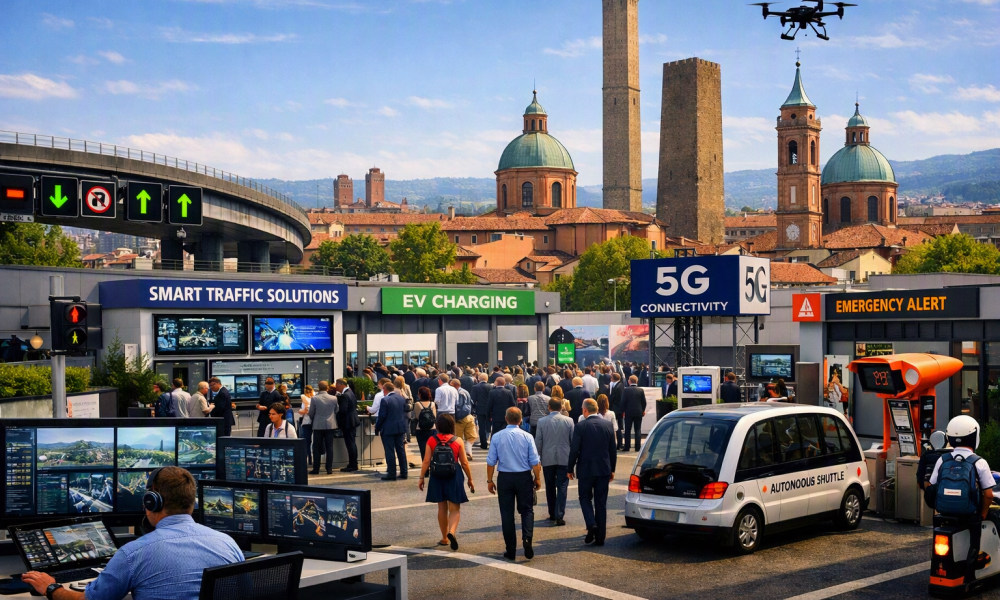
Traffic 2026 unfolded in Bologna fully in-tune with Europe’s shifting mobility landscape. The exhibition arrived at a moment when cities are under pressure to modernise their transport systems, integrate digital infrastructure, and respond to rising expectations around cleaner, safer and more predictable mobility. Its timing added weight to the conversations taking place across the halls of BolognaFiere, where suppliers, operators, public authorities and technology specialists gathered to explore how Intelligent Transport Systems are evolving in practice rather than theory.
The event’s character was shaped by its scale and its proximity to other major shows. Traffic 2026 sat within the wider Urban Tech 2026 cluster, surrounded by exhibitions dedicated to EV charging, batteries, telecommunications infrastructure, cybersecurity, fleet management, construction engineering and paving technologies. This created a setting where ITS was not treated as a standalone discipline but as part of a broader ecosystem of digital, operational and urban-infrastructure innovation. The result was a week in which mobility professionals could move seamlessly between discussions on traffic control, electrification, connectivity, resilience and urban-technology strategy.
Bologna itself provided a fitting backdrop. The city’s transport challenges mirror those seen across Europe, with historic urban form, rising congestion, pressure on public transport capacity, and a growing need to manage environmental impacts. Traffic 2026 reflected these realities by bringing together hundreds of exhibitors across a large and varied footprint. The technologies on display ranged from advanced traffic-management platforms to smart-road systems, emissions monitoring, congestion-management tools, radar and lidar equipment, and roadside devices designed to support more responsive and data-driven operations.
Public transport featured prominently. Ticketing systems, payment platforms, mobility-control-room technologies and solutions for collective transport highlighted the growing need for integration between road-traffic operations and public-transport networks. The presence of urban cable-cars and automated people movers added a forward-looking dimension, suggesting that cities may increasingly diversify their modal mix to relieve pressure on roads and improve resilience. Parking solutions, access-control systems, public lighting, digital screens and street furniture rounded out a picture of urban mobility that is becoming more connected, sensor-rich and digitally orchestrated.
The conversations made it clear that Europe’s mobility landscape is fragmenting and reforming at speed. Municipalities are being asked to modernise traffic-management centres, adopt predictive analytics, and integrate data from legacy roadside systems with cloud-native platforms. Exhibitors specialising in big-data systems, cybersecurity, satellite-data services and engineering tools reflected a recognition that ITS is now inseparable from digital-infrastructure strategy. Video surveillance, emergency lighting, radiocommunications, measurement systems and secure-access technologies reinforced the idea that mobility networks must be protected from both physical and digital threats.
The co-location with E-Charge 2026 and E-Tech Europe 2026 proved particularly valuable. Electrification is reshaping road-transport operations, influencing everything from charging-infrastructure planning to grid-integration strategies. Traffic management cannot remain isolated from these shifts. Charging patterns affect congestion, kerbside allocation and long-distance route planning. Battery innovation influences vehicle performance, fleet-management strategies and the operational behaviour of electric buses and vans. By placing these shows side by side, Bologna created a space where ITS specialists could engage directly with the technologies that will define future road-network behaviour.
Wireless & Towers 2026 added another layer of relevance. Telecommunications infrastructure underpins every modern ITS deployment. Reliable connectivity is essential for real-time traffic control, V2X communications, remote monitoring and the safe operation of automated systems. Exhibitors specialising in broadcasting, satcom and tower infrastructure highlighted the growing importance of high-bandwidth, low-latency networks. As cities explore 5G-enabled traffic management, connected-vehicle corridors and cloud-based control rooms, the relationship between telecoms and transport becomes increasingly strategic.
Security and cybersecurity were recurring themes throughout the week. The SECSOLUTION Forum brought together specialists in digital protection, secure-access systems, video surveillance and emergency-response technologies. The discussions reflected a growing awareness that traffic systems are critical infrastructure. As roadside equipment becomes more connected, and as control rooms integrate cloud services and third-party data feeds, vulnerabilities multiply. The presence of companies providing professional clothing and equipment for local police and public administrations reinforced the link between mobility operations and frontline enforcement.
Fleet Manager Academy and Asphaltica contributed operational and engineering perspectives. Fleet management is undergoing rapid transformation as operators adopt telematics, predictive maintenance, electrification strategies and real-time route optimisation. Road-paving engineering remains central to the durability and performance of smart-road infrastructure. Sensors embedded in road surfaces, intelligent markings and new materials capable of supporting automated-vehicle navigation all require close collaboration between ITS specialists and civil-engineering teams. Traffic 2026 encouraged this cross-disciplinary dialogue by placing these communities within easy reach of one another.
Urban Tech 2026 provided a wider frame for the week’s discussions. Urban technologies increasingly overlap with mobility systems, from digital-twin modelling to environmental monitoring and public-realm design. Bologna’s decision to cluster these events suggested a recognition that cities must treat mobility as part of a broader digital-transformation agenda. Traffic 2026 became not only a showcase of ITS technologies but a forum for exploring how cities can integrate transport, energy, communications and public-realm systems into coherent operational platforms.
The practicalities of the event supported its ambition. BolognaFiere’s extensive parking facilities, clear motorway connections and free admission helped attract a broad professional audience. Accessibility features and on-site services contributed to a modern exhibition experience, while the detailed exhibitor list and regular updates encouraged ongoing engagement. Bologna’s proximity to the famed motor valley also added interest. These details mattered because they shaped the event’s ability to convene the full spectrum of ITS stakeholders, from municipal authorities to technology suppliers and infrastructure operators.
Traffic 2026, viewed in retrospect, offered a clear snapshot of a sector in transition. ITS is no longer defined by isolated systems or single-purpose technologies. It is becoming a multi-layered ecosystem where traffic management intersects with electrification, telecommunications, cybersecurity, public transport, construction, fleet operations and urban-technology strategy. The week in Bologna captured this complexity by bringing together the components of modern mobility in one place.
The significance lies not only in the technologies that were on display but in the way the event illustrated Europe’s broader mobility trajectory. Cities are moving towards integrated digital infrastructure, cleaner transport systems, more resilient operations and a future in which mobility can be orchestrated with intelligence and confidence. Traffic 2026 may have lasted only a few days, yet its themes will shape discussions across the sector for months to come.
Click the buttons below to see more articles:
See all ArticlesIndustry InsightEventsITS Thought LeadershipITS Educational