150x150.png)
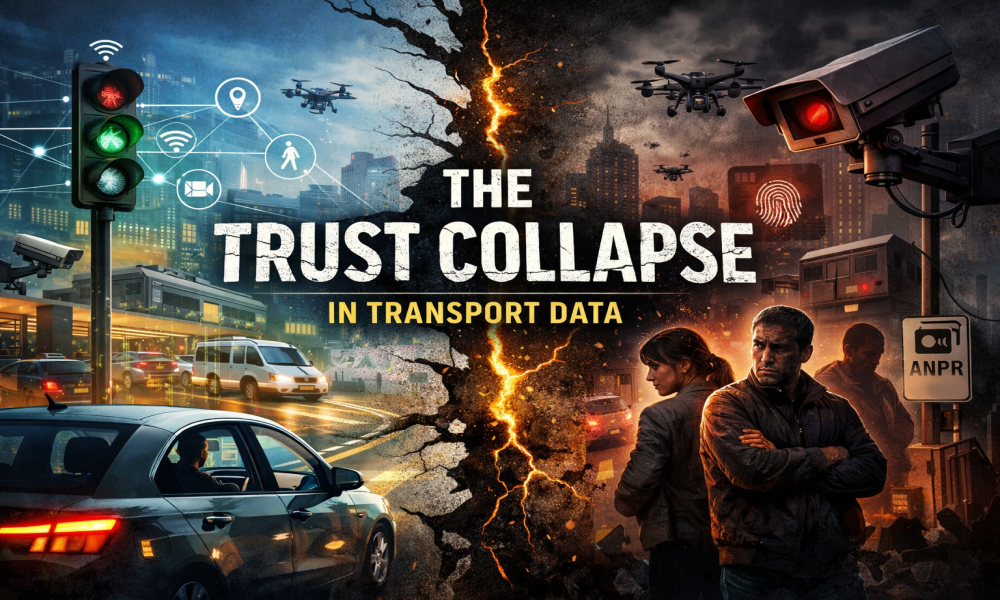
For more than a decade, the intelligent transport community has championed the idea that data is the quiet engine of safer, cleaner, more efficient mobility. From adaptive signals to connected vehicle alerts, from multimodal journey planners to predictive maintenance, the promise has always been the same. If we can understand the network in real time, we can manage it better. Yet as the technical capability has matured, public trust has travelled in the opposite direction. Citizens are becoming more sceptical, more defensive and more resistant to the very data flows that make modern mobility possible.
This is the trust collapse, a widening gap between what transport systems need to function and what the public is willing to consent to. Unless the sector confronts it head-on, the future of smart mobility will be shaped not by innovation, but by suspicion.
Transport data is one of the few domains where the benefits are both immediate and tangible. Share your location with a navigation app and you get congestion avoidance. Allow a vehicle to transmit basic safety messages and you reduce collision risk. Permit a city to analyse pedestrian flows and you get safer crossings and better-designed streets.
Yet despite these clear advantages, public willingness to share data is falling. Surveys across Europe and the UK show a steady decline in trust in both public and private data stewards. Citizens increasingly assume that data collection is excessive, opaque or repurposed for commercial or surveillance ends. Even when the data is anonymised, aggregated or used solely for safety, the instinctive reaction is caution.
This is not irrational. It is the predictable outcome of a decade of high-profile data scandals, algorithmic bias controversies and the creeping normalisation of surveillance in everyday life. Mobility has been caught in the crossfire.
The transport sector still relies on consent frameworks designed for a simpler era. The classic model of “tick here to agree”, assumes that citizens understand what they are consenting to, trust the organisation collecting the data and believe the benefits outweigh the risks. None of these assumptions hold today.
Three structural problems now undermine consent:
The sector must accept that the traditional consent model is no longer fit for purpose. What replaces it must be more transparent, more participatory and more aligned with public expectations of fairness.
Transport authorities and technology providers often assume that the public will trust them because they are “the good guys”. But trust is not a default state, it is earned through clarity, openness and accountability.
Too often, transparency is treated as a compliance exercise rather than a communication strategy. Data protection impact assessments sit unread on websites. Privacy notices are written in legalese. Public engagement is reactive rather than proactive.
The result is a vacuum, and this vacuum has filled with suspicion.
When citizens do not understand why data is collected, how long it is stored or who has access to it, they assume the worst. And when they discover a system that they were not told about, even if it is benign, then trust collapses further.
One of the great ironies of the trust collapse is that Europe and the UK already have some of the strongest data protection frameworks in the world. GDPR, the UK GDPR and the Data Protection Act 2018 impose strict requirements on purpose limitation, data minimisation, retention, security and individual rights. Transport authorities and suppliers operate within a legal environment that is, by global standards, exceptionally protective of citizens.
Yet the public rarely hears this.
The ITS sector tends to treat GDPR as a compliance burden rather than a trust-building asset. Instead of foregrounding the safeguards of mandatory impact assessments, the right to object, the right to erasure, the restrictions on repurposing data, the sector hides them in the small print.
This is a missed opportunity.
If citizens understood that mobility data in Europe and the UK is governed by legally enforceable principles, independent regulators and significant penalties for misuse, they would feel more confident that their rights are protected. The sector should be actively publicising these safeguards, not quietly complying with them. GDPR should be part of the public narrative, a reassurance, not an afterthought.
The phrase “smart city” once evoked images of seamless mobility, clean air and optimised infrastructure. Today, it increasingly triggers concerns about surveillance, profiling and loss of autonomy. Transport sits at the centre of this tension.
Sensors, cameras, connected vehicles, mobile apps and payment systems all generate location-rich data. Even when anonymised, these datasets can reveal patterns of life, such as where people live, work, worship, protest or seek medical care. The ethical stakes are high.
Three ethical questions now dominate the debate:
Ethical smart mobility requires more than technical safeguards. It requires a moral framework that prioritises human dignity, autonomy and fairness.
The trust collapse is not inevitable. It is the result of choices, and it can be reversed by making better ones. The sector needs a new social contract for mobility data, built on five principles:
The intelligent transport community stands at a crossroads. We can continue to build ever more sophisticated data systems while public trust quietly erodes. Or we can treat trust as a core infrastructure asset which is as essential as fibre, sensors, or software.
Citizens are not anti-technology. They are anti-exploitation. They want mobility systems that respect their rights, protect their privacy and deliver genuine public value. If we meet those expectations and if we communicate the legal safeguards already in place, then the future of smart mobility remains bright. If we ignore them, the trust collapse will become the defining constraint on the next decade of transport innovation.
The choice is ours, and the time to act is now.
Click the buttons below to see more articles:
See all ArticlesIndustry InsightEventsITS Thought LeadershipITS Educational